Since founding Pavlok several years ago, we have literally seen hundreds of successful use cases with our Pavlok wearable.
While we’ve covered how Pavlok has helped users stop smoking, wake up on time, and be more productive, today I wanted to share a few unique ways to use Pavlok 2 that you may not have thought of.
Beyond The Zap
While Pavlok was founded on the principle of administering a light shock to reduce destructive behaviors, the beep and vibrate features are just as powerful! With three options to choose from, there a nearly endless amount of applications. Not only can you reduce your bad habits, but you can also use the Pavlok 2 as your personal assistant for reminders as well as a daily awareness tool.
Stop Your Child From Sucking Their Thumb With A Beep
Thumb sucking is a habit that is formed from an early age. But getting the little ones to break that habit doesn’t come easy. Of course, the Pavlok 2 zap feature is not suitable for a young child, but using the beep and vibrate feature can be just as effective.
Thanks to Pavlok 2’s new and improved motion sensor technology, you can have the Pavlok 2 beep every time your child brings their hand close to their mouth. The beep or vibration can be programed however you wish. After just a few weeks you should start seeing a noticeable improvement in thumb sucking reduction.
Public Accountability
With the Pavlok 2 it’s easier than ever to be held publicly accountable for your goals. For example, you can set up a system to make sure you write each day. Or you can set other specific goals for yourself while Pavlok holds you accountable.
Let’s say you’ve committed to going to the gym 3 times a week. With our IFTTT integrations, you can make it so you MUST check in to the gym location Monday, Wednesday, Friday. If you don’t “check-in”, a link to zap you is automatically sent to all your social media services with the text
“I didn’t go to the gym today. Zap me!”
It’s easy to succumb to excuses when no one is watching. Pavlok 2 ensures you stay on track.
Drop And Give Me 10
Even if you’ve formed the habit of going to the gym on a regular basis, sitting at your computer for 10-12 hours a day isn’t doing your health any favors.
One way to ensure you take a few breaks to get up and move is by setting several reminders on your Pavlok alarm throughout the day. When it goes off, simply stand up do a few jumping jacks or if you’re feeling extra adventurous knock out a few push-ups in the office.
Your body will thank you.
Drink Your Water!
The benefits of drinking enough water are undeniable, given the majority of Americans suffer from varying degrees of dehydration.
You can use the Pavlok 2 multiple alarm feature to remind you when to drink water throughout the day. Keep a bottle of water at your desk and when the vibration goes off just take a sip.
We’ve had Pavlok users effortlessly double their water intake without making any other drastic changes in their daily routine.
Earn Volts!
One of the most exciting developments with Pavlok 2 and our brand new Pavlok Core app, is you are now able to earn our in-app currency Volts, for performing certain behaviors.
Not only will you reap the benefits of building healthy habits, but you will also earn Volts that you can use to purchase app upgrades and other goodies within the app.
Earning Volts is as easy as checking in daily, doing jumping jacks and disarming your alarm at a defined time, or dozens of other positive behaviors throughout the day.
Want to go through one of our premium habit change courses? Use your volts to dig in.
Want to vote on our future integrations and features? Volts gives you a say.
While we will be sharing more about the Volts ecosystem shortly, let’s just say earning and collecting Volts will totally be worth it. 🙂
Pavlok 2 isn’t just the best habit change wearable on the market; it’s the only wearable that will reward you for good habits.
With just a beep, zap, or buzz, the possibilities are endless.
The holiday season is fast approaching, and while it’s always a great time to enjoy the company of family and friends, it’s also easy to overspend.
The National Retail Federation projects the US to spend between 678 billion and 682 billion during November and December.
Yes, billion with a B.
While there’s certainly nothing wrong with spending money on gifts and experiences this holiday season, we wanted to share a quick guide to help you cut back on your spending while still making the most of the holiday spirit.
Remember Overspending Means Stress
With companies spending hundreds of million of dollars on marketing, it’s easy to convince yourself you need to buy the latest phone, designer clothes, or gift that will often just collect dust on a shelf.
Getting the latest gadget or favorite gift item might make you happy in the short term, but the stress caused by financial hardship almost always comes back to haunt you.
Before you ring up a $1k tab on Amazon, take a moment to remind yourself that the costs of your actions today will be felt for many months to come.
If you still feel the need to purchase it after a few days, make the decision guilt free.
Personalized Gifts When Possible
One of the easiest ways to cut back on holiday spending is by putting together personalized gifts for family and friends.
Not only will these gifts be more meaningful to those on the receiving end, but they will also be significantly less costly.
Instead of buying the latest TV, put together a photo album.
Instead of buying the latest designer clothes, take a peak on Etsy for a more customized gift.
Spend a few hours putting together a thoughtful gift, and your wallet will thank you.
Go Shopping With A Plan
One of the reasons so many people throw their budget out of the window during the holiday season is they go shopping without a plan.
Before you go to the mall or start browsing Amazon, have a clear idea of what you’re looking for.
Sure, there might be something that pops up that makes the perfect gift every now and then, but the bulk of your holiday purchases should be conscious, not last second impulse buys.
Spend on Experiences Not Items
Chances are you have a ton of gifts in your closet you never used, and that goes for the people you gave gifts to as well.
When possible, try to purchase experiences both for yourself and others. Not only will these be more enjoyable and memorable in the long run, but you can also significantly cut back on your “random item” gifts that very likely won’t be remembered just months from now.
Unsubscribe from company emails
As we’ve said time and time again, your willpower isn’t unlimited. In fact, each day you have a finite amount. Being exposed to your favorite brands and companies emails is only setting yourself up to make an in-the-moment purchase.
If you absolutely must stay subscribed to your favorite places to shop, make sure your emails go straight to a specific email label and only stop in to check once every couple weeks.
Put Away The Credit Cards
A good rule of thumb is to only purchase holiday gifts with cash on hand. While credit cards have their place for financially healthy individuals, using them to buy the latest and greatest will end up costing you down the road.
If you need help cutting back on your credit card spending be sure to check out our free guide here.
Coupons
If you do decide to purchase a more expensive gift or item, spend a few moments looking for coupons online. Just 5-10 minutes can end up saving you hundreds of dollars over the course of the holidays. There are several fantastic coupon apps such as “Honey” on Chrome and other browsers that automatically find you discounts you might not have otherwise seen.
Keep a holiday spending budget
We aren’t suggesting you become scrooge with your holiday spending, but taking a few moments to allocate a certain amount of money into holiday spending will help keep you on track.
List out the gifts you’re hoping to buy, and for whom, and stick to the budget and plan as best you can.
Be Mindful
Last and not least, the best way to cut back on your holiday spending is to become aware of your shopping habits.
Do you browse Amazon while you eat lunch at your desk? Does the thought of seeing your extended family make you feel like you need to buy the best gifts?
Over the course of the holiday season, make a note of every time you feel urged to shop and spend money. Many Pavlok users, for example, zap themselves anytime they are about to make an impulse purchase.
Enjoy The Holidays!
The holidays are a great time to be with your family and friends and share meaningful gifts with those you love.
This guide isn’t about NOT spending money; it’s about being conscious about when you choose to do so.
No gift is worth the stress of paying it off many months down the road. With a little bit of planning and a clear game plan, you can enjoy the holidays without going overboard.
Of course, if you want to give the gift of habit change for life, consider getting your family or friends a Pavlok 2.
Only if it fits into your holiday spending plan of course. 😉
I’m super excited to share today’s interview with Pavlok community member Tina. If you’re active in our Pavlok Facebook group, the name should sound familiar as she’s Pavlok’s kickass community manager 🙂
She’s shared a little bit of her story in the past, but we wanted to dive even deeper into her incredibly inspiring story.
In our interview, she shares more on how Pavlok helped her with chronic oversleeping, and how she is now more mindful of her eating habits.
It’s a short clip, but I’m confident you’ll leave inspired. And if you’re looking to upgrade your habits you can preorder the Pavlok 2 at 20% off during our November early bird sale.
Focusing on just one habit change can have a profound effect in many areas of your life. Are you up for the challenge?
-Maneesh Sethi
P.S We are kicking off a wake-up challenge in the Pavlok Facebook group on November 1st, so be sure to join in on the fun.
As I’ve said time and time again, one of my favorite things about building Pavlok is hearing about the incredible results many members of the Pavlok community have seen in their lives after using Pavlok.
And while we’ve shared these stories via our #MotivationMonday emails for the last year, the Pavlok team and I decided we wanted to dig deeper and share these stories in an ‘interview’ format.
Over the last few months our start interviewer Alex has set out to have conversations with Pavlok users who have used Pavlok to help them in a wide range of ways.
Some have used Pavlok to quit smoking. Others have used Pavlok to start waking up on time.
Our goal with these interviews is to give you an inside look at the journey of transformation – the ups and downs, the good and the bad.
Change takes time. It takes hard work. Sometimes it’s painful. But with the right approach and support system, things can and do get better.
In our interview, today with sit down with Pavlok community member Alli Bogdan who shares her incredible journey of overcoming years of abuse with the help of Pavlok.
Alli’s story does end on an extraordinary positive note. However the topic matter does cover abuse, so please use your best judgement when watching.
We are honored that Alli felt comfortable sharing her story with the Pavlok community, and hope it motivates and inspires those who need it most.
Watch the video to hear Alli’s incredible story of how she overcame years of abuse through emotional healing.
Drinking should be defined as the amount of alcohol consumed of alcohol. According to the National Institute on Alcohol Abuse and Alcoholism there are two separate levels of alcohol consumption. All of which can be dangerous, but obviously the more alcohol consumed the more you put yourself and others at risk of injury and even death.
Moderate levels of alcohol consumption is the lowest level. In its definition It includes 1 drink per day for women and 2 drinks per day for men.
The final level of alcohol use is “Heavy Alcohol use”. It has been defined as binge drinking for 5 or more days days in the past month. Binge drinking is consuming enough alcohol to reach or surpass a blood alcohol content of .08 or higher.
It should be noted that the criterion of “one drink” changes dependent on the % of alcohol in that drink. For beer, a 12 fl oz at 5 % alcohol is consider 1 drink; Wine, 5 fl oz at 12%, is 1 drink; Liquor, 1.5 fl oz at 40% alcohol (80 proof). It is estimated that 1 fl oz can take an hour to metabolize.
What is the problem?
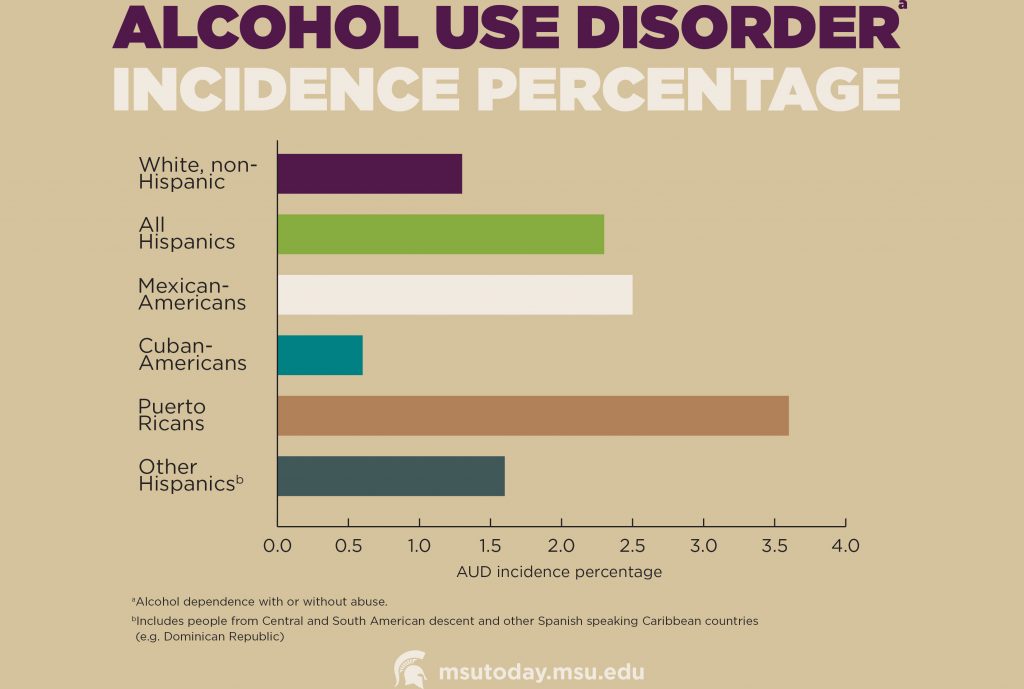
According to the National Council on Alcoholism and Drug Dependence, Inc alcohol is the most used addictive substance in the United States. With one in twelve Americans suffering from alcohol abuse or dependency, it is a dangerous but popular drug. Alcohol abuse does not only affect the person who uses alcohol, it also adversely affects the spouse, children, and coworkers.
Identification of risk of developing Alcohol Use Disorder (AUD) for women is having three or less drinks a day and not drinking every day of the week. For men it increased to four drinks a day and 14 drinks per week. The good news is that even if you meet this criteria only 1 out of 50 actually develop/have AUD. In other words, many “casual drinkers” already show risks of developing AUD, but only 2% actually are diagnosed.
Had times when you ended up drinking more, or longer, than you intended?
More than once wanted to cut down or stop drinking, or tried to, but couldn’t?
Spent a lot of time drinking? Or being sick or getting over other aftereffects?
Wanted a drink so badly you couldn’t think of anything else?
Found that drinking—or being sick from drinking—often interfered with taking care of your home or family? Or caused job troubles? Or school problems?
Continued to drink even though it was causing trouble with your family or friends?
Given up or cut back on activities that were important or interesting to you, or gave you pleasure, in order to drink?
More than once gotten into situations while or after drinking that increased your chances of getting hurt (such as driving, swimming, using machinery, walking in a dangerous area, or having unsafe sex)?
Continued to drink even though it was making you feel depressed or anxious or adding to another health problem? Or after having had a memory blackout?
Had to drink much more than you once did to get the effect you want? Or found that your usual number of drinks had much less effect than before?
Found that when the effects of alcohol were wearing off, you had withdrawal symptoms, such as trouble sleeping, shakiness, restlessness, nausea, sweating, a racing heart, or a seizure? Or sensed things that were not there?
Basic Facts (Population, demographics, facts.)
It is estimated that there are 88,000 deaths a year due to alcohol, and it is the third leading cause of death in the nation. Alcohol affects men and women differently: it takes women longer to metabolize it; however, alcohol abuse is more common in men than in women. In the world, over 2 billion people drink alcohol, and around 75 million people are affected by alcohol-related disorders.
Although not all alcohol use leads to addiction or dependency, alcohol has been the only drug banned as an amendment via the 18th amendment only to be repealed in the 21st.
Effects
According to drugabuse.com short term effects of alcohol may include some positive symptoms such as mild euphoria, mood enhancement, lowered anxiety, marked sedation. It should also be noted the negative short-term consequences such as impaired vision, delayed reaction time, confusion, vomiting, blackouts, loss of bladder control.
Long-term consequences may include cancer, hepatitis, scarring of the liver, and increased blood pressure which could lead to heart problems. Financially it takes a toll too.
According to a 2000 report on alcohol, the cost estimate for alcohol abuse was over 184 trillion dollars in 1998, which was up from a 1992 estimate of 148 trillion. These include the cost of loss of an individual, services such as counseling, criminal justice, and medical consequences.
How Alcohol Affects your Brain and Body
Habit Analysis and Common Triggers
To best analyze a habit we first must devise it up into three parts. The trigger, or what is evoking or eliciting the habit, the habit itself, and the rewards granted by that habit.
Triggers for alcohol consumption vary and can be very subtle. Here are some to consider:
Friends invitation to a bar
A sign on at a bar
Being in a setting that sells liquor
Lack of alternatives in the evening
Holidays such as St. Patrick’s Day, the day before Thanksgiving, and birthdays
Free samples offered at stores
Deals and specials
An abundance of time waiting (airports, casinos, hotels)
Social events
Sporting events (Football game, Bowling, Darts)
Like triggers the form of habits may vary from case to case. It is important to note which behaviors are “acceptable” and which should be avoided. For example many consider drinking at a bar is acceptable; however, drinking on the job may be less than satisfactory. Of course many of these depends on the individual circumstance. Each may mold both a different trigger and reward.
With friends at a bar
Alone at a bar
Drinking at home
Concealed drinking on the job
Drinking and driving
Binge drinking
Taking shots
Drinking Wine
Drinking Beer
Drinking games such a beer pong, flip cup, and others which speed of consumption matter.
Although rewards and reinforcers differ conceptually, the following should be considered more like reinforcers as they are likely to be maintaining habit. They may not be considered as rewards to general society.
Social praise (Chug! Chug! Chug!)
Social bonding as a chance to meet new people
The “buzz” feeling of alcohol
Passing out
The escape of a less desirable situation
“Liquid confidence”
The taste
A marker of celebration such as holidays, end of a work week, and a completion of a task
Inclusion in a participation in a cultural event
Access to other things such as pool, darts, food
After analyzing a habit cycle we then know the best place to manipulate one of the three variables. By doing this we may encounter more than one trigger, habit pattern, or reward type that controls the drinking behavior. We should choose one habit to change first and work our way towards others.
It may be easiest to manipulate the trigger variable in many of these cases as we can change many things before the trigger occurs to break the habit. More on this later.
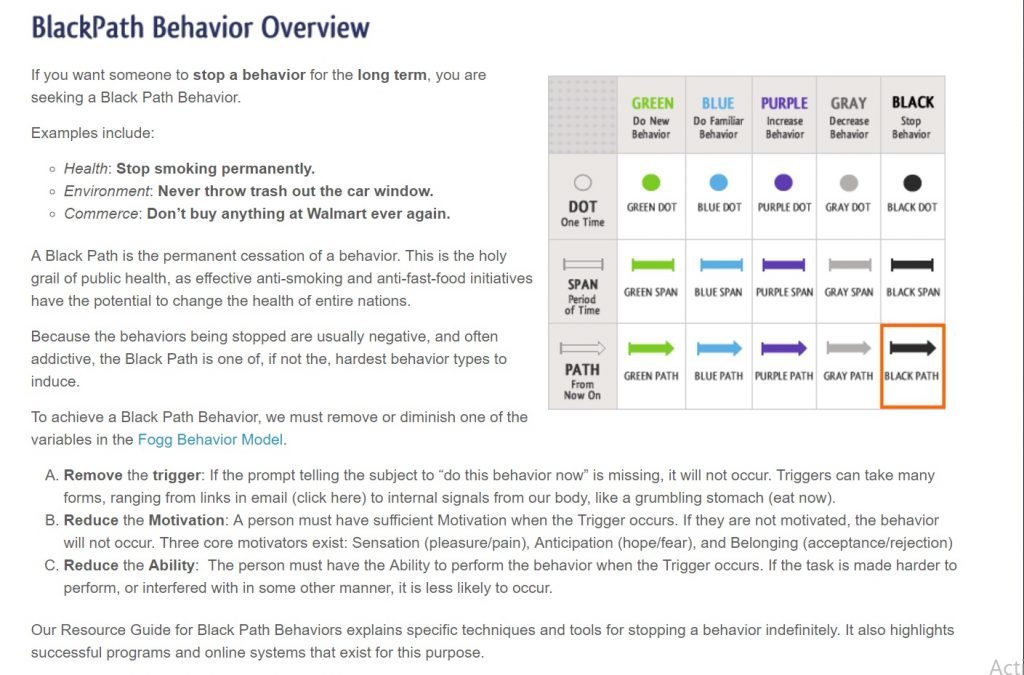
As mentioned above to change a habit we must alter the habit cycle. The usual goal of treatment in alcohol is usually abstinence, in other words completely removing alcohol consumption. This can be done in three different ways: by removing the trigger (the trigger), reducing the motivation (the reward), or by reducing the ability to perform the habit.
Stopping the Habit for Good
Possible triggers for alcohol consumption as discussed above include most bars and restaurants which serve alcohol. Many sporting events serve alcohol, and it is popular to consume alcohol while watching a sporting event. Some peers could also serve as a trigger as in many settings drinking is a social event. To accomplish the elimination of alcohol consumption it may be suggested to remove these triggers. One could simply avoid any place which serves alcohol, which may be a difficult challenge. The other solution is to find similar triggers that do not yield the same consequence, such as drinking alcohol free beer and sparkling champagne.
Rewards for alcohol varies from person to person: the buzz feeling, the excitement of events that are paired with alcohol consumption, and the feeling of belonging with your peers who are also drinking all may function. It is suggested to try to reduce these motivation. Possibly by finding alternative sources that fulfill that same level of motivation. Find alternative activities that can be done without alcohol, locate different peer. More specifically one could join a club that meets up at the same time you would normally drink.
An alternative view is that alcohol consumption may not be due to a reward, but rather as a way to gain distance from something aversive. If a bar is the only place to get away from a nagging spouse or daily responsibility, the environment may be perfect to establish a dependency on alcohol. One report may describe it best as an escape from reality.
Reducing the Habit
If your goal is to decrease alcohol consumption, we still need to examine the habit cycle. Instead of blocking the ability to drink, if one would like to just decrease the behavior, we may reduce the ability to drink. This could mean purchasing less alcohol, limiting the nights of the week you goes, and drinking only drinks with less alcohol content. Here it would be helpful to have clear goals: a specific number of days you may consume alcohol, how much money you can spend, or the amount you can assume.
Which one of these is not a specific goal?
A. I want to drink only 1 day a week
B. I want drink less
C. I want to spend $10 or less on alcohol this week
D. Drinking is bad, I only want to drink after work on Friday
B is correct. Drinking less is not specific. We need to know how much.
To replace rewards rather than simply to reduce, we can associate drinking with an aversive stimulus such as pain, fear, or rejection. In this approach we drink, but may pay for it. This can be with money, electrical shock, or with the loss of something pleasurable.
Treatment
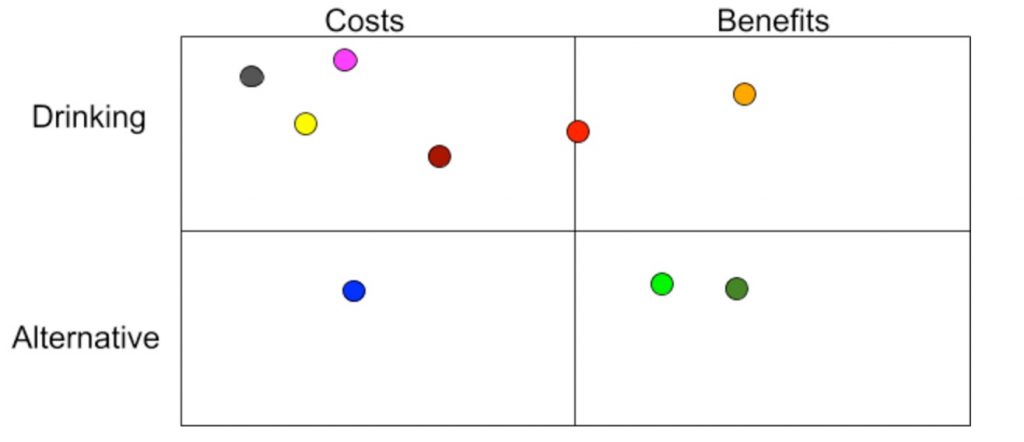
To best analyze treatment solution we may use a Cost and Benefit Matrix featured below. The boxes here are not an exhausted. Any intervention, independent of success can fit into these boxes to be analyzed. There are four ways of reducing the drinking behavior:
Increase the cost of drinking
Decrease the benefits of drinking
Decrease the cost of alternatives
Increase the benefits of the alternative
Cost and Benefit Matrix of Consuming Alcohol Compared to Alternatives
Cost
Benefits
Drinking
(1.) $, Hangover, Cancer,…
(2.)Buzz, Social, Escape,…
Alternative
(3.)
(4.)
Most interventions aim at intervening at only the first two levels by manipulating the effects of drinking. Here are some examples:
Going to AA – (1.) Drinking results in the loss of tokens and social acceptances
Antabus drug (1. ) Drinking now makes you nauseous
Naltrexone and other drugs (2 Orange.) Drinking now loses it’s appeal
DWI (1&2) A penalty for drinking and now blocked from going places
Removal of all alcohol from home (1 Yellow.) It is now harder to get alcohol
Acceptance and Commitment Therapy (ACT) (1.Pink ) increases the costs of drinking by paying for therapy
Free/movie nights (3.) Gives a cheap alternative to accomplish
Marriage Counseling (4.) May save failing marriage.
How the Pavlok Can Help
The Pavlok is programmed to track your behavior. With the If This Then That (IFTTT) app a beep, vibration, or shock can be sent directly to the Pavlok when you are close to any programmed location. This means a user of the Pavlok can simply type the address of their local bar and if they approach this site, a stimulus will be administered.
If you already own a Pavlok and want to set up the location feature with IFTTT click here https://ifttt.com/login to set up account and follow these steps.
Click My Applets
Click “+This”
Type “Location”
Click location and choose one of the three options
Pick the location by typing in the address
Press “Create Trigger”
Press +that
Type “Pavlok” in the search
Choose one of the four options “zap”
Set strength (low, medium, high)
Click “Create action”
Click “Finish”
Sources And Resources
Dickter, C.L., Forestell, C.A., Hammett, P.J. et al. Psychopharmacology (2014) 231: 2031. doi:10.1007/s00213-013-3348-6
Survey that when answered, refreshes with bj fogg image ????
A startup CTO, startup consultant, father, husband, and homeowner… There are a lot of things demanding my time. Employees, clients, writing code, exercising, family time and more. It all adds up.
As business keeps growing, the one thing that’s consistently been falling by the wayside is my writing. And that kind of sucks.
I like writing. It helps clear my head.
It keeps me mindful of different aspects of my different businesses, and I find it generally boosts my productivity for whatever reason. Plus, it helps boost my consulting business and builds up my tribe.
It’s important, and I have to make the time for it consistently.
I’ve already used my Pavlok to create an extra hour or so in my day by helping me actually wake up early. It also reminds me every day to switch to my standing desk — helping me stay a bit more active.
But how can it remind you to write?
It’s a technically challenging thing to do. There’s no physical gesture that makes writing at a MacBook look differently from screwing around on Facebook.
It’s not easy to know when I don’t do something every day unless I physically check in saying I did it, and that’s not my style. It’s another task to do in an already stacked day.
So how can we make this work? How can I shock myself into writing every day without actually doing some boring admin work every day?
After some trial and error, I’ve found the solution.
Before the system is revealed, let me explain how I write as it may be different from how you write.
First off, I use Pages on my MacBook.
I don’t really like Google Docs to write since it’s in the browser, and that can lead to distraction. Yes, I’m aware that I can blacklist sites when I go to write, but again, more admin work than I’d like to deal with. Pages works for me.
Second, I use Dropbox to store it and share it with the team that will help edit and share everything to the world on my blog, my Entrepreneur column, or anywhere else. Yes, I realize that I can use Google Docs for this, and I personally don’t want to. See above.
With that 2 step approach, I can write anywhere at any time without any excuses. As soon as I get some internet and my Dropbox syncs up, it’ll check in with my system and not shock me.
Here’s how to do it.
Keep A Record Of All Writing With IFTTT And Google Sheets
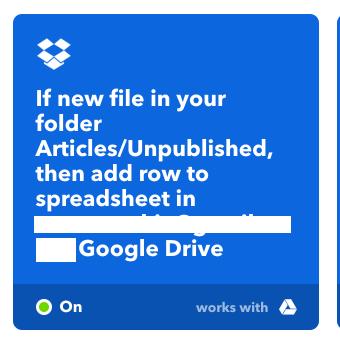
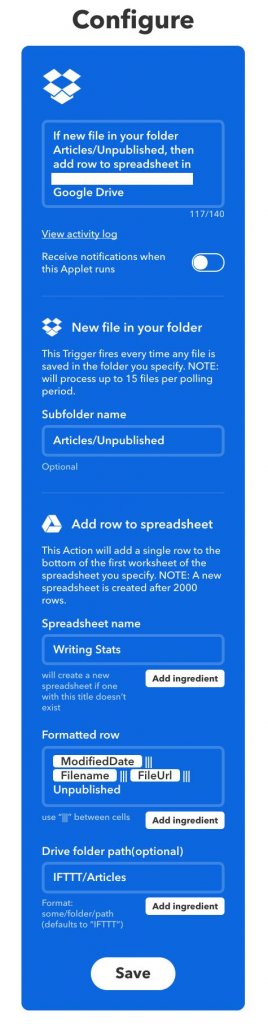
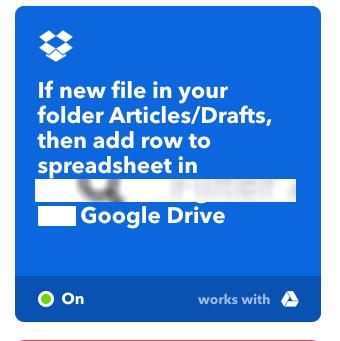
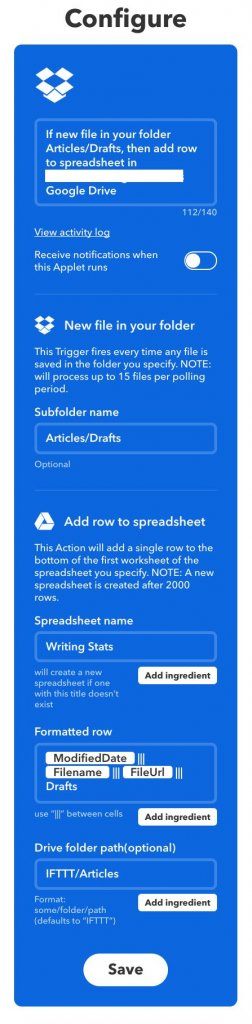
Since I put my articles into Dropbox, I can use IFTTT to write a row to a spreadsheet on Google Sheets. It’s essentially a log book that updates every time a new file is created in one of my writing folders.
There are two specific folders that I care about: Drafts (everything I’m working on that’s unfinished) and Unpublished (all finished work that needs to be published somewhere.) If a new file shows up anywhere in these folders, it means I did some writing for the day. Log it in Google Sheets.
(Here’s my unpublished trigger.)
(And the detail.)
(Here’s my drafts trigger.)
(And the detail.)
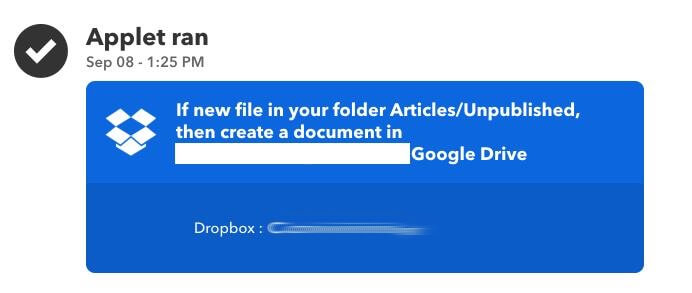
(Here’s IFTTT running to create the sheet)
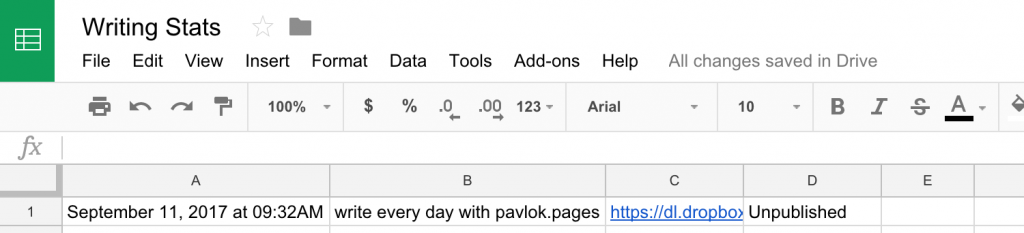
(Here’s what the sheet looks like. 100% created and maintained by IFTTT)
NOTE: For this to work, there has to be at least one row in the sheet. It won’t work without a row to check, so add one in manually if you want it to start on day 1.
2. Alert Me If There Wasn’t An Update For Today Using Google Scripts
This is a fairly straight forward process: Check the latest row every day and send me an email if there was no new row added. That means I didn’t write.
My goal is to write every weekday by 4 pm EST, so that’s when I check.
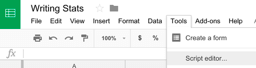
For this part, you need to use Google Scripts on the sheet.
(Here’s how to get to the script editor)
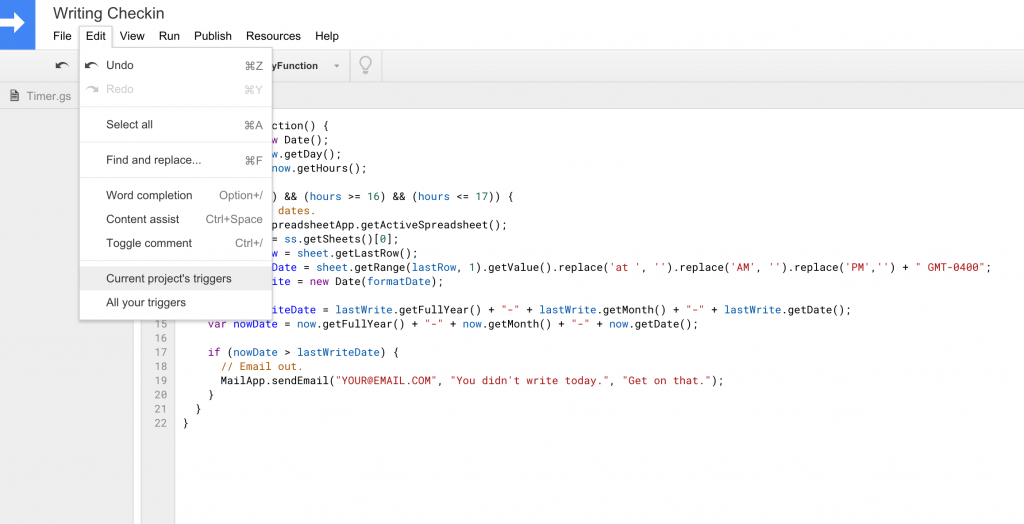
You have a script that checks the last row of the sheet and looks at the day. If that date isn’t today’s date, it means you didn’t write today. In that case, it sends an email.
function myFunction() { var now = new Date(); var day = now.getDay(); var hours = now.getHours();
if ((day < 6) && (hours >= 16) && (hours <= 17)) { // Get the dates. var ss = SpreadsheetApp.getActiveSpreadsheet(); var sheet = ss.getSheets()[0]; var lastRow = sheet.getLastRow(); var formatDate = sheet.getRange(lastRow, 1).getValue().replace(‘at ‘, ”).replace(‘AM’, ”).replace(‘PM’,”) + ” GMT-0400″; var lastWrite = new Date(formatDate);
if (nowDate > lastWriteDate) { // Email out. MailApp.sendEmail(“YOUR@EMAIL.COM”, “You didn’t write today.”, “Get on that.”); } } }
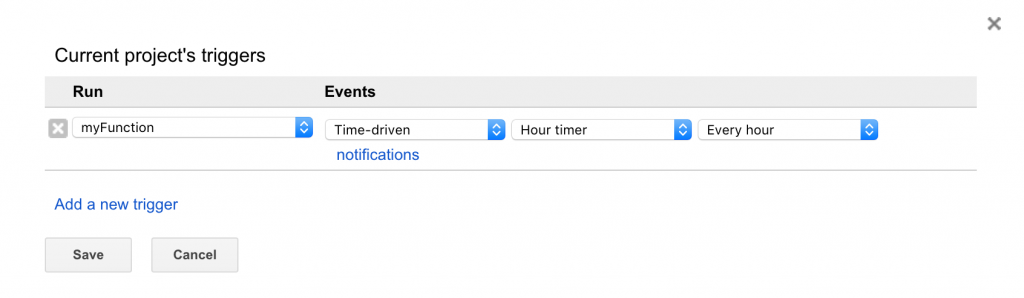
For this part to work, you have to schedule it to run. I have it running every weekday between 4 pm and 5 pm, so it will zap me at the end of the day if I forgot to write.
(This is how you create the trigger.)
(This is what you set the trigger to.)
3. Zap If I Didn’t Write Today
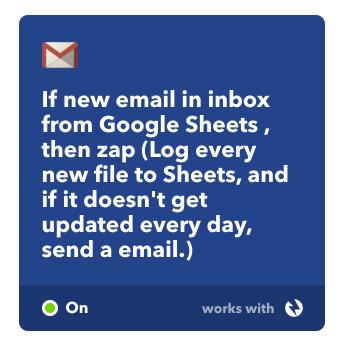
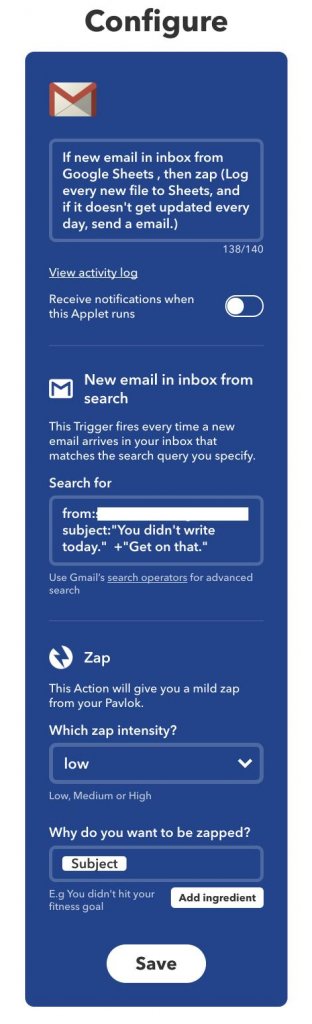
The last step is to get back into IFTTT with a script that checks for that “You didn’t write today…” email and use it as a trigger for Pavlok to zap.
(Here’s my Pavlok trigger.)
(And the detail.)
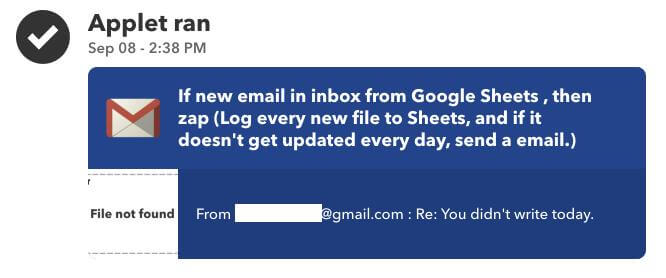
(Here’s IFTTT triggering a zap.)
And that, my friend, is how I’m forcing myself to write. After a few 70% shocks to the wrist, this will be yet another positive habit that sticks.
This can be used for more than traditional writing too.
Want to write code every day? Sync up a folder that stores your code.
Want to post on Instagram every day? Use Instagram posts to log to Sheets instead of Dropbox.
Want to work out every day? Use your chosen fitness tracker to log to Sheets instead of Dropbox.
I can think of about a hundred others. You’re only limited by your imagination and desire to build a new habit.
It might seem like a lot of steps to go through to make sure I write consistently, but if you think about the one-time setup cost vs. the ongoing benefits of building such a productive habit, it’s a no-brainer.
Want to make writing a habit? Get your Pavlok today.