It’s no secret that having a good morning routine is one of the best things you can do to get your day started off right.
Instead of hitting snooze and reacting to your day, incorporating just a few tweaks to your morning ritual can make all the difference.
Regardless of whether you consider yourself a morning person these 7 habits will get your day started off on the right foot.
Wake up 30 minutes early
[bctt tweet=”No. You don’t have to wake up at 4:45 to have an awesome morning.” username=”pavlok”]
Stop feeling guilty about not jumping out of bed before the break of dawn. Instead, aim to give yourself just 30 minutes of extra time to get moving.
30 minutes is just enough time to give yourself time to wake up and not feel rushed throughout your morning while not sacrificing the amount of sleep you get.
Use the extra 30 minutes however you like. Heart a few Instagram photos. Watch the lady with the Chewbacca mask. Or get started on some of the habits below — guilt free.
Make Your Bed (3 minutes)
It may sound silly, but making my bed each morning has been one of the best additions to my morning routine this year. Starting your day by making your bed is perfect “small win” to give you a quick boost of momentum and get your mind in the right place to tackle the day.
For one, making your bed is something you can control, and feeling in control is one of the best ways to improve both your confidence and overall well being.There’s something that feels inherently good about having a made bed before you walk out the door. It’s also a nice way to return home after a long day at work.
Floss One Tooth (1 minute)
This is something Stanford professor and habit extraordinaireBJ Fogg teaches. Before coming across the floss one tooth concept I had always struggled to floss consistently despite knowing the clear health benefits.
After you brush your teeth, you commit to flossing just ONE tooth — which takes less than a few seconds. If you floss one tooth you are successful. Of course, to get the benefits of flossing you’ll want to floss all your teeth eventually, but building the habit of flossing is far more important in the long term.
Some days you’ll get “lazy” and floss one tooth and that’s perfectly ok. Eventually after doing one tooth for consecutive days you’ll work your way to adding another tooth. Because you’re already in motion you’re literally tricking your brain into building good habits.
Our brains are funny aren’t they?
If you’ve struggled to make flossing a regular habit give this a try. Trust me.
Get Up And Move (5 minutes)
I like to spend a few minutes moving my body after making my bed. Sometimes I like do pushups. Other times I’ll do a quick 7 minute workout. In the spirt of small wins, moving your body even just for a few minutes helps you start your day off on the right track.
Not only does moving help you wake up, it gets the blood flowing to your muscles and brain.
Plan Your Day (5 minutes)
Stop reacting to your day and take a few minutes to plan your game of attack. Open up your calendar. Take note of what’s on your agenda. Give your mind a general idea of what to expect. Is today packed with meetings? Perhaps you should leave for work a few minutes early. Lunch with coworkers? Perhaps you should skip the usual Starbucks frap.
Once you have an overview of your day, jot down 2-3 of your most important tasks for the day. I like to to put my 2-3 tasks on a blank index card.
Your goal should be to complete your 2-3 MIT’s (most important items) each day. If you can do that, you’ll have had a “successful” day.
Of course life happens, but taking a few moments to clarify your focus will significantly increase your chances of having a genuinely productive day.
Take A Cold Shower (5 minutes)
Taking a cold shower certainly isn’t for everyone, but I can say for certain when I’ve taken cold showers consistently my productivity and overall happiness levels have skyrocketed.
I typically like to commit to 30-60 days of cold showers when ever I want to step up my game.I use the app Cold Shower Therapy (CST) by my friend Joel Runyon to help keep track of my cold showers and gamify the process.
While I can’t attest to the many claimed “health” benefits of taking cold showers, my personal experience and those at Pavlok has proven them to be accurate.
[bctt tweet=”Nothing says “wake up” like standing under a stream of freezing cold water.” username=”pavlok”]
Meditate (3 Minutes)
Since the beginning of 2016 I’ve made it a priority to meditate on a consistent basis and couldn’t be happier that I did. Without a doubt, it has been one of the best things I’ve done (aside from quitting smoking.
The other day, I started a fascinating discussion on my Facebook page about online”hate” and whether haters should be confronted.
As one can expect, everyone and I do mean everyone, had an opinion.
It was one of my most commented on Facebook statuses to date.
The suggestions were mixed, to say the least.
“Ignore them!”
“Put them on blast!”
“Don’t waste your time.”
“They deserve to have their eyes burn under the sight of the eclipse. And then be eaten by Daenerys’ dragons.”
How interesting.
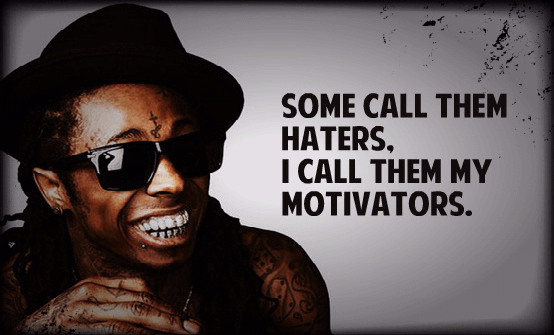
It’s no secret, as a very public CEO who had a less than ideal Shark Tank experience, myself and my team are constantly on the receiving end up some pretty brutal hate.
While 99.9% of the hate directed towards myself and Pavlok is quite funny, some of it can sting.
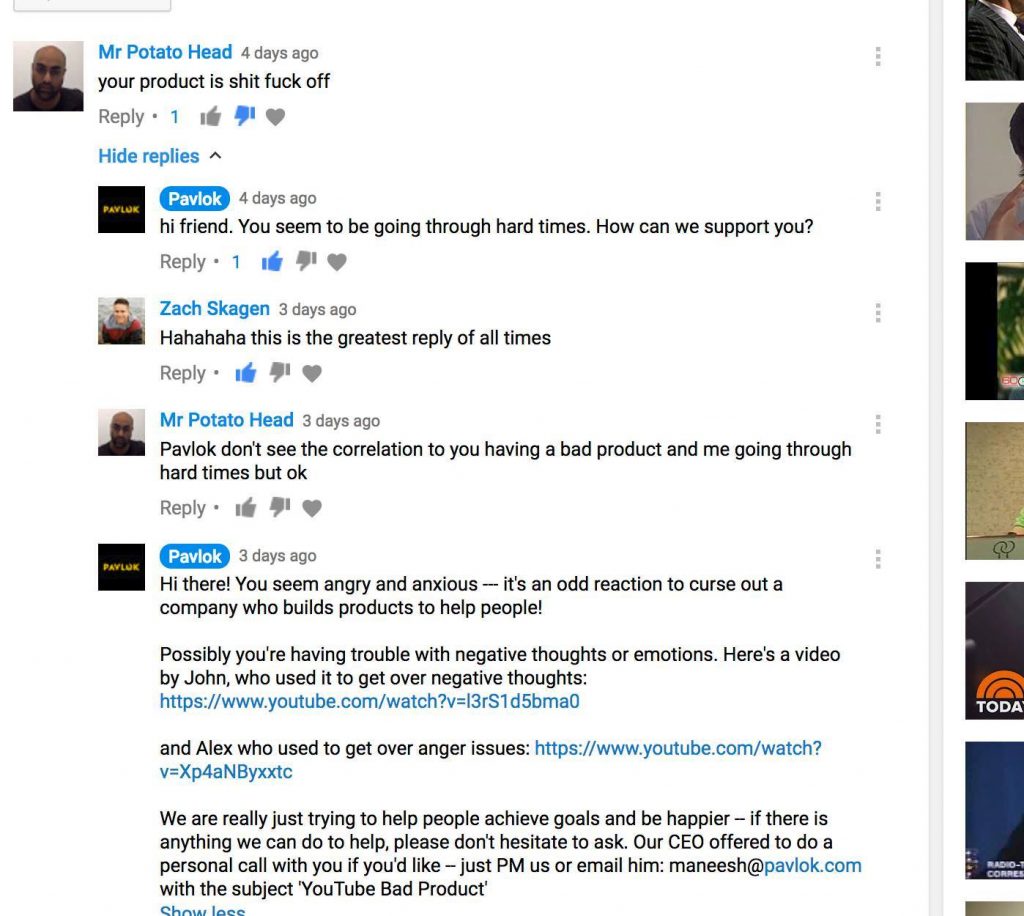
For example, this guy called me a scamming potato head.
🙁
I’m certainly not the only one who is on the receiving end of hate.
Perhaps you can relate.
Maybe your friends give you a hard time about wanting to lose weight.
Or your buddies have a cigarette in front of you just to taunt you.
Or your aunt replies “why even bother” when you share your most ‘ambitious’ goals.
The truth is, there’s always going to be the naysayers and the people who want to see you fail.
And I’ll admit, on days when things aren’t going so well… seeing all that hate can take its toll.
But….
My mission with Pavlok is to change how the world sees addiction — which is no easy feat. Just as losing 10 lbs, or quitting nail-biting, is no walk in the park, making change that matters takes both time and courage.
So yes, confront your haters if it makes you feel better. Or walk away if you prefer.
But don’t let the haters prevent you from becoming the best version of yourself. Push through the noise and lose those 10 lbs. Have your very last cigarette.
The internet might be home to all the haters, but the community of Pavlok is full of thousands of people all around the world working on being the best they can be.
Let the haters hate, while you continue improving yourself and the world.
It’s the only way.
-Maneesh Sethi
CEO of Pavlok
P.S I don’t see my haters with twobest selling products on Amazon.
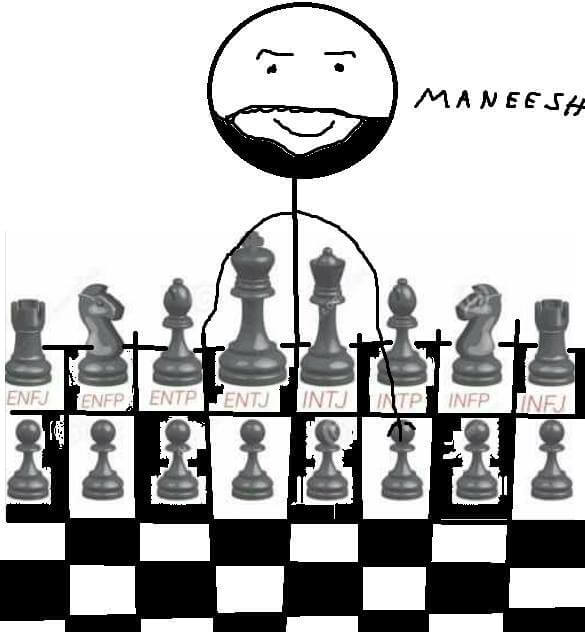
To my haters… you keep hating, while I keep playing chess.
Are you tired of being the “negative” friend? Do you struggle to see the positive in your everyday life?
Do you find yourself always in a bad mood or thinking the worst of others or even yourself?
You’re not alone.
[bctt tweet=”One recent study in college aged students showed that on average, around 60-70 percent of their daily thoughts were “negative” in nature! ” username=”pavlok”]
It’s no wonder, so many of us struggle with depression and anxiety!
While everyone has negative thoughts now and then, chronic negative thinking is one of the biggest causes of depression, anxiety and more.
Of course, there are certainly real conditions that affect your brain chemistry and require professional medical attention, but for many, just making just a few small tweaks in your day can make a significant difference.
The truth is, ‘negative thinking’ is habitual, just like brushing your teeth every morning, or drinking a glass of water when you wake up. At Pavlok we’ve studied the science of habit change for the last 4 + years and have discovered several actionable tips and strategies to help reduce negative thinking and improve your overall outlook on life.
Again, we don’t pretend to be a doctor, but having helped thousands of people around the world improve their habits and thinking we’ve learned a thing or two.
Here are a few tips to help reduce negative thinking… even if you’ve tried everything before.
How To Reduce Your Negative Thoughts
Hang Around Positive People
Before you shake your head and exclaim “thank you captain obvious” it’s important to take a quick audit of your social circle.
Is your social life (aka family and friends) draining? Or do they challenge and push you to be the best you can be?
Of course, your social circle is only part of the equation, but if your friends and family are always bringing you down, it’s incredibly tough to overcome your negative thoughts and beliefs.
Reduce Your News Consumption
We’re not suggesting you transform to into a hermit and ignore the often harsh realities of the world, but the truth is, the news is designed to make you anxious and depressed (it gets clicks after all)
Instead of checking your latest news source or social media network replace it with reading an interesting book or going for a run.
This simple tweak alone will go a long way in helping you fight those negative thoughts and increase your chances of success.
Start A Gratitude Journal
One of the best ways to combat your negative thoughts is to train yourself to look for the positive!
The easiest way to do this is to start a gratitude journal where you write 2-3 positive things that happened to you each day. Over time you’ll start to notice things you might not otherwise have seen.
Do this for a month straight, and we promise you’ll be in a much better position than when you started.
Talk To Your Doctor
When you’re caught in a “negative spiral” many of the above tips and tricks might seem pointless. Again, negative thinking for some individuals is a real medical condition, and it always makes sense to get an opinion (or two) from a medical professional you trust.
We’re not suggesting you NEED medication to fix your negative thinking, but it’s important you get a holistic view of your situation.
Use The Pavlok System
While the steps above will most certainly be helpful in reducing your habitual negative chatter, Pavlok has helped thousands of people around the world improve their habits and thoughts through our Pavlok wearable.
If you’re wanting to take control of your negative thoughts, and give yourself the best chance to say goodbye to negative thinking for good, order your Pavlok Habit System today.
Imagine no longer being that “negative” friend.
Imagine no longer having your day ruined by one small event.
Imagine waking up optimistic about your future and your life.
It’s time to stop imaging. No matter what habit you’re trying to break…
With a combination of a few small tweaks and taking action today, you can begin to transform your habits for the better.
To help you overcome your negative thoughts and beliefs, for a limited time only, we are offering $40 off your Pavlok 2 order. Just use the coupon code “POSITIVITY” at checkout.
Editors Note: This is a guest post from a Pavlok user Eric who used Pavlok to help stop biting his nails.
I was once at a party in NYC with some high society types. I didn’t quite fit in, but we all try to level up socially at times. After my third conversation about the latest trip to the Hamptons and how I, “just had to come along next time,” I decided to retreat to the couch for a breather.
It was a nice enough apartment that the host requested we take our shoes off, so when I moved to the sofa, I could feel something sharp protruding from the plush carpet. Thinking it odd that such an affluent host would have anything but a clean floor, I figured I’d reach down to investigate. I rubbed my hand across the carpet searching for the seemingly invisible annoyance, and I was shocked at what I discovered. It was a long fingernail, most likely from someone’s thumb.
Instantly I began to judge the entire guest list. Being a life long finger nail biter and toenail picker myself, I sympathized with the culprit. But at the same time, I was disgusted.
Seeing it from the other side was enough for me to realize the gravity of my habit regarding social perceptions. Nail biting wasn’t just a bad habit, it was disgusting. My final revelation in all this was no matter what, I had to figure out how to stop.
That task proved much more challenging than I thought, and if you’re reading this, you’ve likely realized something similar.
Can you relate? Has your nail-biting ever put you in an awkward situation?
The Consequences Of Nail Biting
[bctt tweet=”Awkward social interactions are only the tip of the iceberg with nail biting.” username=”pavlok”]
Often, nail biters bite off more than they should chew and end up digging into the live skin and tissue underneath the nail, affecting the nail bed and the cuticle. This damaged skin is exposed to a greater likelihood of infection, especially because the mouth can be an excellent medium for transmitting bacteria and debris.
If that weren’t enough, nail biting has even been linked to certain mouth and dental issues because chronic nail biters can chip teeth and damage their gums.
Because of this, nail biting has an actual medical term, “onychophagia.” If that doesn’t make you feel worse, in the medical community, it’s associated with the following “nervous habits,” of which it is the most common; thumb-sucking, nose-picking, hair-twisting or hair-pulling, tooth-grinding, and picking at skin.
Furthermore, the medical literature agrees the habit often begins early in life with half of all children ages 10 to 18 biting their nails. Thankfully, most people quit on their own by age 30. (WebMD)
If that last sentence made you laugh from sheer hopelessness, you’re not alone. It’s not surprising most people’s only hope is to pray they grow out of it by 30 with the sheer volume of terrible advice out there on the web to “help you stop.” After extensive research and my lifelong effort to quit, it seemed easier to throw my hands in the air and just give up.
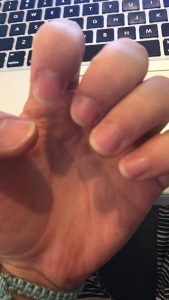
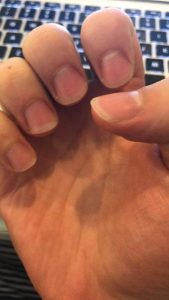
Lucky for you that’s not what I did, and in this post, I’m going to outline the exact method I used to quit biting my nails forever, in less than five days. If that sounds too good to be true, I assure you it’s not. I went from brutal looking nails with worse cuticles to this…
(These are my real hands at the time I’m writing this, see the keyboard in the background? And for all the doubters who think I must relegate my chewing to a single hand, I included both.)
I had concluded I was doomed. I had accepted the fact that I’d always have to hide my hands, but now my nails look so good I could be a hand model.
But to understand why the Pavlok method is so effective, you first must see why all the other advice out there isn’t.
The Exact Way to Never Actually Quit Biting Your Nails
Today, when you find yourself with a socially embarrassing bad habit, it’s best to turn to Google. After all, you can find the best modern science and society has to offer on the subject without having to admit to a single person you have a “weird” problem.
Sadly, the internet is in the dark when it comes to actually learning how not to bite your nails.
I mean, there are entire businesses built on helping people quit their addictions, but the best we can do on nail biting is, frankly, shockingly embarrassing.
Here’s an extensive list of all the strategies I found on the internet to help with nail biting:
-Keep your hands busy
-Keep your nails trimmed
-Maintain a healthy diet
-Play/fiddle with an object (good plug for fidget spinners)
-Do a hobby
-Use a “nibble inhibitor” solution on your nails, apply it several times a day, and carry a spare
-Consider covering your nails with band-aids, tape, or gloves
-Use fake nails and acrylics
-Take it easy, break the habit one nail at a time
-Maintain healthy nails
-Wear fake nails
-Exercise
-Meditation
-You can do anything you set your mind to so just commit
-STOP! (yes this was an actual suggestion on one apparently helpful website)
-Rubber band yourself every time you catch yourself
-Fix underlying causes
-Enlist help
-Therapy
-Tell others to point it out
-Set reminders
-Wear “Chewelry,” i.e. necklaces and bracelets you can chew on instead
-Keep at it
-Nail care
-Nail supplements
-Visualize success
-Keep your nails short
-Keep a cuticle cutter in your purse
-Put on nail art that you wouldn’t want to ruin
As you can see, quitting nail biting is incredibly easy, all you have to do is pick one of the many useful strategies from this extensive list, and you should see results in no time.
I swear I didn’t set out to write a comedic blog post, but there’s no other logical reaction to this list other than sheer laughter. These suggestion are all I can find through pages and pages of Google searches and scholarly articles. The above is the advice doctors are trained to give patients like you when you spend all day at their offices.
But it’s not enough to only call these bad ideas out without examining why they don’t work, or if they do provide a temporary fix, why they don’t stick. So, I thought we’d explore the top six most popular suggestions and deconstruct why they don’t work with real psychological and behavioral change science.
The 6 Most Commonly Suggested Strategies for Breaking Your Nail Biting Habit That Don’t Work
Keep Your Nails Shorter
Use a Bad Tasting Nail Polish to Prevent Biting
Splurge and Treat Yourself to Expensive Manicures Frequently
Keep Your Hands and Mouth Busy
Cover Your Nails with Bandages, Adhesives, or Gloves
Break The Habit Gradually, One Nail at a Time
1. Keep Your Nails Shorter
On the surface, this suggestion makes total sense, and it insidiously inspires someone to take quick action, clip their nails short, and think they’re cured forever.
Until something happens, something they never expected, and their nails start to grow again.
You see, people don’t bite their nails when they’re short (duh) so having short nails will make you stop for a few days. But how do you keep them short? And now the theory unravels. Much of the reason people bite their nails is that they have the opportunity to bite their nails. If they had a regular nail shortening and care routine, they probably wouldn’t bite in the first place.
So this strategy is a result of curing the habit, not a tactic to make the pattern stop. As you’ll see, a proper habit forming or deforming routine gives considerable thought to the reward, and in this instance, a beneficial reward would be maintaining healthy nails and keeping them relatively short. But all of that happens after the urge to bite has come and passed. In summary, most nail biters shorten their nails just fine with their mouth, keep their mouth away from them until they are long enough again, and go right back to biting.
[bctt tweet=”Shortening your nails alone will only solve the surface level problem, the habit remains unchanged. ” username=”pavlok”]
2. Use a Bad Tasting Nail Polish to Prevent Biting
Taste is a fickle thing. For example, do you like spicy food? If you do, you probably really like it. Moreover, you probably look to increase your spice tolerance at certain times when the opportunity arises. You might even remember a time when you didn’t like spicy food or food as spicy as you like now.
On the other hand, if you don’t like spicy food you probably don’t even like the smallest amount of spicy. You likely think all spicy food tastes horrible and you can’t understand why anyone would crave spicy food as much as your friends do.
My point is that taste is extremely relative and is based on many psychological and physiological factors. Some studies even suggest our brains re-condition our taste buds to enjoy spice because of the nutrient density, as this article mentions. So, it’s entirely possible that what you find repulsive today may not be so unpleasant over time.
Indeed, what we see happen is that exact pattern of desensitization. Commonly, people paint their nails with nasty polish all day, but can’t kick their habit. Much like the friend who chews Nicorette all day but still can’t stop sneaking a cigarette, you can change one aspect of the behavior without truly conquering the habit. As we’ll illustrate, what you’re doing, in this case, is only changing the routine part of the habit without doing the deep work to eliminate the triggers and reward the new behavior.
C’mon internet, can’t you do better?
3. Splurge and Treat Yourself to Expensive Manicures Frequently
This one feels like some manicure lobbyist invented it (do those exist?). It’s like we can’t fix any of our problems in America without someone suggesting that we just throw more money at it.
This one fails for many of the same reasons the “just cut your nails shorter” line doesn’t work. However, this one hurts even more because now your bank account is crying louder than your nail beds and you’re feeling guilty every time you chomp down on those expensive bedazzled scratchers.
Don’t get me wrong, I love a nice manicure, but I won’t be fooled into thinking just paying my way out of my problem will cure me.
4. Keep Your Hands and Mouth Busy
If Pavlok made a fidget spinner, this is when I would link to it. As much fun as it is to believe we all have ADHD, fidgeting can’t be the cure for everything. The popularity of fidget cubes and fidget spinners has more to do with smart marketing than changed behavior and a happier, more focused society.
I’m sure the most committed to change could find a way to have something in their pocket to play with at all times along with a fresh stick of gum on hand, but do you want to live like that? One empty pocket away from a relapse?
The minute you’re empty handed you’ll likely return to your old ways. Precisely because you haven’t changed anything about them, you’ve just anxiously avoided dealing with them in perpetuity. It’s like the people who just push their debt further and further into the future accruing more and more along the way.
Eventually, everything crashes to a standstill, and you’re back to square one. Moving on.
5. Cover Your Nails with Bandages, Adhesives, or Gloves
One of the biggest reasons people wish to change their nail biting habit is because it causes social awkwardness, as we mentioned at the beginning of the article.
I’m willing to bet wearing gloves around all day, especially if you live somewhere hot, will cause even more interpersonal angst. And even if you get away with looking like a deranged serial killer most of the day, it just doesn’t seem very practical. I’d like to see an office worker get any emails written with garden gloves on all day.
Until Drake makes wearing bandages around every fingertip the next fashion trend, I wouldn’t seriously look at this as even a remote solution. And again, as soon as the gloves come off you’re back to biting.
6. Break The Habit Gradually, One Nail at a Time
Out of all the common suggestions, this is the one I like the best because it’s the only one that includes an iota of habit science. Acclaimed masters of habit like Charles Duhigg and Leo Babauta recommend breaking up habits into bite sized chunks you can conquer over time.
Although personally, I found that one nail was usually all it took to take me down that slippery slope towards chewing every finger. For some habits, like working out, breaking it up and starting with one push-up a day makes sense, but for nail biting, one nail usually means all nails.
And, at the end of the day, the mental resources required to resist biting one finger at a time are the same needed to withstand biting all your fingers. So why not recruit those resources for the right project and tackle the habit with science?
Well, that’s exactly what I suggest.
Watch the video and see how Pavlok family member Nagina used Pavlok To Quit Biting Her Nails.
The Science of Habit Change
It’s widely considered (and popularized by Charles Duhigg in his book The Power of Habit) in the study of behavior change that a habit is composed of three fundamental parts. The “cue” or “trigger,” the “routine,” and the “reward.” To change a habit, you must tackle all three areas.
Which again, is why many of the common suggestions don’t work. They target one aspect, two at best, and they don’t holistically solve the problem. However, more capable students could mix and match different suggestions with a strategic study of their triggers to make headway.
For me, the entire solution came in the form of Pavlok.
>>> How I Used Pavlok to Stop Nail Biting <<<
Step 1: Awareness of Why I Bit My Nails in the First Place
Pavlok gets a lot of hype and notoriety for its ability to “shock,” but that’s such a small piece of the puzzle. One of the most helpful aspects of wearing a Pavlok around is its ability to draw your conscious attention to your unconscious triggers and start to dive deeply into the cues of your habit. And all of that can be done without a single zap.
For nail biting, Pavlok can detect when your hand is in your mouth, and you’re about to bite, thanks to its built-in accelerometer. So even if you end up biting, Pavlok will vibrate drawing your attention to what you’re doing. You can keep on biting, but often just the awareness reminder is enough to jolt you out of the routine. After about 36 hours of consistent buzzing, I was extremely aware of what caused me to bite.
I found myself biting most often for the following reasons: 1. My nails had grown long and uneven, and my subtle OCD organized brain wanted to even everything out. 2. I was nervous or tense, and I bit out of anxiousness. 3. I was bored and idle, so I unconsciously bit to pass the time.
When it comes to changing your habits, that information alone is invaluable because it helps you to circumvent the habit before it even starts. You can take action to help yourself avoid those scenarios or come out with a counter plan.
Step 2: Rewarding Myself Differently for Avoiding Nail Biting
Often, the reason we continue to perform our bad habit is that it feels good. We get a dopamine or serotonin response from our brain for doing it. For me, biting my nails meant my OCD brain could relax because my nails were even and short, even if they got that way painfully. Or, I didn’t have to think about being nervous because I had something to distract me. Also, time went by faster when I was having fun biting my fingers. That feels good.
Until it doesn’t. Here is where the zap of Pavlok can help. There’s nothing like a good old electric shock to tell your brain to stop secreting feel-good chemicals when you do something wrong. But you don’t have to use that feature if you don’t want to. For nail biters, it can also be as helpful to channel that automatic secretion of good feeling juices into a beneficial behavior.
For example, instead of getting a manicure to prevent yourself from nail biting, what if you could only get one if you went five days without biting? This is a strategy that worked for me.
Every time I bit I would mildly zap myself to tell my brain I didn’t like this behavior. And then after I stopped biting, and my nails grew long, I scheduled regular manicures to replace the reward of even nails with the better reward of professional looking, Hollywood nails. Once girls started complimenting them, it was game over for my old reward system. Compliance felt a lot easier after that.
Step 3: Changing the Routine Mid Habit
Another thing I discovered early on, and consider yourself warned because this is pretty nasty, is that I often picked off my long nails to assist me with picking my teeth post meal. Yeah, I told you, pretty gross.
Thanks to my childhood braces and evenly spaced teeth, after an excellent steak dinner, my mouth is littered with little goodies. Half an hour after eating I used to find myself biting away as usual because now I had a nice little makeshift toothpick. I’m making a disgusted face at myself just writing this. I would even pick like this amidst company. Ah, I need to take a cold shower in shame.
Unlocking this level of awareness with Pavlok helped me kill two birds with one stone. Once I realized this was a thing for me, I went to the store and purchased some of those single serve floss picks and started carrying them around with me. I’d leave some in the car and have some in my pocket just in case
Then, whenever I caught myself biting with the Pavlok, I’d zap and then reach for a little toothpick. Even if I didn’t have anything in my teeth, I’d still just play around with it. People accepted it socially because now it just looked like I was obsessed with my teeth, I’d get a good floss in at the least, and I still had a nervous tick to replace nail biting. Over time I could go longer and longer without noticing my need to perform the routine, and now I don’t even carry the picks.
If I do go to a nice steak dinner, and I’m the slightest bit tempted to reach for my nails (the regular streamlined guy manicure makes it pretty hard), I can do a quick zap with my Pavlok as a reminder. Or, if I’m not wearing it, I can usually wait until returning home to grab a toothpick or ask around for one (or floss) because I’m no longer so conditioned to alleviate the situation with a nail right then and there.
Ok, I promise I’m done writing about how disgusting I am.
Pavlok Isn’t The Only Answer For Everyone, But It Was For Me
I’m sure some of you are reading along thinking, “what the hell, is this guy a Pavlok sales rep or what?” And the answer is no. This post is an entirely honest synopsis of my experience. It’s been the game changer for this habit in my life.
For other habits, I could see more of the conventional wisdom working well. Maybe it’s just me, but for nail biting, I couldn’t keep from laughing at any of the mainstream suggestions.
Pavlok is certainly just another tool in one’s arsenal to help change your habits. And as many would say, change your habits, and you change your life.
>Many of us love efficiency and working smarter over harder. Pavlok makes habit change pretty damn easy. Remember, I decimated a life long nail biting habit in less than a week. I’m confident I’d still be wearing gloves if that were my main strategy.
Moreover, I did all this with Pavlok 1. With Pavlok 2 there are even more powerful features and enhancements to help you even further.
If you’re serious about leaving nail biting behind, and you’ve been searching for a solution, Pavlok may be the answer.
Available Now: Reserve Your Pavlok Rise On Indiegogo
If you’ve been following us at Pavlok over the last few months, you’ve seen us share the power of having a morning routine.
And after over a year of hard work to the Pavlok community, we couldn’t be more excited to announce the launch of Pavlok Rise on Indiegogo — the newest addition to the Pavlok family.
If you’ve been following us at Pavlok over the last few months, you’ve seen us share the power of having a morning routine.
And after over a year of hard work and listening to the Pavlok community, we couldn’t be more excited to announce the launch of Pavlok Rise on Indiegogo — the newest addition to the Pavlok family.
Introducing Pavlok Rise
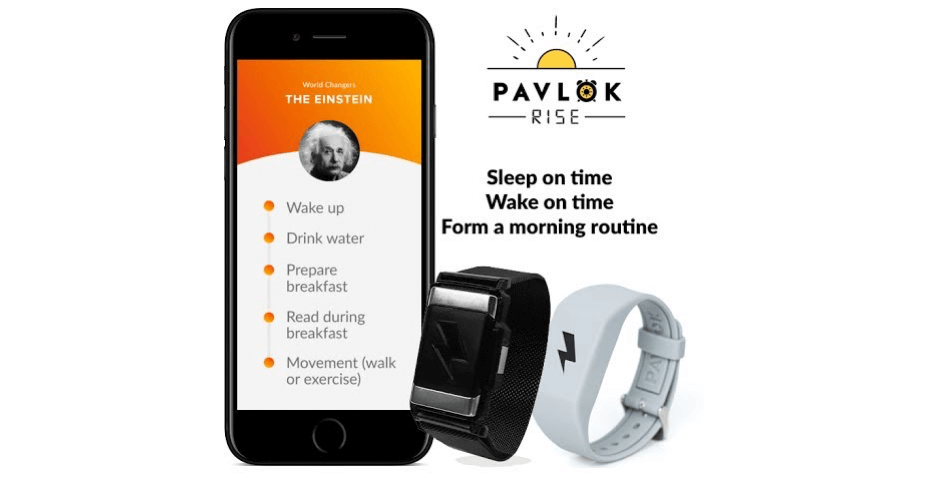
Pavlok Rise is the only wearable and software combination to help you get to sleep, wake up early, and form a productive morning routine.
For starters, be sure to check out the official Pavlok Rise video on our Indiegogo page and learn more about what Pavlok Rise has to offer.
We also wouldn’t be where we are today without the incredible support of the Pavlok community. For our campaign, we’ve gone out of our way to offer some amazing perks to those who wish to support Pavlok Rise during the Indiegogo launch. Some of the perks include…
You’ll be the FIRST to get your hands on the Pavlok Rise.
When you order on Indiegogo, regardless of which perk you choose, you’re guaranteed one of the best deals that will ever be available for Pavlok Rise.
Be a part of Pavlok’s DNA – One special perk gives you the opportunity to help us develop the Pavlok Rise’s gesture recognition for our sensor core technology (+ you’ll get the hardware two months before everyone else.)
To celebrate, I’m going on Facebook Live @ 3 EST today to answer any questions you might have and share our vision for the future.
Can’t wait to see you there.
xoxo
-Maneesh Sethi
CEO of Pavlok
P.S
Already A Pavlok User? Have Questions? Don’t Worry We Have You Covered.
We’ve created a special page sharing exactly how Rise is from Pavlok and Shock Clock. Whether you choose to upgrade or not, you’ll always be able to use your original Pavlok and Shock Clock.