Alcohol

Alcoholism

Define

Drinking should be defined as the amount of alcohol consumed of alcohol. According to the National Institute on Alcohol Abuse and Alcoholism there are two separate levels of alcohol consumption. All of which can be dangerous, but obviously the more alcohol consumed the more you put yourself and others at risk of injury and even death.

Moderate levels of alcohol consumption is the lowest level. In its definition It includes 1 drink per day for women and 2 drinks per day for men.

The final level of alcohol use is “Heavy Alcohol use”. It has been defined as binge drinking for 5 or more days days in the past month. Binge drinking is consuming enough alcohol to reach or surpass a blood alcohol content of .08 or higher.

It should be noted that the criterion of “one drink” changes dependent on the % of alcohol in that drink. For beer, a 12 fl oz at 5 % alcohol is consider 1 drink; Wine, 5 fl oz at 12%, is 1 drink; Liquor, 1.5 fl oz at 40% alcohol (80 proof). It is estimated that 1 fl oz can take an hour to metabolize.

What is the problem?

According to the National Council on Alcoholism and Drug Dependence, Inc alcohol is the most used addictive substance in the United States. With one in twelve Americans suffering from alcohol abuse or dependency, it is a dangerous but popular drug. Alcohol abuse does not only affect the person who uses alcohol, it also adversely affects the spouse, children, and coworkers.

Identification of risk of developing Alcohol Use Disorder (AUD) for women is having three or less drinks a day and not drinking every day of the week. For men it increased to four drinks a day and 14 drinks per week. The good news is that even if you meet this criteria only 1 out of 50 actually develop/have AUD.  In other words, many “casual drinkers” already show risks of developing AUD, but only 2% actually are diagnosed.

  • Had times when you ended up drinking more, or longer, than you intended?
  • More than once wanted to cut down or stop drinking, or tried to, but couldn’t?
  • Spent a lot of time drinking? Or being sick or getting over other aftereffects?
  • Wanted a drink so badly you couldn’t think of anything else?
  • Found that drinking—or being sick from drinking—often interfered with taking care of your home or family? Or caused job troubles? Or school problems?
  • Continued to drink even though it was causing trouble with your family or friends?
  • Given up or cut back on activities that were important or interesting to you, or gave you pleasure, in order to drink?
  • More than once gotten into situations while or after drinking that increased your chances of getting hurt (such as driving, swimming, using machinery, walking in a dangerous area, or having unsafe sex)?
  • Continued to drink even though it was making you feel depressed or anxious or adding to another health problem? Or after having had a memory blackout?
  • Had to drink much more than you once did to get the effect you want? Or found that your usual number of drinks had much less effect than before?
  • Found that when the effects of alcohol were wearing off, you had withdrawal symptoms, such as trouble sleeping, shakiness, restlessness, nausea, sweating, a racing heart, or a seizure? Or sensed things that were not there?


Basic Facts (Population, demographics, facts.)

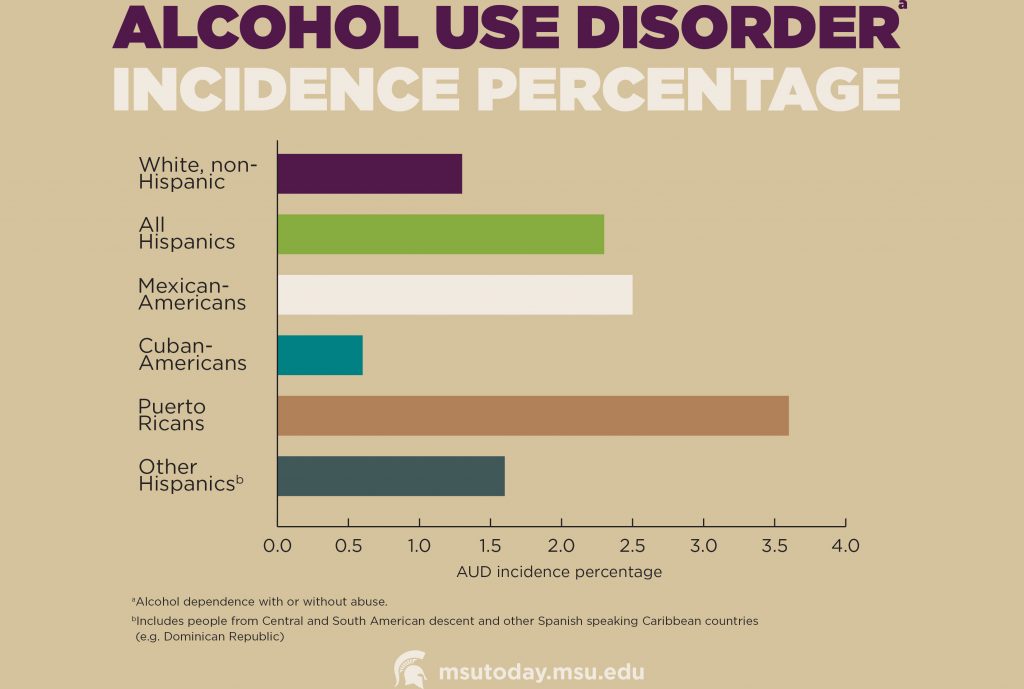
It is estimated that there are 88,000 deaths a year due to alcohol, and it is the third leading cause of death in the nation. Alcohol affects men and women differently: it takes women longer to metabolize it; however, alcohol abuse is more common in men than in women. In the world, over 2 billion people drink alcohol, and around 75 million people are affected by alcohol-related disorders.

Although not all alcohol use leads to addiction or dependency, alcohol has been the only drug banned as an amendment via the 18th amendment only to be repealed in the 21st.
Effects

According to drugabuse.com short term effects of alcohol may include some positive symptoms such as mild euphoria, mood enhancement, lowered anxiety, marked sedation. It should also be noted the negative short-term consequences such as impaired vision, delayed reaction time, confusion, vomiting, blackouts, loss of bladder control.

Long-term consequences may include cancer, hepatitis, scarring of the liver, and increased blood pressure which could lead to heart problems. Financially it takes a toll too.

According to a 2000 report on alcohol, the cost estimate for alcohol abuse was over 184 trillion dollars in 1998, which was up from a 1992 estimate of 148 trillion. These include the cost of loss of an individual, services such as counseling, criminal justice, and medical consequences.

How Alcohol Affects your Brain and Body

Habit Analysis and Common Triggers

To best analyze a habit we first must devise it up into three parts. The trigger, or what is evoking or eliciting the habit, the habit itself, and the rewards granted by that habit.

Triggers for alcohol consumption vary and can be very subtle. Here are some to consider:

  • Friends invitation to a bar
  • A sign on at a bar
  • Being in a setting that sells liquor
  • Lack of alternatives in the evening
  • Holidays such as St. Patrick’s Day, the day before Thanksgiving, and birthdays
  • Free samples offered at stores
  • Deals and specials
  • An abundance of time waiting (airports, casinos, hotels)
  • Social events
  • Sporting events (Football game, Bowling, Darts)

Like triggers the form of habits may vary from case to case. It is important to note which behaviors are “acceptable” and which should be avoided. For example many consider drinking at a bar is acceptable; however, drinking on the job may be less than satisfactory. Of course many of these depends on the individual circumstance. Each may mold both a different trigger and reward.

  • With friends at a bar
  • Alone at a bar
  • Drinking at home
  • Concealed drinking on the job
  • Drinking and driving
  • Binge drinking
  • Taking shots
  • Drinking Wine
  • Drinking Beer
  • Drinking games such a beer pong, flip cup, and others which speed of consumption matter.

Although rewards and reinforcers differ conceptually, the following should be considered more like reinforcers as they are likely to be maintaining habit. They may not be considered as rewards to general society.

  • Social praise (Chug! Chug! Chug!)
  • Social bonding as a chance to meet new people
  • The “buzz” feeling of alcohol
  • Passing out
  • The escape of a less desirable situation
  • “Liquid confidence”
  • The taste
  • A marker of celebration such as holidays, end of a work week, and a completion of a task
  • Inclusion in a participation in a cultural event
  • Access to other things such as pool, darts, food

After analyzing a habit cycle we then know the best place to manipulate one of the three variables. By doing this we may encounter more than one trigger, habit pattern, or reward type that controls the drinking behavior. We should choose one habit to change first and work our way towards others.

It may be easiest to manipulate the trigger variable in many of these cases as we can change many things before the trigger occurs to break the habit. More on this later.

What is the correct order of the habit cycle?

Habit, Trigger, Reward,
Reward, Habit, Trigger
Trigger, Reward, Habit
Trigger, Habit, Reward

Changing the Habit

As mentioned above to change a habit we must alter the habit cycle. The usual goal of treatment in alcohol is usually abstinence, in other words completely removing alcohol consumption. This can be done in three different ways: by removing the trigger (the trigger), reducing the motivation (the reward), or by reducing the ability to perform the habit.

Stopping the Habit for Good
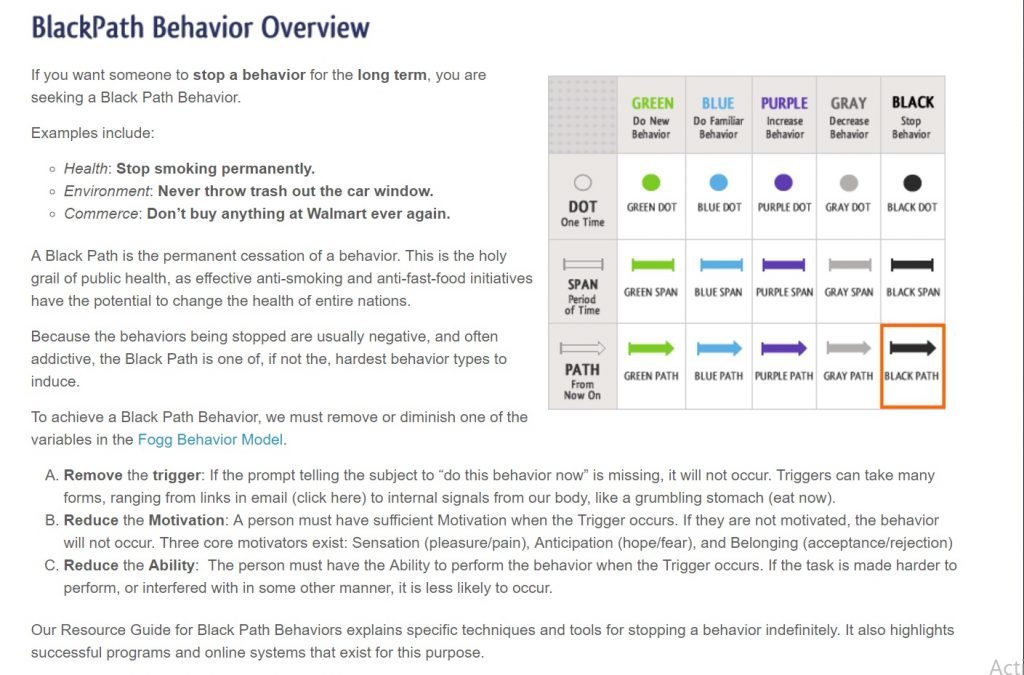
Possible triggers for alcohol consumption as discussed above include most bars and restaurants which serve alcohol. Many sporting events serve alcohol, and it is popular to consume alcohol while watching a sporting event. Some peers could also serve as a trigger as in many settings drinking is a social event. To accomplish the elimination of alcohol consumption it may be suggested to remove these triggers. One could simply avoid any place which serves alcohol, which may be a difficult challenge. The other solution is to find similar triggers that do not yield the same consequence, such as drinking alcohol free beer and sparkling champagne.

Rewards for alcohol varies from person to person: the buzz feeling, the excitement of events that are paired with alcohol consumption, and the feeling of belonging with your peers who are also drinking all may function. It is suggested to try to reduce these motivation. Possibly by finding alternative sources that fulfill that same level of motivation. Find alternative activities that can be done without alcohol, locate different peer. More specifically one could join a club that meets up at the same time you would normally drink.

An alternative view is that alcohol consumption may not be due to a reward, but rather as a way to gain distance from something aversive. If a bar is the only place to get away from a nagging spouse or daily responsibility, the environment may be perfect to establish a dependency on alcohol. One report may describe it best as an escape from reality.

Reducing the Habit

If your goal is to decrease alcohol consumption, we still need to examine the habit cycle. Instead of blocking the ability to drink, if one would like to just decrease the behavior, we may reduce the ability to drink. This could mean purchasing less alcohol, limiting the nights of the week you goes, and drinking only drinks with less alcohol content. Here it would be helpful to have clear goals: a specific number of days you may consume alcohol, how much money you can spend, or the amount you can assume.

Which one of these is not a specific goal?

A. I want to drink only 1 day a week
B. I want drink less
C. I want to spend $10 or less on alcohol this week
D. Drinking is bad, I only want to drink after work on Friday

B is correct. Drinking less is not specific. We need to know how much.

To replace rewards rather than simply to reduce, we can associate drinking with an aversive stimulus such as pain, fear, or rejection. In this approach we drink, but may pay for it. This can be with money, electrical shock, or with the loss of something pleasurable.

Treatment

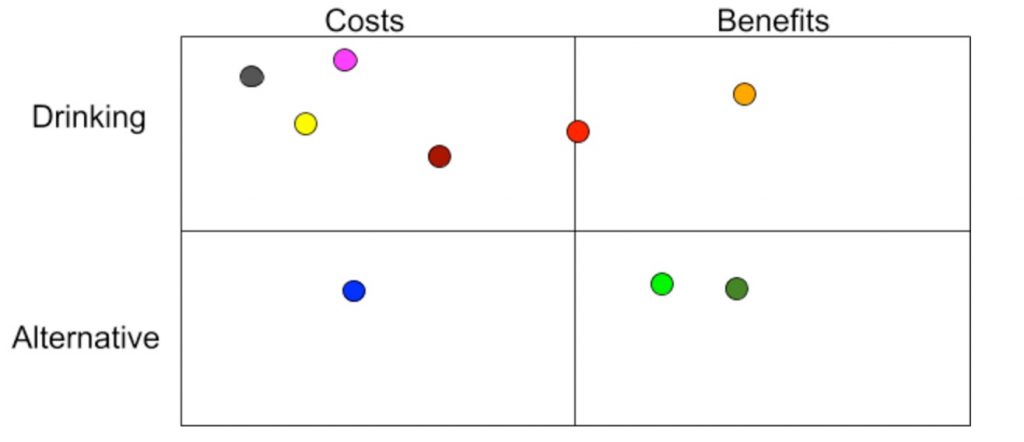
To best analyze treatment solution we may use a Cost and Benefit Matrix featured below. The boxes here are not an exhausted. Any intervention, independent of success can fit into these boxes to be analyzed. There are four ways of reducing the drinking behavior:

  1. Increase the cost of drinking
  2. Decrease the benefits of drinking
  3. Decrease the cost of alternatives
  4. Increase the benefits of the alternative

Cost and Benefit Matrix of Consuming Alcohol Compared to Alternatives


Cost Benefits
Drinking (1.) $, Hangover, Cancer,… (2.)Buzz, Social, Escape,…
Alternative (3.) (4.)


Most interventions aim at intervening at only the first two levels by manipulating the effects of drinking. Here are some examples:

  • Going to AA – (1.) Drinking results in the loss of tokens and social acceptances
  • Antabus drug (1. ) Drinking now makes you nauseous
  • Naltrexone and other drugs (2 Orange.) Drinking now loses it’s appeal
  • DWI (1&2) A penalty for drinking and now blocked from going places
  • Removal of all alcohol from home (1 Yellow.) It is now harder to get alcohol
  • Acceptance and Commitment Therapy (ACT) (1.Pink  ) increases the costs of drinking by paying for therapy
  • Advertising and state funded programs  (1. Black)  
Alternative solutions include:

  • Providing community activities for kids (4.) Gives a community outlet
  • Free/movie nights  (3.) Gives a cheap alternative to accomplish
  • Marriage Counseling (4.) May save failing marriage.


How the Pavlok Can Help

The Pavlok is programmed to track your behavior. With the If This Then That (IFTTT) app a beep, vibration, or shock can be sent directly to the Pavlok when you are close to any programmed location. This means a user of the Pavlok can simply type the address of their local bar and if they approach this site, a stimulus will be administered.

To reserve your Pavlok click here.

If you already own a Pavlok and want to set up the location feature with IFTTT click here https://ifttt.com/login to set up account and follow these steps.

  1. Click My Applets
  2. Click “+This”
  3. Type  “Location”
  4. Click location and choose one of the three options
    1. Pick the location by typing in the address
    2. Press “Create Trigger”
    3. Press +that
  1. Type “Pavlok” in the search
  2.  Choose one of the four options “zap”
  3. Set strength (low, medium, high)
  4. Click “Create action”
  5. Click “Finish”

Sources And Resources

  • Dickter, C.L., Forestell, C.A., Hammett, P.J. et al. Psychopharmacology (2014) 231: 2031. doi:10.1007/s00213-013-3348-6
    Survey that when answered, refreshes with bj fogg image ????
The Ultimate Guide To Stop Biting Your Nails

Editors Note: This is a guest post from a Pavlok user Eric who used Pavlok to help stop biting his nails.

I was once at a party in NYC with some high society types. I didn’t quite fit in, but we all try to level up socially at times. After my third conversation about the latest trip to the Hamptons and how I, “just had to come along next time,” I decided to retreat to the couch for a breather.

It was a nice enough apartment that the host requested we take our shoes off, so when I moved to the sofa, I could feel something sharp protruding from the plush carpet. Thinking it odd that such an affluent host would have anything but a clean floor, I figured I’d reach down to investigate. I rubbed my hand across the carpet searching for the seemingly invisible annoyance, and I was shocked at what I discovered. It was a long fingernail, most likely from someone’s thumb.

Instantly I began to judge the entire guest list. Being a life long finger nail biter and toenail picker myself, I sympathized with the culprit. But at the same time, I was disgusted.

Seeing it from the other side was enough for me to realize the gravity of my habit regarding social perceptions. Nail biting wasn’t just a bad habit, it was disgusting. My final revelation in all this was no matter what, I had to figure out how to stop.

That task proved much more challenging than I thought, and if you’re reading this, you’ve likely realized something similar.

Can you relate? Has your nail-biting ever put you in an awkward situation?

The Consequences Of Nail Biting

[bctt tweet=”Awkward social interactions are only the tip of the iceberg with nail biting.” username=”pavlok”]

Often, nail biters bite off more than they should chew and end up digging into the live skin and tissue underneath the nail, affecting the nail bed and the cuticle. This damaged skin is exposed to a greater likelihood of infection, especially because the mouth can be an excellent medium for transmitting bacteria and debris.

If that weren’t enough, nail biting has even been linked to certain mouth and dental issues because chronic nail biters can chip teeth and damage their gums.

Because of this, nail biting has an actual medical term, “onychophagia.” If that doesn’t make you feel worse, in the medical community, it’s associated with the following “nervous habits,” of which it is the most common; thumb-sucking, nose-picking, hair-twisting or hair-pulling, tooth-grinding, and picking at skin.

Furthermore, the medical literature agrees the habit often begins early in life with half of all children ages 10 to 18 biting their nails. Thankfully, most people quit on their own by age 30. (WebMD)

If that last sentence made you laugh from sheer hopelessness, you’re not alone. It’s not surprising most people’s only hope is to pray they grow out of it by 30 with the sheer volume of terrible advice out there on the web to “help you stop.” After extensive research and my lifelong effort to quit, it seemed easier to throw my hands in the air and just give up.

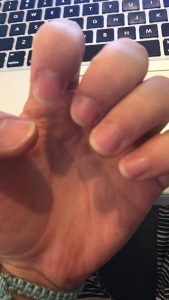
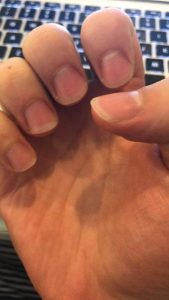
Lucky for you that’s not what I did, and in this post, I’m going to outline the exact method I used to quit biting my nails forever, in less than five days. If that sounds too good to be true, I assure you it’s not. I went from brutal looking nails with worse cuticles to this…

(These are my real hands at the time I’m writing this, see the keyboard in the background? And for all the doubters who think I must relegate my chewing to a single hand, I included both.)

I had concluded I was doomed. I had accepted the fact that I’d always have to hide my hands, but now my nails look so good I could be a hand model.

But to understand why the Pavlok method is so effective, you first must see why all the other advice out there isn’t.

The Exact Way to Never Actually Quit Biting Your Nails

Today, when you find yourself with a socially embarrassing bad habit, it’s best to turn to Google. After all, you can find the best modern science and society has to offer on the subject without having to admit to a single person you have a “weird” problem.

Sadly, the internet is in the dark when it comes to actually learning how not to bite your nails.

I mean, there are entire businesses built on helping people quit their addictions, but the best we can do on nail biting is, frankly, shockingly embarrassing.

Here’s an extensive list of all the strategies I found on the internet to help with nail biting:

-Keep your hands busy
-Keep your nails trimmed
-Maintain a healthy diet
-Play/fiddle with an object (good plug for fidget spinners)
-Do a hobby
-Use a “nibble inhibitor” solution on your nails, apply it several times a day, and carry a spare
-Consider covering your nails with band-aids, tape, or gloves
-Use fake nails and acrylics
-Take it easy, break the habit one nail at a time
-Maintain healthy nails
-Wear fake nails
-Exercise
-Meditation
-You can do anything you set your mind to so just commit
-STOP! (yes this was an actual suggestion on one apparently helpful website)
-Rubber band yourself every time you catch yourself
-Fix underlying causes
-Enlist help
-Therapy
-Tell others to point it out
-Set reminders
-Wear “Chewelry,” i.e. necklaces and bracelets you can chew on instead
-Keep at it
-Nail care
-Nail supplements
-Visualize success
-Keep your nails short
-Keep a cuticle cutter in your purse
-Put on nail art that you wouldn’t want to ruin

As you can see, quitting nail biting is incredibly easy, all you have to do is pick one of the many useful strategies from this extensive list, and you should see results in no time.

I swear I didn’t set out to write a comedic blog post, but there’s no other logical reaction to this list other than sheer laughter. These suggestion are all I can find through pages and pages of Google searches and scholarly articles. The above is the advice doctors are trained to give patients like you when you spend all day at their offices.

Look, even Whose Line Is It Anyway? understands how comical these suggestions are:

But it’s not enough to only call these bad ideas out without examining why they don’t work, or if they do provide a temporary fix, why they don’t stick. So, I thought we’d explore the top six most popular suggestions and deconstruct why they don’t work with real psychological and behavioral change science.

The 6 Most Commonly Suggested Strategies for Breaking Your Nail Biting Habit That Don’t Work

  1. Keep Your Nails Shorter
  2. Use a Bad Tasting Nail Polish to Prevent Biting
  3. Splurge and Treat Yourself to Expensive Manicures Frequently
  4. Keep Your Hands and Mouth Busy
  5. Cover Your Nails with Bandages, Adhesives, or Gloves
  6. Break The Habit Gradually, One Nail at a Time

1. Keep Your Nails Shorter

On the surface, this suggestion makes total sense, and it insidiously inspires someone to take quick action, clip their nails short, and think they’re cured forever.

Until something happens, something they never expected, and their nails start to grow again.

You see, people don’t bite their nails when they’re short (duh) so having short nails will make you stop for a few days. But how do you keep them short? And now the theory unravels. Much of the reason people bite their nails is that they have the opportunity to bite their nails. If they had a regular nail shortening and care routine, they probably wouldn’t bite in the first place.

So this strategy is a result of curing the habit, not a tactic to make the pattern stop. As you’ll see, a proper habit forming or deforming routine gives considerable thought to the reward, and in this instance, a beneficial reward would be maintaining healthy nails and keeping them relatively short. But all of that happens after the urge to bite has come and passed. In summary, most nail biters shorten their nails just fine with their mouth, keep their mouth away from them until they are long enough again, and go right back to biting.

[bctt tweet=”Shortening your nails alone will only solve the surface level problem, the habit remains unchanged. ” username=”pavlok”]

2. Use a Bad Tasting Nail Polish to Prevent Biting

Taste is a fickle thing. For example, do you like spicy food? If you do, you probably really like it. Moreover, you probably look to increase your spice tolerance at certain times when the opportunity arises. You might even remember a time when you didn’t like spicy food or food as spicy as you like now.

On the other hand, if you don’t like spicy food you probably don’t even like the smallest amount of spicy. You likely think all spicy food tastes horrible and you can’t understand why anyone would crave spicy food as much as your friends do.

My point is that taste is extremely relative and is based on many psychological and physiological factors. Some studies even suggest our brains re-condition our taste buds to enjoy spice because of the nutrient density, as this article mentions. So, it’s entirely possible that what you find repulsive today may not be so unpleasant over time.

Indeed, what we see happen is that exact pattern of desensitization. Commonly, people paint their nails with nasty polish all day, but can’t kick their habit. Much like the friend who chews Nicorette all day but still can’t stop sneaking a cigarette, you can change one aspect of the behavior without truly conquering the habit. As we’ll illustrate, what you’re doing, in this case, is only changing the routine part of the habit without doing the deep work to eliminate the triggers and reward the new behavior.

C’mon internet, can’t you do better?

3. Splurge and Treat Yourself to Expensive Manicures Frequently

This one feels like some manicure lobbyist invented it (do those exist?). It’s like we can’t fix any of our problems in America without someone suggesting that we just throw more money at it.

This one fails for many of the same reasons the “just cut your nails shorter” line doesn’t work. However, this one hurts even more because now your bank account is crying louder than your nail beds and you’re feeling guilty every time you chomp down on those expensive bedazzled scratchers.

Don’t get me wrong, I love a nice manicure, but I won’t be fooled into thinking just paying my way out of my problem will cure me.

4. Keep Your Hands and Mouth Busy

If Pavlok made a fidget spinner, this is when I would link to it. As much fun as it is to believe we all have ADHD, fidgeting can’t be the cure for everything. The popularity of fidget cubes and fidget spinners has more to do with smart marketing than changed behavior and a happier, more focused society.

I’m sure the most committed to change could find a way to have something in their pocket to play with at all times along with a fresh stick of gum on hand, but do you want to live like that? One empty pocket away from a relapse?

The minute you’re empty handed you’ll likely return to your old ways. Precisely because you haven’t changed anything about them, you’ve just anxiously avoided dealing with them in perpetuity. It’s like the people who just push their debt further and further into the future accruing more and more along the way.

Eventually, everything crashes to a standstill, and you’re back to square one. Moving on.

5. Cover Your Nails with Bandages, Adhesives, or Gloves

One of the biggest reasons people wish to change their nail biting habit is because it causes social awkwardness, as we mentioned at the beginning of the article.

I’m willing to bet wearing gloves around all day, especially if you live somewhere hot, will cause even more interpersonal angst. And even if you get away with looking like a deranged serial killer most of the day, it just doesn’t seem very practical. I’d like to see an office worker get any emails written with garden gloves on all day.

Until Drake makes wearing bandages around every fingertip the next fashion trend, I wouldn’t seriously look at this as even a remote solution. And again, as soon as the gloves come off you’re back to biting.

6. Break The Habit Gradually, One Nail at a Time

Out of all the common suggestions, this is the one I like the best because it’s the only one that includes an iota of habit science. Acclaimed masters of habit like Charles Duhigg and Leo Babauta recommend breaking up habits into bite sized chunks you can conquer over time.

Although personally, I found that one nail was usually all it took to take me down that slippery slope towards chewing every finger. For some habits, like working out, breaking it up and starting with one push-up a day makes sense, but for nail biting, one nail usually means all nails.

And, at the end of the day, the mental resources required to resist biting one finger at a time are the same needed to withstand biting all your fingers. So why not recruit those resources for the right project and tackle the habit with science?

Well, that’s exactly what I suggest.

Watch the video and see how Pavlok family member Nagina used Pavlok To Quit Biting Her Nails.

The Science of Habit Change

It’s widely considered (and popularized by Charles Duhigg in his book The Power of Habit) in the study of behavior change that a habit is composed of three fundamental parts. The “cue” or “trigger,” the “routine,” and the “reward.” To change a habit, you must tackle all three areas.

Which again, is why many of the common suggestions don’t work. They target one aspect, two at best, and they don’t holistically solve the problem. However, more capable students could mix and match different suggestions with a strategic study of their triggers to make headway.

For me, the entire solution came in the form of Pavlok.

>>> How I Used Pavlok to Stop Nail Biting <<<

Step 1: Awareness of Why I Bit My Nails in the First Place

Pavlok gets a lot of hype and notoriety for its ability to “shock,” but that’s such a small piece of the puzzle. One of the most helpful aspects of wearing a Pavlok around is its ability to draw your conscious attention to your unconscious triggers and start to dive deeply into the cues of your habit. And all of that can be done without a single zap.

For nail biting, Pavlok can detect when your hand is in your mouth, and you’re about to bite, thanks to its built-in accelerometer. So even if you end up biting, Pavlok will vibrate drawing your attention to what you’re doing. You can keep on biting, but often just the awareness reminder is enough to jolt you out of the routine. After about 36 hours of consistent buzzing, I was extremely aware of what caused me to bite.

I found myself biting most often for the following reasons: 1. My nails had grown long and uneven, and my subtle OCD organized brain wanted to even everything out. 2. I was nervous or tense, and I bit out of anxiousness. 3. I was bored and idle, so I unconsciously bit to pass the time.

When it comes to changing your habits, that information alone is invaluable because it helps you to circumvent the habit before it even starts. You can take action to help yourself avoid those scenarios or come out with a counter plan.

Step 2: Rewarding Myself Differently for Avoiding Nail Biting

Often, the reason we continue to perform our bad habit is that it feels good. We get a dopamine or serotonin response from our brain for doing it. For me, biting my nails meant my OCD brain could relax because my nails were even and short, even if they got that way painfully. Or, I didn’t have to think about being nervous because I had something to distract me. Also, time went by faster when I was having fun biting my fingers. That feels good.

Until it doesn’t. Here is where the zap of Pavlok can help. There’s nothing like a good old electric shock to tell your brain to stop secreting feel-good chemicals when you do something wrong. But you don’t have to use that feature if you don’t want to. For nail biters, it can also be as helpful to channel that automatic secretion of good feeling juices into a beneficial behavior.

For example, instead of getting a manicure to prevent yourself from nail biting, what if you could only get one if you went five days without biting? This is a strategy that worked for me.

Every time I bit I would mildly zap myself to tell my brain I didn’t like this behavior. And then after I stopped biting, and my nails grew long, I scheduled regular manicures to replace the reward of even nails with the better reward of professional looking, Hollywood nails. Once girls started complimenting them, it was game over for my old reward system. Compliance felt a lot easier after that.

Step 3: Changing the Routine Mid Habit

Another thing I discovered early on, and consider yourself warned because this is pretty nasty, is that I often picked off my long nails to assist me with picking my teeth post meal. Yeah, I told you, pretty gross.

Thanks to my childhood braces and evenly spaced teeth, after an excellent steak dinner, my mouth is littered with little goodies. Half an hour after eating I used to find myself biting away as usual because now I had a nice little makeshift toothpick. I’m making a disgusted face at myself just writing this. I would even pick like this amidst company. Ah, I need to take a cold shower in shame.

Unlocking this level of awareness with Pavlok helped me kill two birds with one stone. Once I realized this was a thing for me, I went to the store and purchased some of those single serve floss picks and started carrying them around with me. I’d leave some in the car and have some in my pocket just in case

Then, whenever I caught myself biting with the Pavlok, I’d zap and then reach for a little toothpick. Even if I didn’t have anything in my teeth, I’d still just play around with it. People accepted it socially because now it just looked like I was obsessed with my teeth, I’d get a good floss in at the least, and I still had a nervous tick to replace nail biting. Over time I could go longer and longer without noticing my need to perform the routine, and now I don’t even carry the picks.

If I do go to a nice steak dinner, and I’m the slightest bit tempted to reach for my nails (the regular streamlined guy manicure makes it pretty hard), I can do a quick zap with my Pavlok as a reminder. Or, if I’m not wearing it, I can usually wait until returning home to grab a toothpick or ask around for one (or floss) because I’m no longer so conditioned to alleviate the situation with a nail right then and there.

Ok, I promise I’m done writing about how disgusting I am.

Pavlok Isn’t The Only Answer For Everyone, But It Was For Me

I’m sure some of you are reading along thinking, “what the hell, is this guy a Pavlok sales rep or what?” And the answer is no. This post is an entirely honest synopsis of my experience. It’s been the game changer for this habit in my life.

For other habits, I could see more of the conventional wisdom working well. Maybe it’s just me, but for nail biting, I couldn’t keep from laughing at any of the mainstream suggestions.

Pavlok is certainly just another tool in one’s arsenal to help change your habits. And as many would say, change your habits, and you change your life.

>Many of us love efficiency and working smarter over harder. Pavlok makes habit change pretty damn easy. Remember, I decimated a life long nail biting habit in less than a week. I’m confident I’d still be wearing gloves if that were my main strategy.

Moreover, I did all this with Pavlok 1. With Pavlok 2 there are even more powerful features and enhancements to help you even further.

If you’re serious about leaving nail biting behind, and you’ve been searching for a solution, Pavlok may be the answer.

21 Scientific Studies On Aversion and Bad Habits

For 80+ years, doctors and scientists have studied the efficacy of electric shock on changing behaviors. After rigorous testing, these researchers report their results in peer reviewed journals which are often cited in further studies.

This post is a collection of scientific reports from the world’s top academic and medical institutions. We’ve included summaries of 21 articles so you can sample this body of research — the science Pavlok is built on.


Up To 61.4% of Subjects Quit Smoking With 5 Days of Aversive Conditioning

A follow-up study was conducted at approximately one year post-treatment of a group of 832 clients treated at a commercial stop smoking program. The treatment program employed five days of aversive conditioning for various smoking behaviors. It also included an educational and counseling component and a six week support phase with weekly support groups and one conditioning reinforcement treatment in the second week. The clients were contacted a mean of 13.7 months after completion of treatment. Fifty-two percent of all clients achieved their goal of total abstinence from cigarettes since “graduation” from the program. The factor most predictive of success or failure was whether or not the client returned to a home containing a smoker. Of those returning to a nonsmoking home, 61.4% of the men and 60.2% of the women were successful. Of those who returned to a smoking household, 70.2% returned to smoking. This study demonstrates that the treatment, process appears to be free of complications and is associated with successful outcomes in the majority of clients. Further improvement in outcome might result from simultaneous treatment of all household smokers.

Reference: Journal of Substance Abuse Treatment, Long Term Outcome of Clients Treated in a Commercial Stop Smoking Program, Vol. 5. pp. 33-36, 1988


81.8% of Nail Biters Have Significant Nail Growth With Electric Shock Therapy

Subjects (N=61) 31 males and 30 females, with a mean age of 19.75 yr and an average of 12 yr of nail biting were randomly assigned to one of four groups: (1) shock, (2) negative practice, (3) bitter substance, and (4) attention-placebo control. A shock generator capable of delivering a measured voltage of 200 V at 10 mA was used to administer faradic shock. Half of the subjects from each treatment condition were instructed to self-monitor their nailbiting throughout treatment. All groups experienced an increase in nail growth, with no significant difference among groups. However, self-monitoring subjects exhibited significantly greater increases in nail growth than non-self-monitoring subjects (p<.05). Compared to the control condition, a significantly greater proportion of subjects in each of the three aversion treatment conditions had either ceased biting their nails or were biting less frequently 3 months later (p<.05). Moreover, there was a significant increase in awareness of nailbiting among individuals still biting their nails (p<.01). This increased awareness was experienced primarily by self-monitoring subjects. Awareness appears to be a crucial factor in the reduction of nailbiting.

Reference: Vargas, John M., and Vincent J. Adesso. ‘A Comparison Of Aversion Therapies For Nailbiting Behavior’. Behavior Therapy 7.3 (1976): 322-329. Web.


Aversion Study Results In Sustained Weight Loss of 9.17 lbs

Favorite foods (CS) were paired with noxious odors (UCS) to help overweight Ss achieve and maintain weight loss. The average age of Ss was 39.56 years with a range of 18-60 years and the average weight was 181.67 lbs with a range of 152-237 lbs. All Ss had been defined as “overweight” according to the New Weight Standards (Statistical Bulletin, November, 1959) and also by their physicians. After the 9-week conditioning period, a significant (obtained p = 0.002, significant at p<0.05) average weight loss for the six experimental Ss of 13.33 lbs compared with an average weight loss of 1.00 lb for the six control Ss was reported. After 48 weeks, the experimental Ss had an average weight loss of 9.17 lbs, while the control group had a weight gain of 1.33 lbs.

Reference: Foreyt, John Paul, and Wallace A. Kennedy. ‘Treatment Of Overweight By Aversion Therapy’. Behaviour Research and Therapy 9.1 (1971): 29-34. Web.


Skin Scratching and Hair Picking Disappear Completely With 20 Minute Sessions

Behaviour therapy provides important psychotherapeutic possibilities for the treatment of dermatological disorders. Compulsive scratching and trichotillomania can be treated by aversive conditioning. In documented case a man aged 33 suffered from severe lichen simplex on the scrotum, thighs and ankles, which had been present for 4 years and for which he had been admitted to the clinic three times, without any lasting result. The patient was seen once a day for a 20 minute session. He was instructed to bring his hand to scratch at a sign from the therapist. At the moment his hand reached site he received an unpleasant, though not painful, electric shock via electrodes on the moving hand. He then had to draw back his hand and say aloud, ‘don’t scratch’. After 19 days of treatment the scratching disappeared completely.

Reference: BAR, LOUIS H. J., and BEN R. M. KUYPERS. ‘Behaviour Therapy In Dermatological Practice’. Br J Dermatol 88.6 (1973): 591-598. Web.


12 Hours of Treatment Can Extinguish a 12 Year Habit

When contrasted with other psychiatric treatments the duration of aversion therapy necessary to break a chronic habit such as compulsive gambling is extremely short. Case 1 required only 12 hours treatment to extinguish a behaviour pattern which had persisted for 12 years. He showed no tendency to resume gambling for 18 months. He relapsed once after a domestic upheaval and after losing his job. He was readministered for four “booster” treatments, during which he showed marked reluctance to gamble. Apart from this single relapse he has not returned to gambling for more than two years. Mainly because of its convenience and practicability, electrical aver- sion therapy is now tending to replace all other aversion techniques (1, 38.)

Reference: Barker, J.C., and Mabel Miller. ‘AVERSION THERAPY FOR COMPULSIVE GAMBLING’. The Lancet 287.7435 (1966): 491-492. Web.


The Elimination of Chronic Cough by Electric Shock

The study presents a case in which aversion therapy was successfully used to eliminate a chronic cough in a 15 yr old boy. Treatment included electric shock aversion therapy employing a response suppression shaping paradigm to remove the cough, and ancillary family treatment to alter the reinforcement pattern which maintained the inappropriate behavior. The S has been free of cough for 1 1/2 yr since treatment. Significant aspects of the case relating to the use of aversion techniques are discussed. This paper is based in part on a presentation given at the Fifth Annual Meeting of the Association for the Advancement of Behavior Therapy, Washington, D.C., September, 1971.

Reference: Barney Alexander, A. et al. ‘The Elimination Of Chronic Cough By Response Suppression Shaping’. Journal of Behavior Therapy and Experimental Psychiatry 4.1 (1973): 75-80. Web.


1 Year Follow Up: 66.7% of Smokers Who Complete 5 Shock Sessions Still Not Smoking

Electric aversion was administered to 14 cigarette smokers. Six of the nine Ss who completed the treatment were still abstinent at one-year follow-up. The overall average of 21.5 cigarettes on the day before treatment dropped to an average of 1.4 cigarettes per day after the third aversion session and most patients stopped smoking within five sessions. It is concluded that electric aversion is a powerful suppressor of cigarette smoking.

Reference: Russell, M. A. H. ‘Effect Of Electric Aversion On Cigarette Smoking’. BMJ 1.5688 (1970): 82-86. Web.


In 3 Sessions Electric Shock Creates Inhibition of Craving For Prescription Drugs

It seems likely that an important reason for the limited success of aversion treatment of drug addiction has been that the aversion is applied only to extrinsic stimuli associated with the drug. No attempt is ordinarily made to combat the endogenous habit. In the present experiment a subject with a Demerol (Pethidine) addiction of 3 years standing was instructed to give him- self a severe shock from a portable apparatus whenever he felt a desire for the drug arise endogenously. On three occasions he gave himself 4, 3 and 2 shocks respectively, dispelling the craving. For a period of 12 weeks the patient remained free from any but minor cravings that he could easily control.

Reference: Wolpe, Joseph. ‘Conditioned Inhibition Of Craving In Drug Addiction: A Pilot Experiment’. Behaviour Research and Therapy 2.2-4 (1964): 285-288. Web.


Aversion Therapy and Sensory Modalities: Clinical Impressions

Clinical findings suggest that the results of aversion therapy may be enhanced by choosing aversive stimuli which match the specific modalities under treatment. “White noise” was most effective in reducing auditory hallucinations; tactile stimuli (electric shocks) were most effective with motor compulsions; and an unpleasant olfactory-gustatory stimulus (an especially foul mixture of smelling salts) worked best with compulsive eaters. (PsycINFO Database Record (c) 2012 APA, all rights reserved)

Reference: Lazarus, Arnold A. ‘AVERSION THERAPY AND SENSORY MODALITIES-CLINICAL IMPRESSIONS’. Perceptual and Motor Skills 27.1 (1968): 178-178. Web.


Aversion Therapy in the Treatment of Trichotillomania: A Case Study

This paper presents a single case study of a patient with compulsive hair- pulling (trichotillomania) of 16 years’ duration, who was successfully treated using electric aversion therapy. All previous attempts at treatment and self- help had been unsuccessful. A behavioural self-control programme was tried initially with some success, but the progress was not maintained following an unplanned break in treatment and this treatment was ineffective when re- instated. Electric aversion therapy eliminated hair pulling almost immediately and the results were maintained on follow-up, with the exception of a minor relapse at a time of stress.

Reference: Crawford, David A. ‘Aversion Therapy In The Treatment Of Trichotillomania: A Case Study’. Behavioral Psychology 16.01 (1988): 57. Web.


Aversive Shock Analysis Physical Danger, Emotional Harm, Effectiveness
and “Dehumanization”

Four major objections to the use of faradic stimulation are reviewed and re- sponded to. It is concluded that aversive stimulation is no more dangerous physically or emotionally than traditional forms of treatment, that some aversive procedures have provided controlled evidence of effectiveness, and that charges of dehumanization are invalid.

Reference: Tanner, Barry A. ‘Aversive Shock Issues: Physical Danger, Emotional Harm, Effectiveness And “Dehumanization”’. Journal of Behavior Therapy and Experimental Psychiatry 4.2 (1973): 113-115. Web.


The Control of Violence & Aggression Through Electric Shock

This study deals with the use of faradic shock administered as a punishment for the purpose of curbing the assaultive and violent behaviors of a 31-year- old, hospitalized, chronic schizophrenic female.Three levels of behaviors were chosen for modification: 1) aggressive acts, 2) verbal threats and 3) accusations of being persecuted and abused. The aversive conditioning approach was employed for each of these levels in a stepwise fashion, with each successive level being included as punishable offenses once effective control over behaviors on the previous level had been demonstrated. The results indicated that a marked reduction in the incidence of the behaviors on all three levels was accomplished by means of this treatment approach. Shortly after instituting the punishment program for accusatory verbalizations, the patient began to show appropriate, socialized behavior which continued throughout the remainder of the program. Moreover, the patient’s weekly behavior rating scores indicated a significant improvement in general functioning over time following initiation of the aversive therapy program.

Reference: Ludwig, Arnold M. et al. ‘THE CONTROL OF VIOLENT BEHAVIOR THROUGH FARADIC SHOCK’. The Journal of Nervous and Mental Disease 148.6 (1969): 624-637. Web.


In 10 Weeks Electrical Aversion Therapy Cured A Chronic Heroin User

A 23-yr-old male graduate student who had been using heroin for 3 yr was treated with electrical aversion conditioning. Treatment was carried out in twenty 20-minute sessions over approximately 10 weeks. The drug taking behavioral sequence was broken into discrete phases which the patient imagined and verbalized. An 8-month follow-up has shown him to be drug free.

Reference: Lubetkin, Barry S., and Steven T. Fishman. ‘Electrical Aversion Therapy With A Chronic Heroin User’. Journal of Behavior Therapy and Experimental Psychiatry 5.2 (1974): 193-195. Web.


Aversion Therapy Is More Effective Than Other Common Treatments

Operant (N = 11), aversion (N = 12), and transactional analysis (N = 12) approaches to the development of self control in excessive cigarette smoking were compared with each other and with a no-treatment control group (N = 15). 10 group treatment sessions were administered to Ss assigned to each of the treatment groups. After treatment and a 1-mo follow-up period, the smoking rates of all treatment conditions were significantly lower than the control group (p < .001). No significant treatment, therapist, or interactional differences or indications of symptom substitution were found. (32 ref.) (Psy- cINFO Database Record (c) 2012 APA, all rights reserved)

Reference: Ober, D. C. ‘Modification Of Smoking Behavior.’. Journal of Consulting and Clinical Psychology 32.5, Pt.1 (1968): 543-549. Web.


9 of 20 Nail Biters Quit On Day 1 & 13 of 20 Quit By Day 4

Twenty unpaid volunteers were obtained through advertisements and notices. Most were UCLA students. Most reported biting since early teen or preteenage years, with sporadic efforts at self-control. Some reported occasional periods of abstinence. Two devices were used, to provide a choice of shock intensity. Aversive stimulation was used in this study to produce supplession. Ss chronic nailbiters, instructed to carry a portable shock device, and use it following the act of placing a finger in the mouth or on the lips, and to discontinue the behavior as soon as it was discovered. The procedure was quite effective; in 9 of 20 cases no biting was reported from the first day. In 4 other cases none was reported after 4 days. All visual checks of nails corroborated subject reports.

Reference: Bucher, Bradley D. ‘A Pocket-Portable Shock Device With Application To Nailbiting’. Behaviour Re- search and Therapy 6.3 (1968): 389-392. Web.


Training Device Takes Chronic Hair Pulling To Near-Zero Levels

The chronic hair pulling of a 36-year-old woman with moderate mental retardation was initially treated with a simplified habit-reversal (SHR) procedure that consisted of awareness training, competing response training, and social support. When SHR did not produce large and sustained reductions in hair pulling, an awareness enhancement device was added, and it reduced hair pulling to near-zero levels in two settings. The results are discussed, and directions for future research with this device are provided.

Reference: Rapp, J T, R G Miltenberger, and E S Long. ‘Augmenting Simplified Habit Reversal With An Awareness Enhancement Device: Preliminary Findings.’. Journal of Applied Behavior Analysis 31.4 (1998): 665- 668. Web.


An Automated Aversion Device in the Treatment of a Compulsive Handwashing Ritual

A 49-yr-old male with a long history of compulsive handwashing was treat- ed by the implementation of a self control procedure. This turned out to be effective only when a powerful external reinforcer (shock) was added to the procedure to increase the patient’s capacity for initiating self-control. Ritualistic handwashing had virtually ceased after 42 days and remained absent at 12 months’ follow-up.

Reference: Le Boeuf, Alan. ‘An Automated Aversion Device In The Treatment Of A Compulsive Handwashing Ritual’. Journal of Behavior Therapy and Experimental Psychiatry 5.3-4 (1974): 267-270. Web.


Faradic Disruption of Obsessive Ideation in the Treatment of Obsessive Neurosis

Faradic disruption of verbal phrases and mental images was used with five chronic obsessive patients in an attempt to reduce obsessive ideation connected with their obsessive fears, doubts and horrific temptations and to reduce or eliminate their compulsive or ritualistic behavior such as handwashing and checking. As a result, three of the five patients were vastly improved and one experienced moderate improvement.

Reference: Kenny, F.T., L. Solyom, and C. Solyom. ‘Faradic Disruption Of Obsessive Ideation In The Treatment Of Obsessive Neurosis’. Behavior Therapy 4.3 (1973): 448-457. Web.


Sadistic Fantasies Modified by Aversive Conditioning and Substitution: A Case Study

A case study involving unpleasant electric shocks as the consequence of sadistic fantasies seems to have successfully helped to suppress or extinguish them while incompatible “normal” sex fantasies were strengthened.

Reference: Mees, H. ‘Sadistic Fantasies Modified By Aversive Conditioning And Substitution: A Case Study’. Behaviour Research and Therapy 4.1-2 (1966): 317-320. Web.


Electric Shock Selectively and Retroactively Strengthens Your Memory

Here we show, in humans, that information is selectively consolidated if conceptually related information, putatively represented in a common neural substrate, is made salient through an emotional learning experience. Memory for neutral objects was selectively enhanced if other objects from the same category were paired with shock. Retroactive enhancements as a result of emotional learning were observed following a period of consolidation, but were not observed in an immediate memory test or for items strongly encoded before fear conditioning. These findings provide new evidence for a generalized retroactive memory enhancement, whereby inconsequential information can be retroactively credited as relevant, and therefore selectively remembered, if conceptually related information acquires salience in the future.

Reference: Davichi, Lila, and Dunsmoor, Joseph E., and Murty, Vishnu P., and Phelps, Elizabeth A. ‘Emotional learning selectively and retroactively strengthens memories for related events’. Nature (2015). Web.


Shock Treatment: 84.2% of Marijuana Smokers Quit & Their Collective IQ Increases By 6%

Twenty-two chronic marijuana smokers participated in a smoking cessation clinical trial. The mean age of the 16 male and 6 female subjects was 29.8 years. The mean number of years of marijuana smoking was 13.7. The mean number of daily marijuana cigarettes smoked was 3.4. The clinical trial consisted of five consecutive days of 50 minute aversion therapy sessions (faradic, rapid smoking, and quick puffing) utilizing THC-free marijuana. Three weekly 60 minute group cohort sessions in self-management counseling followed. The treatment period spanned four weeks. All 22 subjects achieved abstinence (by self-report) by the end of the five days of aversion therapy; 19 of 21 subjects (90.5%) reported abstinence at the conclusion of the clinical trial, following the group sessions. At six months post treatment follow-up 15 of the 20 subjects (75.0%) reported abstinence; at 12 month posttreatment follow-up 16 of the 19 subjects (84.2%) achieved abstinence. The mean number of daily marijuana cigarettes smoked decreased from a baseline pretreatment level of 3.40 to 0 at the conclusion of aversion therapy, .07 at the conclusion of the clinical trial, .26 at six month posttreatment follow-up and .23 at the 12 month posttreatment follow-up. The mean scores on the Shipley Institute of Living Scale, were: IQ 106 and CQ 92 at pretreatment; IQ 112 and CQ 104 at posttreatment. The investigators conclude the treatment procedure offers promise as a marijuana smoking cessation treatment program.

Reference: Knowles, P.L, & Schmeling, G, & Smith, J.W. A marijuana smoking cessation clinical trial utilizingTHC-free marijuana, aversion therapy, and self-management counseling. J Subst Abuse Treat. 1988;5(2):89-98. Web.


How Pavlok Knows When To Shock You

peter-the-cheater

The #1 question everyone asks about Pavlok is “how does it know?”

How does it know you are smoking?

How does it know you are on Facebook?

How does it know you just ate your third Big Mac with extra cheese?

The simple answer is there are both easy-track and hard-track habits.

Examples of easy-tracks include time spent on Facebook, pressing a snooze button or obsessively checking your phone.

Basically, an app goes “beep you are on Facebook” and Pavlok shocks you.

Easy tracks are the near-term priority for Pavlok.

But there are also hard-tracks like smoking, nail biting and over eating. Yes, these are trackable too, but the technology is still in development.

If you have a hard-track habit, there is actually something better — “self shock” — the way scientists have been doing this for decades.

When you shock yourself — which we teach you how and when to do in the included 5 day habit change app — you increase awareness & supercharge your natural ability to resist.

Because of this, self shock actually has much higher success rates than an automatic shock does for changing habits.

how-pavlok-works-self-shock

And there is another option too. You can link your Pavlok to a friend’s phone via Bluetooth and let them monitor you. This method works well when you need a little extra help to quit your habit.

BTW, the #2 question everyone asks about Pavlok is “will it work for my habit?”

And the answer is yes, yes it will :- )

Click here for the list of bad habits you can break with Pavlok.

The Big List Of Bad Habits

[et_pb_section bb_built=”1″ admin_label=”section” _builder_version=”3.0.47″][et_pb_row admin_label=”row” _builder_version=”3.0.48″ background_size=”initial” background_position=”top_left” background_repeat=”repeat”][et_pb_column type=”4_4″][et_pb_text _builder_version=”3.19.4″ background_size=”initial” background_position=”top_left” background_repeat=”repeat”]


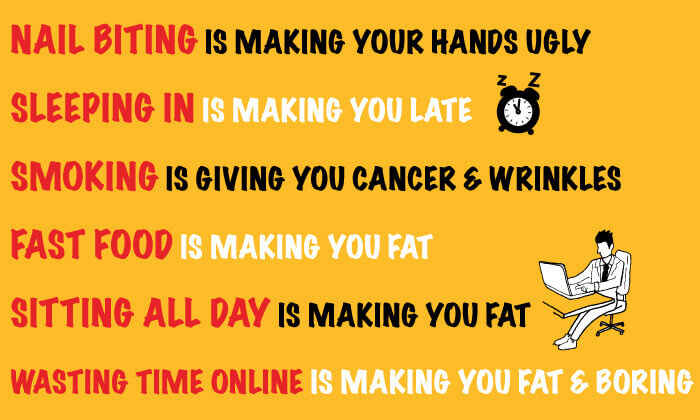
We all have bad habits that are ruining our lives…

bad-habits

So we invented Pavlok — the very first wearable device that helps you break bad habits at their source.

Pavlok uses proven psychological concepts to create a Pavlovian association (get it?) to the habit you want to break.

Simply put Pavlok on, download the app, and follow the five day program. For five days, do the habit you want to quit. Pavlok will administer an electric stimulus as you do the bad habit, and a vibration as you do good habits. 

The vibrations and electric stimuli create an association that trains your brain to stop liking the habit — in as little as five days. Your brain creates an aversion to the bad habits — and a liking for good ones.

For decades, this technology was only available in scientific labs — for a very high price.

But now, for the first time ever — you can get this technology, shipped directly to your door.

[/et_pb_text][et_pb_gallery _builder_version=”3.19.4″ gallery_ids=”52966,52971,52970,52969,52968,52967″ show_title_and_caption=”off” link_option_url=”https://wp.pavlok.com/products/pavlok-2″ link_option_url_new_window=”on” zoom_icon_color=”#2ea3f2″ hover_overlay_color=”rgba(255,255,255,0.9)” posts_number=”1″ show_pagination=”off” fullwidth=”on” max_width=”60%” /][et_pb_text _builder_version=”3.19.4″ background_size=”initial” background_position=”top_left” background_repeat=”repeat”]

 Click Here To Learn More About Pavlok

These are 173+ habits Pavlok will help you break:

  1. Swearing
  2. Trichotillomania
  3. Picking Your Nose
  4. Smoking Cigarettes
  5. Biting Fingernails
  6. Drinking Coffee
  7. Drinking Tea
  8. Hair picking
  9. Watching Reality Television
  10. Eating Fast Food
  11. Alcohol (if you think you may be an alcoholic, please get professional help)
  12. Emotional Shopping
  13. Spending On Credit Cards
  14. Facebook
  15. Twitter
  16. Reddit
  17. Eating Candy
  18. Eating White Sugar
  19. Eating Chocolate
  20. Drinking Soda/Pop
  21. Obsessively Checking iPhone/iPad
  22. Eating Meat
  23. Video Games
  24. Cracking Your Knuckles
  25. Speaking With Your Mouth Full
  26. Talking To Yourself
  27. Using Slang
  28. Eating Dairy
  29. Eating Gluten
  30. Picking Your Teeth In Public
  31. Forgetting To Shave
  32. Going To The Club
  33. Using Your Maiden Name

    Learn how to take control of your habits. Click Here.

  34. Humming To Yourself
  35. Excessive Salt
  36. All Work And No Play
  37. Chewing Gum
  38. Smoking eCigarettes
  39. Biting Your Pen
  40. Nibbling While Cooking
  41. Overspending
  42. Overeating
  43. Snacking
  44. Hair Picking
  45. Skin Picking
  46. Not Holding Eye Contact
  47. Interrupting Someone
  48. Sleeping-in
  49. Skipping The Gym
  50. Smoking
  51. Saying “Ummm” And “Ahhh”
  52. Porn Watching
  53. Staying Up Late
  54. Sleeping With Makeup
  55. Lying
  56. Overmedicating
  57. Playing Kingdom Rush
  58. Eating Too Fast / Not Chewing
  59. Skipping Breakfast
  60. Not Protecting Yourself From The Sun
  61. Not Moisturizing
  62. Not Flossing
  63. Not Brushing Your Teeth


    Learn how to take control of your habits. Click Here.

  64. Using Your Phone In Bed
  65. Negative Self Talk / Self Criticism
  66. Saying “Yes” To Everything
  67. Day Dreaming
  68. Procrastinating
  69. Using Devices At Night
  70. Spending Too Much Time Online
  71. Breaking Promises To Yourself
  72. Rambling
  73. Checking Your Hair / Eyebrows / Makeup / Nails
  74. Watching T.V Right After Work
  75. Repeating Yourself
  76. Forgetting What You’ve Told Someone
  77. Forgetting Names Of People You Meet
  78. Giving Away “Tells” In Poker
  79. Falling Asleep In Class
  80. Slouching At The Computer
  81. Slouching While Walking
  82. Masturbating
  83. Eating Past 8 P.M
  84. Letting Fear Stop You From Trying Something New
  85. Telling Secrets
  86. Talking In Class
  87. Gaming In Class
  88. Online Surfing In Class
  89. Losing Focus
  90. Sitting Too Close To The T.V
  91. Eating Cookies Every Damn Day
  92. Arranging Instead of Cleaning
  93. Picking Fights


    Learn how to take control of your habits. Click Here.

  94. Being Unfriendly
  95. Leaving Your Wallet / Keys In Random Places
  96. Skipping Class
  97. Skipping Work
  98. Not Doing Your Homework
  99. Drinking Energy Drinks
  100. Pinching Pennies
  101. Spitting
  102. Horking
  103. Licking Your Lips
  104. Drinking From The Carton
  105. Leaving The Fridge Open
  106. Leaving The Heat On When You Go Out
  107. Skipping Meals
  108. YouTube
  109. Not Showering
  110. Yelling At Your BF/GF
  111. Talking About Your Sister Behind Her Back
  112. Picking Scabs
  113. Popping Zits
  114. Losing Your Temper
  115. Complaining
  116. Annoying People On Purpose
  117. Being Overly Critical
  118. Being Argumentative
  119. Putting Dishes In Sink And Not Washing Them
  120. Quora
  121. Biting Your Lips
  122. Scratching An Itch
  123. Being An Attention Hog 


  124. Opening Countless Tabs
  125. Buzz-friggin’-feed
  126. Trolling Comments
  127. Watching Seinfeld Reruns
  128. Binge Watching Netflix
  129. Emotional Eating
  130. Fiddling With Your Hair
  131. Poor Hygiene
  132. Fiddling With Keys
  133. Cheek Biting
  134. Chewing On Your Hair
  135. Shoplifting
  136. m&m’s
  137. Pocari Sweat From Japan (seriously, if you drink this for 2 or 3 days your body will crave it instead of water)
  138. Hair Pulling
  139. Scratching / Itching
  140. Biting Your Disgusting Toe Nails
  141. Eating When You Are Bored
  142. Hoarding
  143. Being A Know-It-All
  144. Bragging
  145. Chewing Tobacco
  146. Chewing With Mouth Open
  147. Being Late
  148. Eavesdropping
  149. Exaggerating
  150. Excessive Throat Clearing
  151. Fidgeting
  152. Flaking Out
  153. Freeloading


    Learn how to take control of your habits. Click Here.

  154. Gambling
  155. Grinding Your Teeth
  156. Kissing & Telling
  157. Littering (really, stop littering)
  158. Monopolizing A Conversation
  159. Name Dropping
  160. One-Upping
  161. Pencil Chewing
  162. Popping Gum
  163. Speeding
  164. Talking During Movies
  165. Tapping Fingers/Pens/Etc.
  166. Thumb Sucking
  167. Whining
  168. Borrowing And Not Returning Items
  169. Belching
  170. Loitering
  171. Bullying People
  172. Copying
  173. Gossiping
  174. Finishing People’s Sentences
  175. Leaving The Toilet Seat Up
  176. Licking Your Fingers

P.S: Pavlok will never judge you. Some habits are objectively bad, e.g., smoking kills you. Other habits like “sleeping in” depend on context, like if it’s making you late for work. And still other habits aren’t really either good or bad, it’s just personal preference. Also, if you have a condition that puts you or anyone at risk of serious harm you must see a medical professional immediately and you can ask your doctor if Pavlok is right for you.

[/et_pb_text][/et_pb_column][/et_pb_row][/et_pb_section]

Why Willpower and Motivation Aren’t Enough

Think about the last time you failed when trying to form a new habit. Did you blame failure on willpower? Do you think you need more willpower to be successful?

If so, you’ve got it partly wrong.

Yes, willpower is important. Clearly we need willpower to follow the courses of action we set for ourselves. Yet, willpower alone is not sufficient to get us to form those habits. According to psychologist Roy Baumeister, willpower is like a muscle and it can be depleted from doing tasks that require the control of impulses.

This is why habits can’t be formed from brute force alone. You’ll fail if your method relies solely on your willpower. You’re human, and sooner or later, you’ll have a day where you’re feeling tired and lacking in energy.

The same goes for motivation — it also is important, but definitely not enough on it’s own.

You need to have a reason for your habit change, but more importantly, you need to keep that reason in mind. Not just the cue, and reward, but the big-picture goal that you can receive from having changed your habit. However, motivation will not get you out of bed at 5 in the morning so that you can meditate, neither will willpower. What will help you is a mindset and systems. You need to have developed a proper framework to deal with these situations.

You’re a creature of habit. Embrace your inner animal and automate your life.