Click here to hear a very special announcement from yours truly!
Maneesh Sethi here.
CEO of Pavlok.
After many months of hard work, and a wildly successful Pavlok 2 Indiegogo fundraising campaign, we’re excited to finally announce that the entire community can now pre-order the Pavlok 2 and get the Pavlok 2 in time for the holiday season.
Since the release of the original Pavlok, we were blown away at the results users were seeing, sometimes in as little as a few days. Users stopped smoking, quit sugar, and even used Pavlok to wake up on time and be more productive.
But we have always known the Pavlok was just the beginning of our journey. With the Pavlok 2 we have improved virtually every aspect of the original Pavlok. Better hardware, software, and a completely redesigned Pavlok app.
I wanted to share a few key differences between the Pavlok and the Pavlok 2.
Better Battery Life: The new hardware for the Pavlok 2 means less charging and more breaking and changing habits. Wear your Pavlok 2 comfortably throughout the day knowing it will be ready to shock, beep, or buzz when you need it.
New Integrations: We continue to add integrations from a wide variety of 3rd party sources to allow you to customize your Pavlok 2 to the fullest. Using services such as IFTTT you can even have your Amazon Alexa initiate a zap. Furthermore, there are dozens of other integrations with Google Chrome, Zapier, and more.
More Reliable: We heard you loud and clear, the Pavlok 2 works flawlessly time and time again. No more bluetooth pairing errors or the zap not working. We’ve used the best quality material to ensure your Pavlok 2 works every time.
Motion Tracking: Thanks to our DNA Indiegogo backers, the Pavlok 2 is smarter than ever before. We are constantly adding new hand gestures that the Pavlok 2 can accurately recognize and administer your action of choice.
A More User Friendly App: With the new Pavlok 2 hardware we also wanted to improve our popular Pavlok app. We’ve redesigned it to make it more user friendly and easily track your your habits and goals. Add modules based on your goals, and track your sleep, progress, and more.
Earn Volts: Finally, one of our favorite newest additions. Along with Pavlok 2 we are releasing our very own digital currency: Volts. You can earn Volts in the app by performing positive behaviors and reaching your goals. Wanna learn more? Look out for the next email this week.
We’re not exaggerating when we say the Pavlok 2 is not just an upgrade of the original Pavlok. It’s a whole new way to approach human behavior.
We expect these to sell like crazy this Christmas and we have a very limited supply. Only 500 Pavlok 2s are available that will ship on our launch date: November 15.
If you want to reserve your Pavlok 2, preorder NOW to get 20% off. This expires in a week.
Imagine starting the new year not just resolving to go to the gym—but actually following through.
Imagine telling all your friends and family at the New Years party you no longer smoke. And still being smoke-free at the next one.
Imagine getting more work done without the need to constantly check Facebook. The rare feeling of focus becomes a natural state of being.
Pavlok 2 was designed to upgrade your habits and your life.
As I’ve said time and time again, one of my favorite things about building Pavlok is hearing about the incredible results many members of the Pavlok community have seen in their lives after using Pavlok.
And while we’ve shared these stories via our #MotivationMonday emails for the last year, the Pavlok team and I decided we wanted to dig deeper and share these stories in an ‘interview’ format.
Over the last few months our start interviewer Alex has set out to have conversations with Pavlok users who have used Pavlok to help them in a wide range of ways.
Some have used Pavlok to quit smoking. Others have used Pavlok to start waking up on time.
Our goal with these interviews is to give you an inside look at the journey of transformation – the ups and downs, the good and the bad.
Change takes time. It takes hard work. Sometimes it’s painful. But with the right approach and support system, things can and do get better.
In our interview, today with sit down with Pavlok community member Alli Bogdan who shares her incredible journey of overcoming years of abuse with the help of Pavlok.
Alli’s story does end on an extraordinary positive note. However the topic matter does cover abuse, so please use your best judgement when watching.
We are honored that Alli felt comfortable sharing her story with the Pavlok community, and hope it motivates and inspires those who need it most.
Watch the video to hear Alli’s incredible story of how she overcame years of abuse through emotional healing.
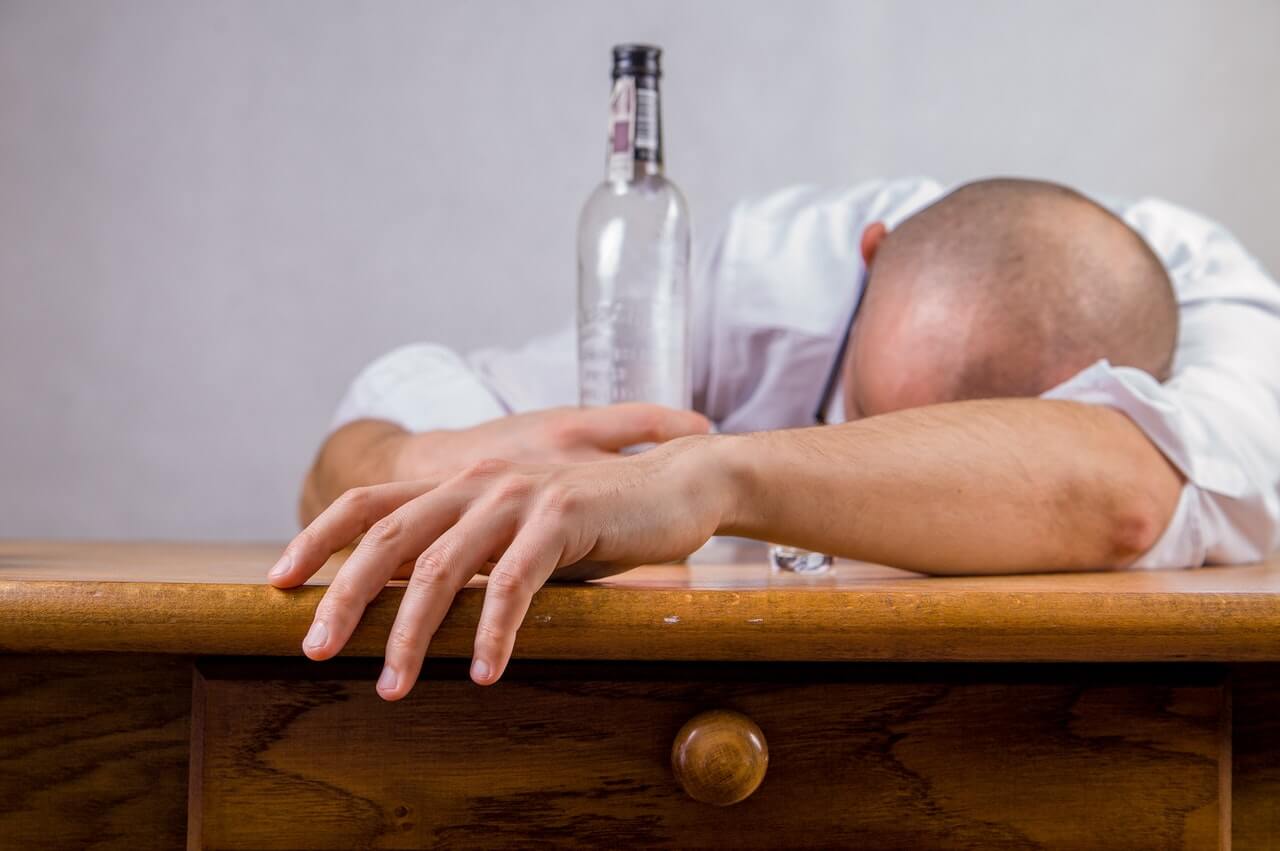
Drinking should be defined as the amount of alcohol consumed of alcohol. According to the National Institute on Alcohol Abuse and Alcoholism there are two separate levels of alcohol consumption. All of which can be dangerous, but obviously the more alcohol consumed the more you put yourself and others at risk of injury and even death.
Moderate levels of alcohol consumption is the lowest level. In its definition It includes 1 drink per day for women and 2 drinks per day for men.
The final level of alcohol use is “Heavy Alcohol use”. It has been defined as binge drinking for 5 or more days days in the past month. Binge drinking is consuming enough alcohol to reach or surpass a blood alcohol content of .08 or higher.
It should be noted that the criterion of “one drink” changes dependent on the % of alcohol in that drink. For beer, a 12 fl oz at 5 % alcohol is consider 1 drink; Wine, 5 fl oz at 12%, is 1 drink; Liquor, 1.5 fl oz at 40% alcohol (80 proof). It is estimated that 1 fl oz can take an hour to metabolize.
What is the problem?
According to the National Council on Alcoholism and Drug Dependence, Inc alcohol is the most used addictive substance in the United States. With one in twelve Americans suffering from alcohol abuse or dependency, it is a dangerous but popular drug. Alcohol abuse does not only affect the person who uses alcohol, it also adversely affects the spouse, children, and coworkers.
Identification of risk of developing Alcohol Use Disorder (AUD) for women is having three or less drinks a day and not drinking every day of the week. For men it increased to four drinks a day and 14 drinks per week. The good news is that even if you meet this criteria only 1 out of 50 actually develop/have AUD. In other words, many “casual drinkers” already show risks of developing AUD, but only 2% actually are diagnosed.
Had times when you ended up drinking more, or longer, than you intended?
More than once wanted to cut down or stop drinking, or tried to, but couldn’t?
Spent a lot of time drinking? Or being sick or getting over other aftereffects?
Wanted a drink so badly you couldn’t think of anything else?
Found that drinking—or being sick from drinking—often interfered with taking care of your home or family? Or caused job troubles? Or school problems?
Continued to drink even though it was causing trouble with your family or friends?
Given up or cut back on activities that were important or interesting to you, or gave you pleasure, in order to drink?
More than once gotten into situations while or after drinking that increased your chances of getting hurt (such as driving, swimming, using machinery, walking in a dangerous area, or having unsafe sex)?
Continued to drink even though it was making you feel depressed or anxious or adding to another health problem? Or after having had a memory blackout?
Had to drink much more than you once did to get the effect you want? Or found that your usual number of drinks had much less effect than before?
Found that when the effects of alcohol were wearing off, you had withdrawal symptoms, such as trouble sleeping, shakiness, restlessness, nausea, sweating, a racing heart, or a seizure? Or sensed things that were not there?
Basic Facts (Population, demographics, facts.)
It is estimated that there are 88,000 deaths a year due to alcohol, and it is the third leading cause of death in the nation. Alcohol affects men and women differently: it takes women longer to metabolize it; however, alcohol abuse is more common in men than in women. In the world, over 2 billion people drink alcohol, and around 75 million people are affected by alcohol-related disorders.
Although not all alcohol use leads to addiction or dependency, alcohol has been the only drug banned as an amendment via the 18th amendment only to be repealed in the 21st.
Effects
According to drugabuse.com short term effects of alcohol may include some positive symptoms such as mild euphoria, mood enhancement, lowered anxiety, marked sedation. It should also be noted the negative short-term consequences such as impaired vision, delayed reaction time, confusion, vomiting, blackouts, loss of bladder control.
Long-term consequences may include cancer, hepatitis, scarring of the liver, and increased blood pressure which could lead to heart problems. Financially it takes a toll too.
According to a 2000 report on alcohol, the cost estimate for alcohol abuse was over 184 trillion dollars in 1998, which was up from a 1992 estimate of 148 trillion. These include the cost of loss of an individual, services such as counseling, criminal justice, and medical consequences.
How Alcohol Affects your Brain and Body
Habit Analysis and Common Triggers
To best analyze a habit we first must devise it up into three parts. The trigger, or what is evoking or eliciting the habit, the habit itself, and the rewards granted by that habit.
Triggers for alcohol consumption vary and can be very subtle. Here are some to consider:
Friends invitation to a bar
A sign on at a bar
Being in a setting that sells liquor
Lack of alternatives in the evening
Holidays such as St. Patrick’s Day, the day before Thanksgiving, and birthdays
Free samples offered at stores
Deals and specials
An abundance of time waiting (airports, casinos, hotels)
Social events
Sporting events (Football game, Bowling, Darts)
Like triggers the form of habits may vary from case to case. It is important to note which behaviors are “acceptable” and which should be avoided. For example many consider drinking at a bar is acceptable; however, drinking on the job may be less than satisfactory. Of course many of these depends on the individual circumstance. Each may mold both a different trigger and reward.
With friends at a bar
Alone at a bar
Drinking at home
Concealed drinking on the job
Drinking and driving
Binge drinking
Taking shots
Drinking Wine
Drinking Beer
Drinking games such a beer pong, flip cup, and others which speed of consumption matter.
Although rewards and reinforcers differ conceptually, the following should be considered more like reinforcers as they are likely to be maintaining habit. They may not be considered as rewards to general society.
Social praise (Chug! Chug! Chug!)
Social bonding as a chance to meet new people
The “buzz” feeling of alcohol
Passing out
The escape of a less desirable situation
“Liquid confidence”
The taste
A marker of celebration such as holidays, end of a work week, and a completion of a task
Inclusion in a participation in a cultural event
Access to other things such as pool, darts, food
After analyzing a habit cycle we then know the best place to manipulate one of the three variables. By doing this we may encounter more than one trigger, habit pattern, or reward type that controls the drinking behavior. We should choose one habit to change first and work our way towards others.
It may be easiest to manipulate the trigger variable in many of these cases as we can change many things before the trigger occurs to break the habit. More on this later.
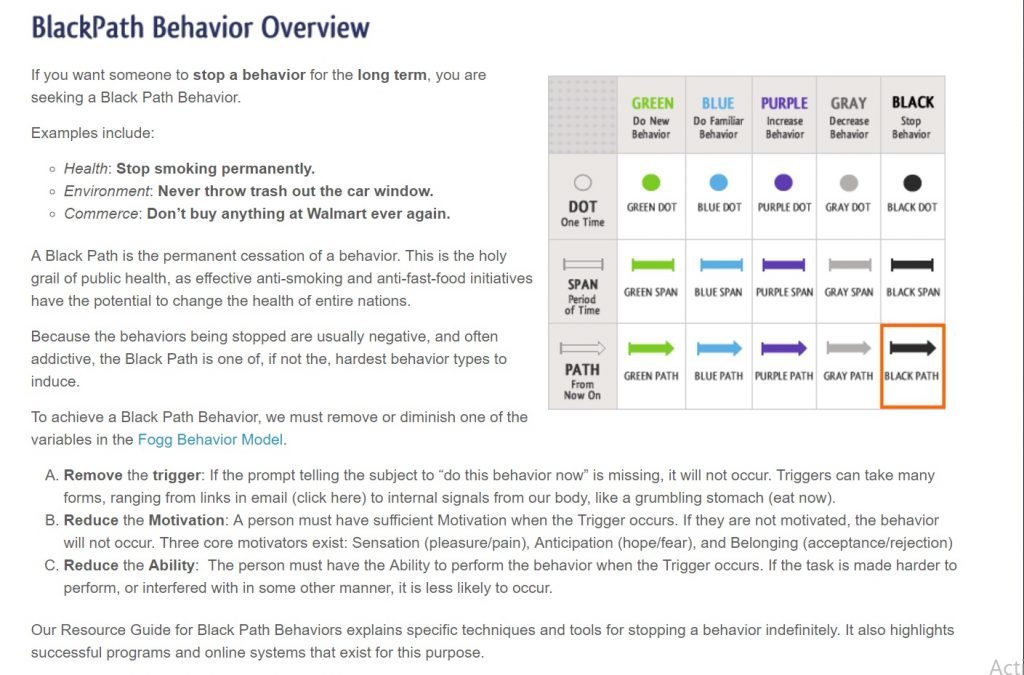
As mentioned above to change a habit we must alter the habit cycle. The usual goal of treatment in alcohol is usually abstinence, in other words completely removing alcohol consumption. This can be done in three different ways: by removing the trigger (the trigger), reducing the motivation (the reward), or by reducing the ability to perform the habit.
Stopping the Habit for Good
Possible triggers for alcohol consumption as discussed above include most bars and restaurants which serve alcohol. Many sporting events serve alcohol, and it is popular to consume alcohol while watching a sporting event. Some peers could also serve as a trigger as in many settings drinking is a social event. To accomplish the elimination of alcohol consumption it may be suggested to remove these triggers. One could simply avoid any place which serves alcohol, which may be a difficult challenge. The other solution is to find similar triggers that do not yield the same consequence, such as drinking alcohol free beer and sparkling champagne.
Rewards for alcohol varies from person to person: the buzz feeling, the excitement of events that are paired with alcohol consumption, and the feeling of belonging with your peers who are also drinking all may function. It is suggested to try to reduce these motivation. Possibly by finding alternative sources that fulfill that same level of motivation. Find alternative activities that can be done without alcohol, locate different peer. More specifically one could join a club that meets up at the same time you would normally drink.
An alternative view is that alcohol consumption may not be due to a reward, but rather as a way to gain distance from something aversive. If a bar is the only place to get away from a nagging spouse or daily responsibility, the environment may be perfect to establish a dependency on alcohol. One report may describe it best as an escape from reality.
Reducing the Habit
If your goal is to decrease alcohol consumption, we still need to examine the habit cycle. Instead of blocking the ability to drink, if one would like to just decrease the behavior, we may reduce the ability to drink. This could mean purchasing less alcohol, limiting the nights of the week you goes, and drinking only drinks with less alcohol content. Here it would be helpful to have clear goals: a specific number of days you may consume alcohol, how much money you can spend, or the amount you can assume.
Which one of these is not a specific goal?
A. I want to drink only 1 day a week
B. I want drink less
C. I want to spend $10 or less on alcohol this week
D. Drinking is bad, I only want to drink after work on Friday
B is correct. Drinking less is not specific. We need to know how much.
To replace rewards rather than simply to reduce, we can associate drinking with an aversive stimulus such as pain, fear, or rejection. In this approach we drink, but may pay for it. This can be with money, electrical shock, or with the loss of something pleasurable.
Treatment
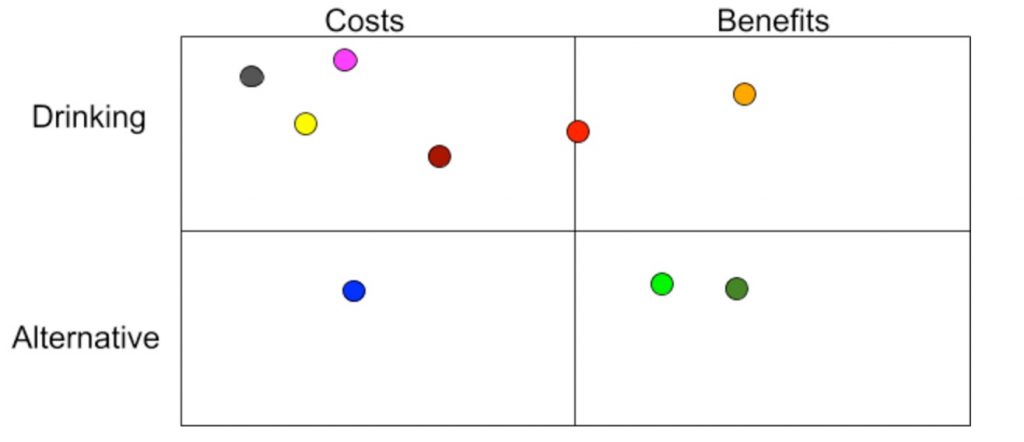
To best analyze treatment solution we may use a Cost and Benefit Matrix featured below. The boxes here are not an exhausted. Any intervention, independent of success can fit into these boxes to be analyzed. There are four ways of reducing the drinking behavior:
Increase the cost of drinking
Decrease the benefits of drinking
Decrease the cost of alternatives
Increase the benefits of the alternative
Cost and Benefit Matrix of Consuming Alcohol Compared to Alternatives
Cost
Benefits
Drinking
(1.) $, Hangover, Cancer,…
(2.)Buzz, Social, Escape,…
Alternative
(3.)
(4.)
Most interventions aim at intervening at only the first two levels by manipulating the effects of drinking. Here are some examples:
Going to AA – (1.) Drinking results in the loss of tokens and social acceptances
Antabus drug (1. ) Drinking now makes you nauseous
Naltrexone and other drugs (2 Orange.) Drinking now loses it’s appeal
DWI (1&2) A penalty for drinking and now blocked from going places
Removal of all alcohol from home (1 Yellow.) It is now harder to get alcohol
Acceptance and Commitment Therapy (ACT) (1.Pink ) increases the costs of drinking by paying for therapy
Free/movie nights (3.) Gives a cheap alternative to accomplish
Marriage Counseling (4.) May save failing marriage.
How the Pavlok Can Help
The Pavlok is programmed to track your behavior. With the If This Then That (IFTTT) app a beep, vibration, or shock can be sent directly to the Pavlok when you are close to any programmed location. This means a user of the Pavlok can simply type the address of their local bar and if they approach this site, a stimulus will be administered.
If you already own a Pavlok and want to set up the location feature with IFTTT click here https://ifttt.com/login to set up account and follow these steps.
Click My Applets
Click “+This”
Type “Location”
Click location and choose one of the three options
Pick the location by typing in the address
Press “Create Trigger”
Press +that
Type “Pavlok” in the search
Choose one of the four options “zap”
Set strength (low, medium, high)
Click “Create action”
Click “Finish”
Sources And Resources
Dickter, C.L., Forestell, C.A., Hammett, P.J. et al. Psychopharmacology (2014) 231: 2031. doi:10.1007/s00213-013-3348-6
Survey that when answered, refreshes with bj fogg image ????
A startup CTO, startup consultant, father, husband, and homeowner… There are a lot of things demanding my time. Employees, clients, writing code, exercising, family time and more. It all adds up.
As business keeps growing, the one thing that’s consistently been falling by the wayside is my writing. And that kind of sucks.
I like writing. It helps clear my head.
It keeps me mindful of different aspects of my different businesses, and I find it generally boosts my productivity for whatever reason. Plus, it helps boost my consulting business and builds up my tribe.
It’s important, and I have to make the time for it consistently.
I’ve already used my Pavlok to create an extra hour or so in my day by helping me actually wake up early. It also reminds me every day to switch to my standing desk — helping me stay a bit more active.
But how can it remind you to write?
It’s a technically challenging thing to do. There’s no physical gesture that makes writing at a MacBook look differently from screwing around on Facebook.
It’s not easy to know when I don’t do something every day unless I physically check in saying I did it, and that’s not my style. It’s another task to do in an already stacked day.
So how can we make this work? How can I shock myself into writing every day without actually doing some boring admin work every day?
After some trial and error, I’ve found the solution.
Before the system is revealed, let me explain how I write as it may be different from how you write.
First off, I use Pages on my MacBook.
I don’t really like Google Docs to write since it’s in the browser, and that can lead to distraction. Yes, I’m aware that I can blacklist sites when I go to write, but again, more admin work than I’d like to deal with. Pages works for me.
Second, I use Dropbox to store it and share it with the team that will help edit and share everything to the world on my blog, my Entrepreneur column, or anywhere else. Yes, I realize that I can use Google Docs for this, and I personally don’t want to. See above.
With that 2 step approach, I can write anywhere at any time without any excuses. As soon as I get some internet and my Dropbox syncs up, it’ll check in with my system and not shock me.
Here’s how to do it.
Keep A Record Of All Writing With IFTTT And Google Sheets
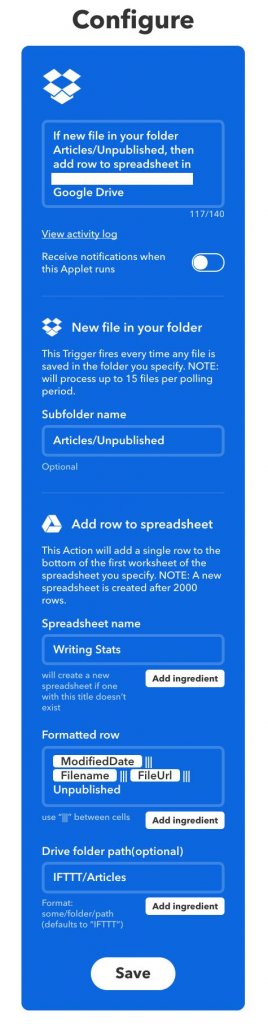
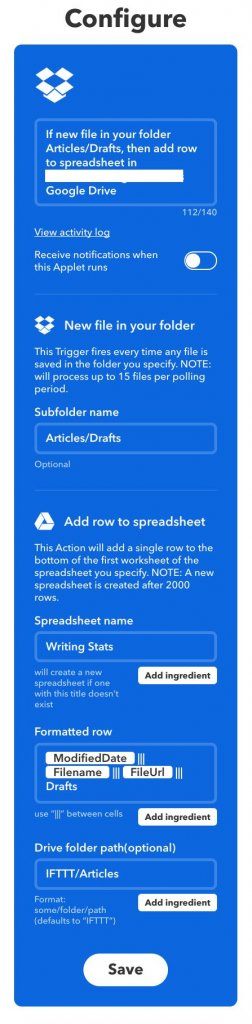
Since I put my articles into Dropbox, I can use IFTTT to write a row to a spreadsheet on Google Sheets. It’s essentially a log book that updates every time a new file is created in one of my writing folders.
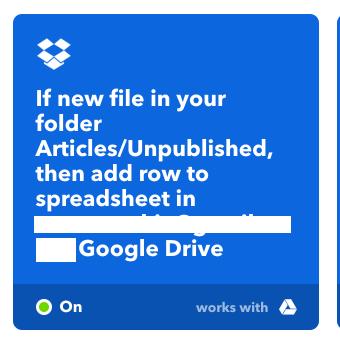
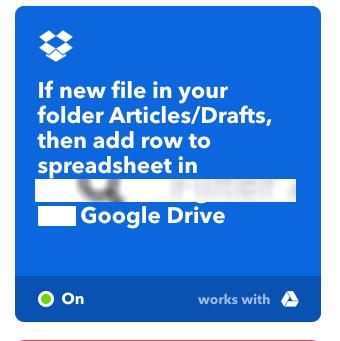
There are two specific folders that I care about: Drafts (everything I’m working on that’s unfinished) and Unpublished (all finished work that needs to be published somewhere.) If a new file shows up anywhere in these folders, it means I did some writing for the day. Log it in Google Sheets.
(Here’s my unpublished trigger.)
(And the detail.)
(Here’s my drafts trigger.)
(And the detail.)
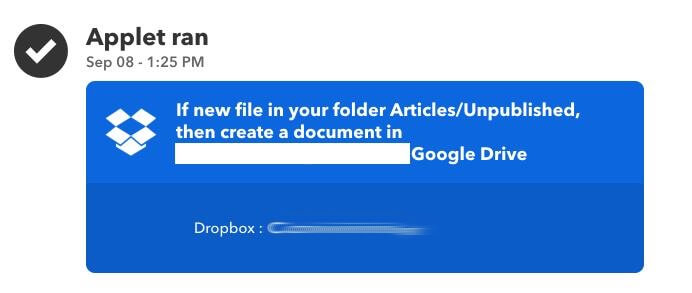
(Here’s IFTTT running to create the sheet)
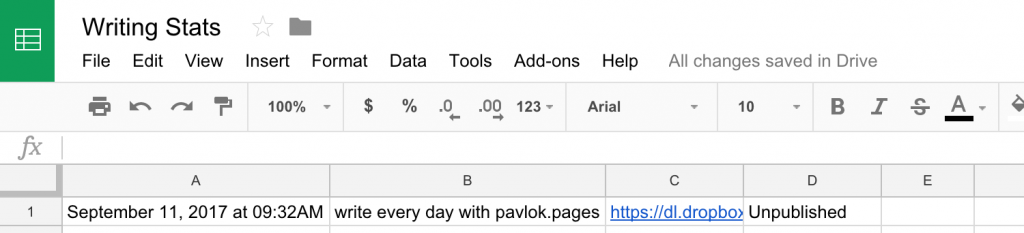
(Here’s what the sheet looks like. 100% created and maintained by IFTTT)
NOTE: For this to work, there has to be at least one row in the sheet. It won’t work without a row to check, so add one in manually if you want it to start on day 1.
2. Alert Me If There Wasn’t An Update For Today Using Google Scripts
This is a fairly straight forward process: Check the latest row every day and send me an email if there was no new row added. That means I didn’t write.
My goal is to write every weekday by 4 pm EST, so that’s when I check.
For this part, you need to use Google Scripts on the sheet.
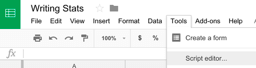
(Here’s how to get to the script editor)
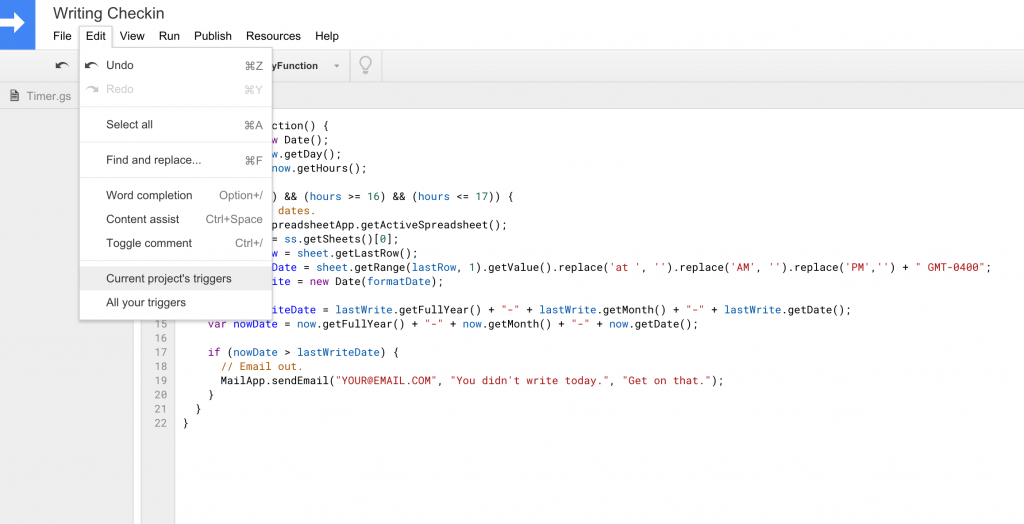
You have a script that checks the last row of the sheet and looks at the day. If that date isn’t today’s date, it means you didn’t write today. In that case, it sends an email.
function myFunction() { var now = new Date(); var day = now.getDay(); var hours = now.getHours();
if ((day < 6) && (hours >= 16) && (hours <= 17)) { // Get the dates. var ss = SpreadsheetApp.getActiveSpreadsheet(); var sheet = ss.getSheets()[0]; var lastRow = sheet.getLastRow(); var formatDate = sheet.getRange(lastRow, 1).getValue().replace(‘at ‘, ”).replace(‘AM’, ”).replace(‘PM’,”) + ” GMT-0400″; var lastWrite = new Date(formatDate);
if (nowDate > lastWriteDate) { // Email out. MailApp.sendEmail(“YOUR@EMAIL.COM”, “You didn’t write today.”, “Get on that.”); } } }
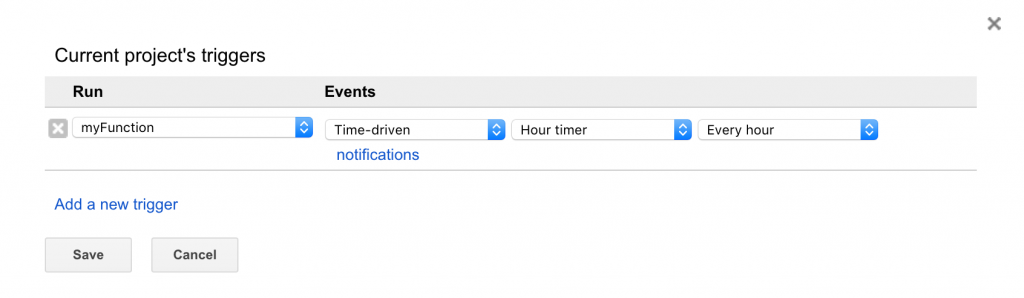
For this part to work, you have to schedule it to run. I have it running every weekday between 4 pm and 5 pm, so it will zap me at the end of the day if I forgot to write.
(This is how you create the trigger.)
(This is what you set the trigger to.)
3. Zap If I Didn’t Write Today
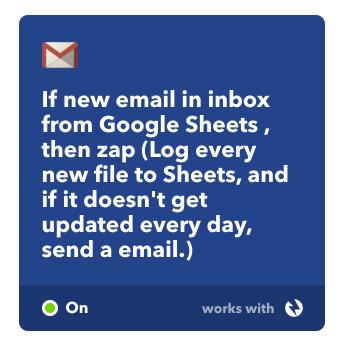
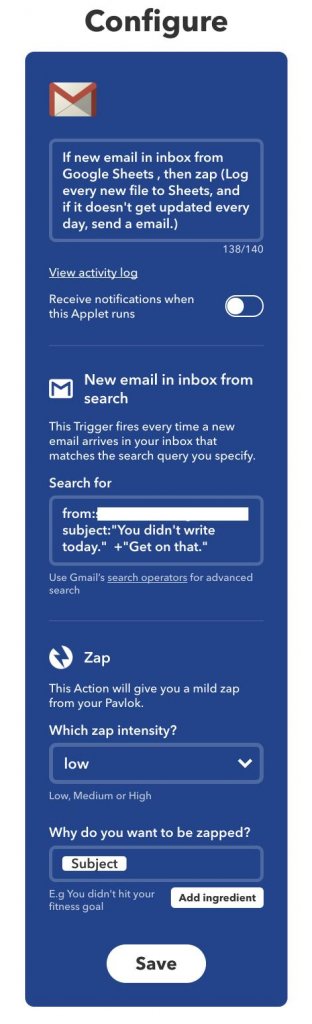
The last step is to get back into IFTTT with a script that checks for that “You didn’t write today…” email and use it as a trigger for Pavlok to zap.
(Here’s my Pavlok trigger.)
(And the detail.)
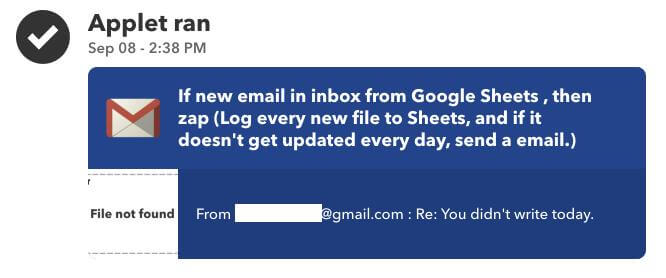
(Here’s IFTTT triggering a zap.)
And that, my friend, is how I’m forcing myself to write. After a few 70% shocks to the wrist, this will be yet another positive habit that sticks.
This can be used for more than traditional writing too.
Want to write code every day? Sync up a folder that stores your code.
Want to post on Instagram every day? Use Instagram posts to log to Sheets instead of Dropbox.
Want to work out every day? Use your chosen fitness tracker to log to Sheets instead of Dropbox.
I can think of about a hundred others. You’re only limited by your imagination and desire to build a new habit.
It might seem like a lot of steps to go through to make sure I write consistently, but if you think about the one-time setup cost vs. the ongoing benefits of building such a productive habit, it’s a no-brainer.
Want to make writing a habit? Get your Pavlok today.
It’s no secret that having a good morning routine is one of the best things you can do to get your day started off right.
Instead of hitting snooze and reacting to your day, incorporating just a few tweaks to your morning ritual can make all the difference.
Regardless of whether you consider yourself a morning person these 7 habits will get your day started off on the right foot.
Wake up 30 minutes early
[bctt tweet=”No. You don’t have to wake up at 4:45 to have an awesome morning.” username=”pavlok”]
Stop feeling guilty about not jumping out of bed before the break of dawn. Instead, aim to give yourself just 30 minutes of extra time to get moving.
30 minutes is just enough time to give yourself time to wake up and not feel rushed throughout your morning while not sacrificing the amount of sleep you get.
Use the extra 30 minutes however you like. Heart a few Instagram photos. Watch the lady with the Chewbacca mask. Or get started on some of the habits below — guilt free.
Make Your Bed (3 minutes)
It may sound silly, but making my bed each morning has been one of the best additions to my morning routine this year. Starting your day by making your bed is perfect “small win” to give you a quick boost of momentum and get your mind in the right place to tackle the day.
For one, making your bed is something you can control, and feeling in control is one of the best ways to improve both your confidence and overall well being.There’s something that feels inherently good about having a made bed before you walk out the door. It’s also a nice way to return home after a long day at work.
Floss One Tooth (1 minute)
This is something Stanford professor and habit extraordinaireBJ Fogg teaches. Before coming across the floss one tooth concept I had always struggled to floss consistently despite knowing the clear health benefits.
After you brush your teeth, you commit to flossing just ONE tooth — which takes less than a few seconds. If you floss one tooth you are successful. Of course, to get the benefits of flossing you’ll want to floss all your teeth eventually, but building the habit of flossing is far more important in the long term.
Some days you’ll get “lazy” and floss one tooth and that’s perfectly ok. Eventually after doing one tooth for consecutive days you’ll work your way to adding another tooth. Because you’re already in motion you’re literally tricking your brain into building good habits.
Our brains are funny aren’t they?
If you’ve struggled to make flossing a regular habit give this a try. Trust me.
Get Up And Move (5 minutes)
I like to spend a few minutes moving my body after making my bed. Sometimes I like do pushups. Other times I’ll do a quick 7 minute workout. In the spirt of small wins, moving your body even just for a few minutes helps you start your day off on the right track.
Not only does moving help you wake up, it gets the blood flowing to your muscles and brain.
Plan Your Day (5 minutes)
Stop reacting to your day and take a few minutes to plan your game of attack. Open up your calendar. Take note of what’s on your agenda. Give your mind a general idea of what to expect. Is today packed with meetings? Perhaps you should leave for work a few minutes early. Lunch with coworkers? Perhaps you should skip the usual Starbucks frap.
Once you have an overview of your day, jot down 2-3 of your most important tasks for the day. I like to to put my 2-3 tasks on a blank index card.
Your goal should be to complete your 2-3 MIT’s (most important items) each day. If you can do that, you’ll have had a “successful” day.
Of course life happens, but taking a few moments to clarify your focus will significantly increase your chances of having a genuinely productive day.
Take A Cold Shower (5 minutes)
Taking a cold shower certainly isn’t for everyone, but I can say for certain when I’ve taken cold showers consistently my productivity and overall happiness levels have skyrocketed.
I typically like to commit to 30-60 days of cold showers when ever I want to step up my game.I use the app Cold Shower Therapy (CST) by my friend Joel Runyon to help keep track of my cold showers and gamify the process.
While I can’t attest to the many claimed “health” benefits of taking cold showers, my personal experience and those at Pavlok has proven them to be accurate.
[bctt tweet=”Nothing says “wake up” like standing under a stream of freezing cold water.” username=”pavlok”]
Meditate (3 Minutes)
Since the beginning of 2016 I’ve made it a priority to meditate on a consistent basis and couldn’t be happier that I did. Without a doubt, it has been one of the best things I’ve done (aside from quitting smoking.
The other day, I started a fascinating discussion on my Facebook page about online”hate” and whether haters should be confronted.
As one can expect, everyone and I do mean everyone, had an opinion.
It was one of my most commented on Facebook statuses to date.
The suggestions were mixed, to say the least.
“Ignore them!”
“Put them on blast!”
“Don’t waste your time.”
“They deserve to have their eyes burn under the sight of the eclipse. And then be eaten by Daenerys’ dragons.”
How interesting.
It’s no secret, as a very public CEO who had a less than ideal Shark Tank experience, myself and my team are constantly on the receiving end up some pretty brutal hate.
While 99.9% of the hate directed towards myself and Pavlok is quite funny, some of it can sting.
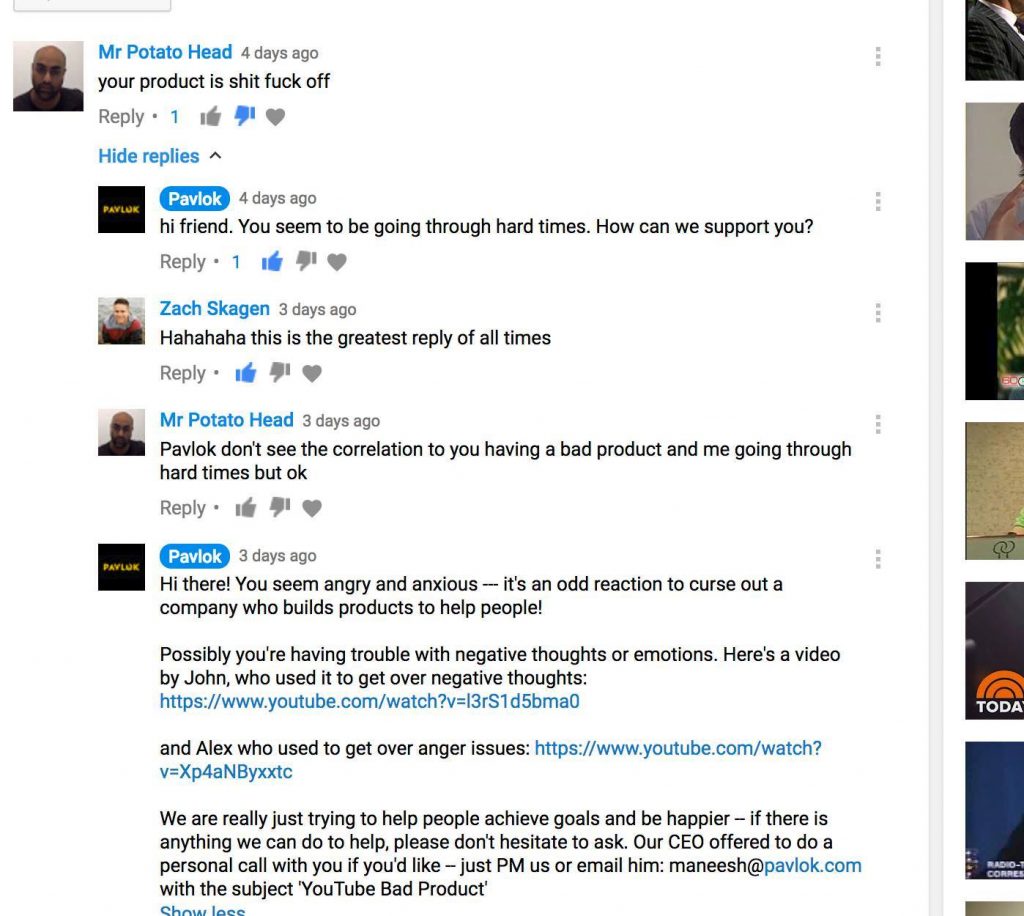
For example, this guy called me a scamming potato head.
🙁
I’m certainly not the only one who is on the receiving end of hate.
Perhaps you can relate.
Maybe your friends give you a hard time about wanting to lose weight.
Or your buddies have a cigarette in front of you just to taunt you.
Or your aunt replies “why even bother” when you share your most ‘ambitious’ goals.
The truth is, there’s always going to be the naysayers and the people who want to see you fail.
And I’ll admit, on days when things aren’t going so well… seeing all that hate can take its toll.
But….
My mission with Pavlok is to change how the world sees addiction — which is no easy feat. Just as losing 10 lbs, or quitting nail-biting, is no walk in the park, making change that matters takes both time and courage.
So yes, confront your haters if it makes you feel better. Or walk away if you prefer.
But don’t let the haters prevent you from becoming the best version of yourself. Push through the noise and lose those 10 lbs. Have your very last cigarette.
The internet might be home to all the haters, but the community of Pavlok is full of thousands of people all around the world working on being the best they can be.
Let the haters hate, while you continue improving yourself and the world.
It’s the only way.
-Maneesh Sethi
CEO of Pavlok
P.S I don’t see my haters with twobest selling products on Amazon.
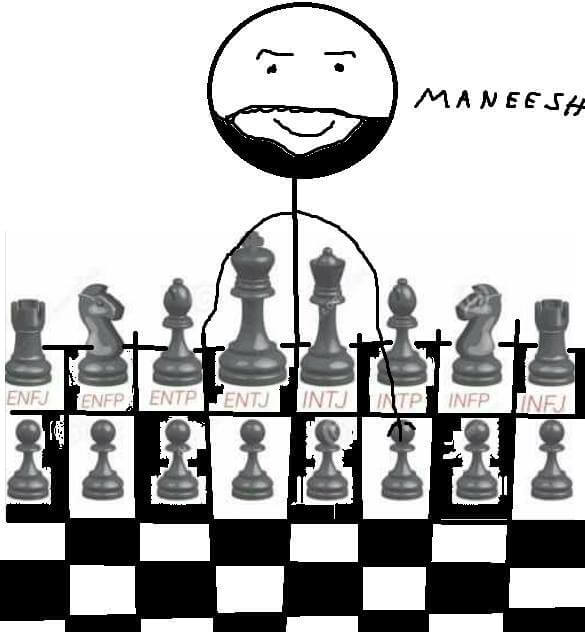
To my haters… you keep hating, while I keep playing chess.