We all have bad habits that are ruining our lives…
So we invented Pavlok — the very first wearable device that helps you break bad habits at their source.
Pavlok uses proven psychological concepts to create a Pavlovian association (get it?) to the habit you want to break.
Simply put Pavlok on, download the app, and follow the five day program. For five days, do the habit you want to quit. Pavlok will administer an electric stimulus as you do the bad habit, and a vibration as you do good habits.
The vibrations and electric stimuli create an association that trains your brain to stop liking the habit — in as little as five days. Your brain creates an aversion to the bad habits — and a liking for good ones.
For decades, this technology was only available in scientific labs — for a very high price.
But now, for the first time ever — you can get this technology, shipped directly to your door.
[/et_pb_text][et_pb_gallery _builder_version=”3.19.4″ gallery_ids=”52966,52971,52970,52969,52968,52967″ show_title_and_caption=”off” link_option_url=”https://wp.pavlok.com/products/pavlok-2″ link_option_url_new_window=”on” zoom_icon_color=”#2ea3f2″ hover_overlay_color=”rgba(255,255,255,0.9)” posts_number=”1″ show_pagination=”off” fullwidth=”on” max_width=”60%” /][et_pb_text _builder_version=”3.19.4″ background_size=”initial” background_position=”top_left” background_repeat=”repeat”]Click Here To Learn More About Pavlok
These are 173+ habits Pavlok will help you break:
- Swearing
- Trichotillomania
- Picking Your Nose
- Smoking Cigarettes
- Biting Fingernails
- Drinking Coffee
- Drinking Tea
- Hair picking
- Watching Reality Television
- Eating Fast Food
- Alcohol (if you think you may be an alcoholic, please get professional help)
- Emotional Shopping
- Spending On Credit Cards
- Eating Candy
- Eating White Sugar
- Eating Chocolate
- Drinking Soda/Pop
- Obsessively Checking iPhone/iPad
- Eating Meat
- Video Games
- Cracking Your Knuckles
- Speaking With Your Mouth Full
- Talking To Yourself
- Using Slang
- Eating Dairy
- Eating Gluten
- Picking Your Teeth In Public
- Forgetting To Shave
- Going To The Club
-
Using Your Maiden Name
Learn how to take control of your habits. Click Here. - Humming To Yourself
- Excessive Salt
- All Work And No Play
- Chewing Gum
- Smoking eCigarettes
- Biting Your Pen
- Nibbling While Cooking
- Overspending
- Overeating
- Snacking
- Hair Picking
- Skin Picking
- Not Holding Eye Contact
- Interrupting Someone
- Sleeping-in
- Skipping The Gym
- Smoking
- Saying “Ummm” And “Ahhh”
- Porn Watching
- Staying Up Late
- Sleeping With Makeup
- Lying
- Overmedicating
- Playing Kingdom Rush
- Eating Too Fast / Not Chewing
- Skipping Breakfast
- Not Protecting Yourself From The Sun
- Not Moisturizing
- Not Flossing
- Not Brushing Your Teeth
- Using Your Phone In Bed
- Negative Self Talk / Self Criticism
- Saying “Yes” To Everything
- Day Dreaming
- Procrastinating
- Using Devices At Night
- Spending Too Much Time Online
- Breaking Promises To Yourself
- Rambling
- Checking Your Hair / Eyebrows / Makeup / Nails
- Watching T.V Right After Work
- Repeating Yourself
- Forgetting What You’ve Told Someone
- Forgetting Names Of People You Meet
- Giving Away “Tells” In Poker
- Falling Asleep In Class
- Slouching At The Computer
- Slouching While Walking
- Masturbating
- Eating Past 8 P.M
- Letting Fear Stop You From Trying Something New
- Telling Secrets
- Talking In Class
- Gaming In Class
- Online Surfing In Class
- Losing Focus
- Sitting Too Close To The T.V
- Eating Cookies Every Damn Day
- Arranging Instead of Cleaning
- Picking Fights
- Being Unfriendly
- Leaving Your Wallet / Keys In Random Places
- Skipping Class
- Skipping Work
- Not Doing Your Homework
- Drinking Energy Drinks
- Pinching Pennies
- Spitting
- Horking
- Licking Your Lips
- Drinking From The Carton
- Leaving The Fridge Open
- Leaving The Heat On When You Go Out
- Skipping Meals
- YouTube
- Not Showering
- Yelling At Your BF/GF
- Talking About Your Sister Behind Her Back
- Picking Scabs
- Popping Zits
- Losing Your Temper
- Complaining
- Annoying People On Purpose
- Being Overly Critical
- Being Argumentative
- Putting Dishes In Sink And Not Washing Them
- Quora
- Biting Your Lips
- Scratching An Itch
- Being An Attention Hog
- Opening Countless Tabs
- Buzz-friggin’-feed
- Trolling Comments
- Watching Seinfeld Reruns
- Binge Watching Netflix
- Emotional Eating
- Fiddling With Your Hair
- Poor Hygiene
- Fiddling With Keys
- Cheek Biting
- Chewing On Your Hair
- Shoplifting
- m&m’s
- Pocari Sweat From Japan (seriously, if you drink this for 2 or 3 days your body will crave it instead of water)
- Hair Pulling
- Scratching / Itching
- Biting Your Disgusting Toe Nails
- Eating When You Are Bored
- Hoarding
- Being A Know-It-All
- Bragging
- Chewing Tobacco
- Chewing With Mouth Open
- Being Late
- Eavesdropping
- Exaggerating
- Excessive Throat Clearing
- Fidgeting
- Flaking Out
- Freeloading
- Gambling
- Grinding Your Teeth
- Kissing & Telling
- Littering (really, stop littering)
- Monopolizing A Conversation
- Name Dropping
- One-Upping
- Pencil Chewing
- Popping Gum
- Speeding
- Talking During Movies
- Tapping Fingers/Pens/Etc.
- Thumb Sucking
- Whining
- Borrowing And Not Returning Items
- Belching
- Loitering
- Bullying People
- Copying
- Gossiping
- Finishing People’s Sentences
- Leaving The Toilet Seat Up
- Licking Your Fingers
P.S: Pavlok will never judge you. Some habits are objectively bad, e.g., smoking kills you. Other habits like “sleeping in” depend on context, like if it’s making you late for work. And still other habits aren’t really either good or bad, it’s just personal preference. Also, if you have a condition that puts you or anyone at risk of serious harm you must see a medical professional immediately and you can ask your doctor if Pavlok is right for you.
[/et_pb_text][/et_pb_column][/et_pb_row][/et_pb_section]45% of Nail Biters Quit On Day 1
In 1968, a University of California professor tested whether a small portable shock device could help nail biters quit their habit (spoiler: it worked!).

The professor, Bradley Bucher, knew nail biting was a common problem. His research showed that in a 1948 study by Coleman and McCalley, a group of 1077 college students had 29% of men and 19% of women that bit their nails.
Roughly 24% of college students bite their nails!
And it’s a serious problem. Nail biting isn’t just about ugly hands. It’s about lowered self confidence, risk of infections and frustrating attempts to quit.
But even with the overwhelming numbers, the professor knew a solution was possible. In the 1950s another study using “negative stimulation” found that after 8 to 10 months, 50% of subjects stopped biting their nails or drastically decreased their habit.
That’s huge.
Why Negative Stimulation Is Actually Good For You
Negative stimulation is part of Aversion Science, an 80+ year old science where the negative stimulus is paired with a habit to make it less pleasurable.
Examples include mixing compounds with alcohol to induce vomiting, smelling rotting food when you are eating sweets, or applying electric shock when you smoke or bite your nails.
Imagine if every time you ate a slice of pizza you got an electric shock. After enough shocks you wouldn’t want to eat pizza anymore.
It’s the same with biting your nails.
Study Finds Electric Shock Helps 45% of Nail Biters Quit On First Day
So knowing that nail biting was such a common and painful problem, and knowing that negative stimulation had success rates of 50%+, the UCLA professor setup his experiment: college students, long time nail biting, control procedures for accuracy, and electric shock to cure the habit.
On day one the professor measured the participants’ nails, then gave each one a small, portable electric shock device and taught them how to use it.
For the next few weeks patients would shock themselves whenever they put a finger or nail to their mouth. And when they applied a shock, they would record it in a small journal.
His goal was for study participants to achieve “normal nail growth” and the results were remarkable…
- in 45% of cases no nail biting was reported FROM THE FIRST DAY
- within 4 days that number was up to 65% (and with minor tweaks could have been 15% higher)
The success rates shock had on breaking nail biting habits was inline with other studies — great. But there was a surprising new finding as well.
The professor discovered electric shock led to a change in attention to the habit in almost every case, i.e., instead of doing it subconsciously, subjects immediately became aware of their nail biting.
This was critical, by using electric shock to develop awareness of the habit cues, subjects were able to engage their own self control techniques (self discipline, motivation, etc.) and drastically increase their chance of success.
Basically, shock = increased attention = no more nail biting.
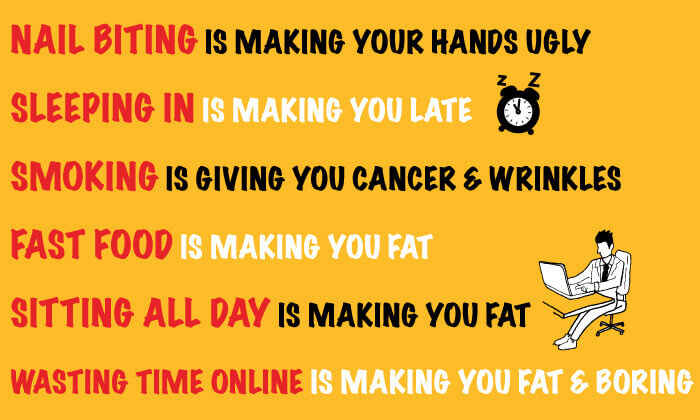
In 2013, Pavlok rediscovered the power of electric shock to break bad habits like nail biting, smoking, overeating and wasting time online.
Since then, we’ve manufactured a wearable electric shock band that our customers use to successfully break their bad habits.
If you are a nail biter and having trouble quitting, it’s worth trying mild electric shock — and you can become one of the 65% that quit in 5 days or less.
Marty Quit Smoking In 3 Weeks

So I was at this party and a guy told me he wanted to quit smoking.
Me: “Great! Come into our office and we will show you how to use Pavlok to quit.”
Him: “Well, ummmm.”
Me: “Really, it’s like 10 minutes a day and totally free, and at the end of it you won’t smoke anymore.”
Him: “Yeah, I don’t know.”
Me: “Seriously dude, I’ll pay you $100 of my own money to quit smoking.”
Even though 2 minutes before he told me he wants to quit smoking…
And even though I was going to pay him to do it…
… he still didn’t come in. He didn’t really want to quit.
Fine, we aren’t here to force you to do anything. But Pavlok is a powerful tool, and if you are ready to quit your habit — smoking, nail biting, watching porn, whatever — it can help. And we’ve got success stories to prove it.
Today is the story of Marty, a 7 year smoker who used Pavlok for 3 weeks and went from 18 cigarettes per day to zero.
Why You Fail At Quitting Cold Turkey
Marty is a 25 year old guy living in San Francisco. He’s a full time driver and until recently smoked a pack a day.
“I started smoking in college. I’d be out drinking and I’d have one or two whenever someone had one, and that eventually escalated to me buying my own packs.”
Fast forward 7 years, Marty was an unhealthy, stressed out smoker that hated his habit.
“I used to have really good cardio — I was on the boxing team — but now I couldn’t even get myself to run a mile. I just wanted to keep up with my active friends. And it wasn’t really helping my mood either, I could see I was really dependant on smoking.”
Marty had tried quitting, but he was on and off for three years. “The longest was a couple weeks, a month at most.”
He was failing because he was relying on willpower.
“I tried reducing at first, but that never worked. I wasn’t really strict about it, and since I was smoking every day anyways I’d say forget it, I’m just going to keep smoking. Then I’d say next time I try to quit I’m going to go cold turkey, but I just kept going back to it.”
Marty kept smoking because his habit was automatic.
As soon as there was a trigger, he would start again. “When I’d go out with friends I’d drink and I’d go buy a pack. Or when I was stressed that would get me smoking again too.”
And then Marty found Pavlok and in three weeks completely quit smoking.
“By the end of week one I was averaging 7 cigarettes a day.”
Marty met Pavlok’s inventor, Maneesh, at an event in San Francisco. Maneesh taught a course on massive self improvement and talked about Pavlok.
“It seemed really interesting. I was going to try quitting again anyways. So it was just ‘if it works then great, and if it doesn’t I’ll find another way.”
Basically, he realized he had nothing to lose (BTW: Pavlok comes with a 30 day 100% money back guarantee so you can try it for yourself risk free).
Armed with his Pavlok, Marty started the self shock program.
“Initially I was skeptical. If I’m shocking myself will it still work? But it did because it made me conscious every time I smoked and so I’d make an effort to put it down. And I didn’t have to quit cold turkey. If my cravings got really bad I was free to smoke.”
Here’s how it worked (remember, before Pavlok Marty was smoking 18 cigarettes per day).
| goal | actual | |
| week 1 | 15 per day | 7 per day |
| week 2 | 5 per day | 2 per day |
| week 3 | 1 per day | 0 per day |
In three weeks Marty went from smoking a pack a day to completely quitting smoking (saving $1825 per year). “I was pretty amazed how fast it was.”
And he is already enjoying the benefits. “I started running again. And I work out almost every day. I’m more willing to to be active because my lungs are clear and I’m not coughing up a storm.”
Marty’s Advice For Smokers
“It depends on how willing you are to quit. A lot of smokers say they want to quit, and I’ve been one of them, but actually they aren’t really dedicated to it — it’s a drastic lifestyle change. But if you are really serious about quitting then this works. Before I would feel weird whenever I wasn’t smoking, like I had to have one. But after using the shock I had that same weird feeling when I did smoke. It was a total reversal, my brain actually thought of smoking as a weird thing.”
Are you really ready to quit your habit?
blu eCigs vs Pavlok
blu eCigs promote themselves as the top eCig on the market. Great, they sell lots, but do they actually work? Not if you want to quit smoking.

blu eCigs are not for quitting smoking and the company says not to use it that way
That surprised me.
When I asked the company for blu’s success rates for quitting smoking they went silent and then started with the lawyer talk:
Please be aware that we are not a smoking cessation device and no electronic cig has been approved by the FDA to make that claim. We are an alternative to smoking tobacco.
Okay. So:
- blu eCig is not a device for quitting smoking;
- no electronic cigarette is FDA approved to help you quit smoking;
- And the main use is as an alternative to tobacco.
What? An alternative to smoking? I’m not going to choose “fruits and berries” flavour instead of Marlboro, Newport or Basics.
If you are serious about quitting a bad habit, Pavlok uses mild electric shock to help you do it. It’s not some magic device that stops smoking instantly, it’s a powerful tool based on 80+ years of aversion science that helps you stick to your goal of quitting.
BTW, here is the actual chat I had with a blu eCig representative…
Thank you for choosing blu eCigs. A representative will be with you shortly.
You are now chatting with ‘Jocquelyn’Jocquelyn: Hello. Thank you for contacting Blu e-Cigs Support Center. My name is Jocquelyn. How may I assist you today?
Michael: Hi, how much does blu cost?
Jocquelyn: Depends on which kit you want
Jocquelyn: Rechargeable is 34.95
Michael: Does that last forever?
Jocquelyn: Plus kit is 42.99 which is the best kit.
Jocquelyn: There is a 1 year warranty on the product.
Michael: And do I buy flavour cartridges too?
Jocquelyn: A pack comes with the starter kit, but you would have to purchase additional cartridges to use the product.
Michael: How much are the cartridges?
Jocquelyn: PREMIUM
Jocquelyn: 1 Five Pack $12.80
Jocquelyn: 2 Five Packs $11.00 ea.
Jocquelyn: 5 Five Packs $10.00 ea.
Jocquelyn: PREMIUM 100
Jocquelyn: 1 Five Pack $13.80
Jocquelyn: 2 Five Packs $11.90 ea.
Jocquelyn: 5 Five Packs $10.80 ea.
Michael: is a 5 pack good for 5 “smoke breaks”?
Jocquelyn: 1 cartridge is equal to 1 pack of cigarettes.
Jocquelyn: A pack of cartridges contain 5 cartridges.
Michael: I see, and do you have any data on using blu to quit smoking? success rates, etc.
Jocquelyn: Please be aware that we are not a smoking cessation device and no electronic cig has been approved by the FDA to make that claim.
Jocquelyn: We are an alternative to smoking tobacco.
Michael: ok, thanks, see ya
Marty Used Pavlok To Quit Chain Smoking
Marty is a 25 year old guy that had been smoking for 7 years. He smoked 18 cigarettes per day.
After 1 week with Pavlok, Marty was down to 7 cigarettes per day and a pack would last him 3 days. He was happy with his progress and with all the money he was saving.
The next week Marty set a goal of 3 cigarettes per day. The result? He only had 2.
If I grabbed my pack I would shock myself, every time I picked up a cigarette I would shock myself. Every time I lit a cigarette I would shock myself, and every time I took a drag I would shock myself. I made it this big hassle so that I’d only smoke if I really really wanted too.
The next week he had just 1 per day, without the cravings.
And by week 4 Marty had completely quit smoking.
He was thrilled, “To be able to quit smoking in 3 weeks is pretty fast in my book!”
Okay, so Marty is just one guy but there are also countless studies on using electric shock to quit bad habits.
Scientific Study Shows Electric Shock Helps Up To 67% Of Motivated People Quit Smoking
 Back in 1970 Hamilton Russell, a UK doctor and member of the Royal Colleges of Physicians, did a study on how electric shock helps smokers quit their habit.
The study was posted in the British Medical Journal and was very promising.
After 3 sessions, the average number of cigarettes smoked daily dropped from 22 to 1.
After 5 sessions, most patients had stopped smoking completely.
But the doctor wanted to make sure the change was permanent. One year after completing the study, 67% were still not smoking.
The doctor concluded that “electric aversion is a powerful suppressor of cigarette smoking.”
Some blu eCigs Contain Twice As Much Nicotine As Cigarettes
Anyone who smokes knows that nicotine is the chemical that makes tobacco products so addictive. So you’d think that a good alternative to smoking would have zero nicotine or at least way less nicotine than cigarettes.
But it turns out that each blu cartridge has up to 18mg of nicotine. For comparison, the average cigarette in the United States contains only 9mg of nicotine. I’d guess that twice as much nicotine would make eCigs twice as addictive.
Pavlok is made of electricity and is not addictive. Our goal is to help you break your bad habit, not replace it with a slightly less bad habit that is more expensive and more addictive.
5 years of blu eCigs costs $4715+
5 years of Pavlok costs $199
blu eCigs has a business model that is really expensive for you (which is why their company makes so much money).
You know how when you buy a razor, then you have to buy all the expensive blades for years? Or when you buy a printer and it’s cheap but then ink refills are so expensive? blu eCigs does the same thing.
blu says their best kit is $42.99 which includes an ecigarette and only 1 pack of flavour cartridges. That won’t last long.
Because blu claims to be an alternative to smoking tobacco, it seems you will still smoke just as much (and possibly more with the extra nicotine). They say 1 flavour cartridge is equal to 1 pack of regular cigarettes and the cartridges come in packs of 5 for about $12.80. Okay, what does that mean?
- Assuming you smoke a pack a day, blu eCigs will cost you $934.40 per year.
- If you smoke 2 packs a day, then it costs you $1868.80 per year.
- If you smoke 3 packs a day, it goes up to $2803.20 per year.
You get the idea. The more you smoke the more expensive blu eCigs are as an alternative. And it is a lot of money, for $2800 you could go on a 7 day vacation with your spouse, or pay off debt, or save for a house, and a lot of other stuff too.
Look at what this guy had to say about blu eCigs pricing:

So blu eCigs aren’t used to quit smoking and they can easily cost you thousands of dollars per year.
But Pavlok has a really simple pricing model. You just buy your unit for $199 and then you own it forever. Plus it comes with a 1 year manufacturer’s warranty.
And Pavlok has a program where if your friend buys from a link you share with them then you earn 20% in cash (about $40). If you refer just 5 people it’s like getting your Pavlok for free. And if you refer 5 more then Pavlok will send you $200.
blu eCigs Are Easy To Forget At Home And Need Constant Recharging
There is one more way to compare blu eCigs with Pavlok, and that’s on convenience.
Whenever I leave the house, I take my keys, phone and wallet. I know that if I have those 3 things, I’ll be fine. But the eCig is another thing to remember to bring, and another thing I have to carry. What do you do on days you forget? Maybe go back to smoking cigarettes.
Pavlok is a wearable wristband, like a watch, that you can put on in the morning and don’t have to worry about for the rest of the day.
And another thing about convenience is charging. In the last few years the number of things you have to charge has probably tripled. Before it was just a cellphone. And now it’s a phone, and an iPad and maybe a laptop and on and on. This means it’s really important that your devices have good batteries that last a long time.
How often do blu eCigs need charged?
blu eCigs typically need a full charge every day. I had to do some math for this because blu presents the data in a tricky way, i.e., # of puffs. But basically it takes 1 full charge to smoke 1 cartridge. If you smoke a pack a day then you have to charge every day. Just like you have to charge your phone and your tablet and everything else.
How often does Pavlok need charged?
Pavlok needs charged just once or twice per week and it takes just 20 minutes each time. Similar to a good quality electric razor.
So, blu eCigs or Pavlok?
Pavlok is cheaper and more effective than blu eCigs — it should be an easy choice.
BTW, here is a discount code to get 10% off your Pavlok device: BONUS10
The discount goes on the very last page and we usually limit codes to 24 hours.
Use Micro-Habits to Create New Behaviors
STEP #1
The first step to installing a great “micro-habit” is choosing the right cue to remind you of your goal and initiate the new behavior. For instance, if you’re trying to create the habit of journaling every night, the cue could be ‘every time you set your alarm clock’, You instill the idea that as soon as you set the alarm you walk over to your desk.
STEP #2
The next step is creating a meaningful routine that encourages you to execute the new behavior. In the past when you’ve tried to instill this habit you may have been telling yourself that you need to sit down for 15 minutes every night and write out a page in your journal, which is intimidating. However, using the micro-habit structure, you change the routine from writing a page to writing ONE sentence in your journal. This all but eliminates any hesitation or resistance that you would’ve previously had.
Eventually you will build up to writing as much as you want in your journal without the side-effects of feeling overwhelmed or exerting any more willpower. This will build up over time in accordance to the Pavlok Habit Model. You don’t need to rush it, you just have to follow the guidelines. By doing this, you’ll have developed a habit almost effortlessly that you may have failed to instill previously. Ah the power of the micro-habit!
STEP #3
Now, it’s time to activate the last part of the habit formation process by creating a reward to solidify the new “micro-habit.”
The reward can be something simple, like having a warm cup of tea with honey or watching a rerun of Dawson’s Creek after you write one sentence in your journal. The actual reward isn’t important — the important part is pairing positive reinforcement with completing your goal every night.
Properly implemented, the “micro-habit” system is a psychologically bulletproof strategy for starting new, positive habits.
Now that you have the tools, go pick a habit you’ve wanted to develop and build your micro-habit system. Find a cue, build a micro-habit routine, and pick a reward and start creating the habits that you’ve always wanted!

Positive vs Negative Reinforcement: Which Is More Effective?
The central premise of Pavlok is getting the user to take action and create a new habit — or change an existing one. To do this, we built “pattern interrupts” — jarring but effective stimuli — into the device that encouraged users to change their routines.
We then faced a difficult question that’s challenged behavioral psychologists for decades.
Which is more effective for behavior change: Negative or positive reinforcement?
Positive reinforcement is a reward for doing something well. Remember the joy of receiving gold star from your kindergarten teacher when you spelled your name correctly? That’s all positive reinforcement.
Negative reinforcement is a penalty for not doing something. Why do you go into work every day? If you’re like most people, you show up because if you don’t, you’ll get fired.
(Note: negative reinforcement is NOT the same thing as “punishment.” Punishment implies that you receive a penalty for doing something you’re not supposed to do — whereas negative reinforcement implies not receiving a penalty for doing something. For instance, if you misbehave and your mom spanks you, that’s punishment: adding a bad stimulus when you did something bad. If you get charged money–or electrically shocked by your Facebook friends—because you don’t exercise, that’s negative reinforcement:
Negative reinforcement occurs when an aversive stimulus (a ‘bad consequence’) is removed after a good behavior is exhibited. The difference is subtle, but very important.)
Do you think positive and negative reinforcement are equally effective?
In the end, it all comes down to pain versus pleasure.
Most would agree that running from painful circumstances is exhausting. It’s annoying. It’s the exact opposite of seeking pleasure.
Our research found that negative reinforcement is actually far more effective for sparking initial habit change.
In the context of the over-snacking example above, imagine that you got fined $50 for every spoonful of ice cream that you ate?
You probably don’t have to spend any time researching to know that you’d very quickly stop eating ice cream.
But here’s where things get interesting: If you were continually penalized for eating ice cream, the negative reinforcement would eventually stop working.
You’d become resentful of the constant punishment. Maybe you’d switch to cookies.
Long term, negative reinforcement doesn’t get the job done — and that’s where we bring back positive reinforcement.
If you allowed the new routine to take place, and you replaced the ice cream with berries successfully for a week, rewarding yourself with a small amount of ice cream on the last day will actually aid in maintaining that habit.
Negative gets you started. Positive keeps you going.
We call this “Push-Pull Motivation” — and it’s the foundation of Pavlok’s habit change technology.