Blog

Compulsive gamblers treated with zaps

Shelton Hospital, Shrewsbury, England: Psychiatrists treat group of compulsive gamblers with Electric Jolt Technology — Two years later: NO desire to gamble; life and happiness restored.

Many people enjoy the occasional bet between friends. It’s innocent fun. The lottery too, is a harmless way to feel like you can still dream of a life of big money and luxury.

But there’s a line.

And that line is very easy to cross.

It’s the line where the casual bet makes way for a craving, to play more and more; to chase your losses as they grow disproportionately.

For compulsive gamblers and their loved ones, life is a constant, uphill struggle. Food disappears from the table, and all income is fed into “that machine”, as it grows fatter and fatter.

What’s worse, a compulsive gambler rarely realizes that he or she has a problem, and will not seek help until the situation becomes desperate.

It is a nightmare that is incredibly hard to wake up from.

In fact, “compulsive gambling has been regarded as a progressive illness which can never be cured but can be arrested” (Barker, Miller, 1968).

This is where science and technology step in, bringing hope to victims of compulsive gambling, and their suffering families.

What you didn’t know: Psychiatrists ALREADY successful in treating compulsive gambling with Electric Jolt Technology… 50 YEARS AGO

Psychiatrists (Barker, Miller, 1968) at Shelton Hospital in Shrewsbury, England, hand-picked a group of compulsive gamblers, to find out how treatment via electric jolts would affect their gambling habits.

All participants were compulsive gamblers. Most of them had lost numerous jobs, some even served time in prison, as a result of their addiction. Gambling had caused them considerable emotional distress and left them in serious financial difficulties.

Despite this, and their best intentions to quit gambling, they had always failed to do so successfully.

In the experiment, the participants were asked to take part in a number of gambling-related activities. Some were asked to play their favorite slot machine, brought on loan from the betting shop. Others were asked to watch videos of themselves in the betting shop, placing bets on horses.

gambling01

During these activities, the participants were given small, harmless electric jolts to the wrist. The jolts did not cause any damage or injury. However, they were sufficiently painful to overcome the participants’ deep-rooted desire to gamble.

More importantly though, the electric jolts were incredibly effective!

100% Success Rate: Electric jolts beats Compulsive Gambling Habit in ALL Participants

Each of the participants underwent between 5 and 12 hours of treatment. At the end of the treatment, 100% reported they had developed an aversion to gambling.

Emotions ranged from disinterest towards gambling, to “being sick of it” and wanting to “throw [the machine] through the window”!

Remember, these were people afflicted with a very strong gambling habit. They had tried and failed numerous times to break this habit, despite the pain, misery, overwhelming debt, and other problems that it had caused them and their loved ones.

Yet, in an incredibly brief period of time —less than 12 hours— their habit was broken for good.

Two Years Later: Still no desire to gamble — they have their lives back

The story for this group of people gets better. All of them returned to a normal life.

When re-assessed two years later, they had repaid their debts and put back together their lives. While some reported a relapse, a brief sequence of “booster” sessions helped them get back on track.

gambling02

The results and conclusions of the researchers are more than encouraging:

“There is scope for refinements in techniques but we are of the opinion that aversion therapy has much greater clinical potential than is at present realised.” (Barker, Miller, 1968)

References

Barker, J. C., & Miller, M. (1968, 12). Aversion Therapy For Compulsive Gambling. The Journal of Nervous and Mental Disease, 146(4), 285-302. doi: 10.1097/00005053-196804000-00002

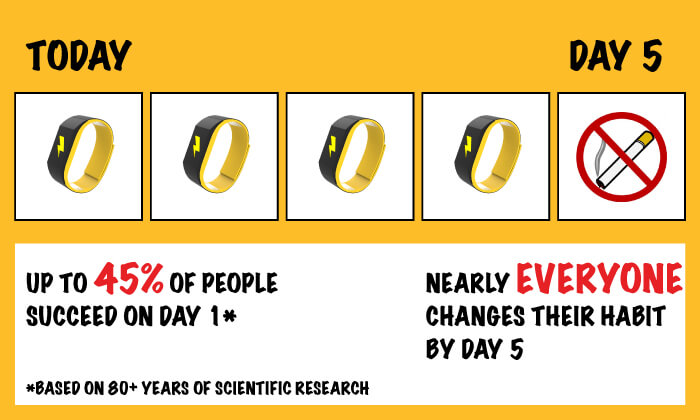
Quit Smoking

quit-smoking-5-days

It’s easy to make the resolution, “I’m going to quit smoking.”

And it’s easier to break that resolution.

Sure, you can convince yourself that this is the last time you’ll ever smoke a cigarette, and you might really believe it, too – but when you’re faced with something as simple as finishing a meal or having a drink, you can feel a sudden need to smoke. And you’re just as good at talking yourself into having one as you were at never having one again.

It only takes 3 days for your body to completely eliminate all of the nicotine in your system, and this is why quitting ‘cold turkey’ is often recommended. But you can still experience cravings like this for weeks, months, and even years after your last cigarette.

This is because your brain, even at the biological level, is constantly learning through associations. Whether you’ve smoked five cigarettes or five thousand cigarettes, each one has served as a lesson. Nicotine has taught your brain to associate smoking with a form of psychological relief, based on the way it activates your reward pathway.

So when you’re finishing your lunch, your brain lights up with neuronal firing, leading to you thinking ‘I should have a cigarette now.’ And your brain is very efficient at creating and maintaining these associations, which is what’s responsible for the high relapse rates among those attempting to quit.

While products like nicotine patches and gum can help you through the withdrawal period, you’re left to rely on your willpower alone when it comes to facing the way your brain has learned to need cigarettes. Nicotine substitution methods like the patch have a success rate of only 9% — over 90% of users go back to cigarettes within 6 months.

Aversion sessions interrupt this reinforcement loop by adding an unpleasant factor to these associations. A negative consequence to smoking a cigarette changes the way your brain works –- instead of fighting your cravings as they come, you can rewrite the code itself at the neuronal level.

In a scientific study, following five days of pairing shocks with cigarette smoking, 60.6% of subjects successfully quit — maintaining total abstinence from cigarettes over a year after the sessions. Beforehand, these subjects smoked an average of over 32 cigarettes per day, and 80% had tried to quit in the past.

After 5 days of pairing electric shock with smoking, 60.6% of smokers quit entirely.

Scientists have been using electric shock in labs for over 50 years in experiments to end bad habits. This technology has always been limited to research studies.

Now, Pavlok puts it in your hands, literally — by building a wristband with simple “one-button activation”. You can safely self-administer electric shocks, and you can control the level of intensity for each shock using an app on your phone. Pavlok’s device means you can take advantage of the scientific research for your own benefit!

How to Use Pavlok to Quit Cigarettes in 5 Days

  1. Try out the device. Shocking yourself can be a little daunting at first, but you can adjust the intensity on your phone to calibrate and find a level of shock that works for you.
  2. Shock for your first cigarette of the day. After getting familiar with the wristband, start administering a shock for each inhale of your first cigarette of the day. Your desire for this primary cigarette is often the most habitual, and breaking this initial craving will have a huge impact on your ability to kick the habit altogether.
  3. Shock for additional cigarettes. You guessed it — after getting accustomed to shocking yourself for each puff of your first cigarette on day one, you can start applying shocks in the same pattern every time you light up.
  4. Keep shocking and keep track of your progress. Continue administering shocks for every inhalation of every cigarette. Many Pavlok users report a rapid drop in daily tobacco use very soon after starting aversion sessions; if you experience this, you can advance to shocking yourself based on cravings alone.

A great example of Pavlok’s success in quitting cigarettes is Marty, who was a pack-a-day smoker for over seven years. He used Pavlok to quit smoking by following the method above, including continuing to shock himself until his cravings subsided.

No matter how long you’ve been a smoker, it’s never too late to quit. Even if you’ve been smoking cigarettes for years, or have tried and failed to quit in the past, Pavlok can help you break your habit in five days!

We know that once you try Pavlok, you’ll love it, and you can join the incredible group of smokers who were able to quit using electric shock aversion sessions.


Pavlok Wins “People’s Choice Award” & Boston’s Best Tech Startup

pavlok-award

When I was 8 years old I was on a terrible t-ball team.

We lost our first game, and our second game and our third game.

We got creamed when we played an unscheduled game against the girls rep team.

Seriously, they destroyed us — it was soul crushing for a bunch of 8 year old Roberto Alomar wannabees.

And we lost the finals too.

But we still got trophies, even if they were half the size of the winners’ trophies.

Today though, I am a winner, because I’m on team Pavlok.

timmy-award-winners


Pavlok Wins “People’s Choice Award” & Boston’s Best Tech Startup

At the first WeWork Boston Demo Day, we pitched Pavlok against some amazing companies:

  • Suitable Technologies (think your very own Skype robot)
  • Spot (Airbnb of parking)
  • JAZE (smart car maintenance)
  • Shelfie (take pictures of unstocked shelves and get points)
  • mettle (video challenge friends and get points)

Congratulations to Shelfie on winning the Grand Prize, and we are pretty happy to be voted as the People’s Choice Award :- )

You can read the full article in BostInno, and this is the excerpt about Pavlok:

“Ever since this startup took to Indiegogo last summer—which was 508 percent funded at $269,702—it’s gained substantial buzz for its shocking device, which aims to bust bad habits and change users’ behavior. Pavlok submits an electronic shock when you don’t accomplish the healthy goals you’ve set for yourself. Software engineer Justus Eapen, who led the pitch, told the audience that he tested out the device himself in an attempt to stop drinking beer in the later hours of working. Eapen says Pavlok worked like a charm, and he also claims he’s spoken with many other users who have been able to stop smoking cigarettes and biting their nails—among other things.”

And Pavlok won not one but two great awards last week.

Tech in Motion hosts the Timmy Awards with 3 categories: Boston’s Best Technology Manager, Boston’s Best Technology Work Culture and Boston’s Best Tech Startup.

We were nominated (and won) Boston’s Best Tech Startup, again with tough competition:

  • 9yahds (cloud based process management)
  • ArtLifting (sells art and helps disadvantaged people)
  • Cintell (customer intelligence software)
  • KeynectUp (contact management)
  • Mapdwell (data interpretation)
  • OtoSense (reacts to sounds in your environment)
  • PillPack (simplified pill taking)
  • SHADO Sports (fantasy sports platform)

About the award for Boston’s Best Tech Startup:

This award recognizes Boston’s best startup that employs forward-thinking technology leaders, possesses a great working environment, and produces an innovative product. Finalists include technology companies based in the Greater Boston Area founded since January 1st, 2013.

Carlos Smoked For 15 Years Then Quit In 5 Days

c03-p011

Most smokers have tried to quit at least once.

  • In 2012 there were 42 million smokers in the US
  • 68.9% of those smokers wanted to stop smoking
  • 42.7% tried to quit and failed
  • And 480,000 died because of smoking that year

*data from the American Cancer Society & Center for Disease Control And Prevention

The math is scary…

  • 42 million smokers
  • ~18 million fail at quitting
  • 480,000 die

But some people do quit successfully. And today’s case study about how Carlos quit his 15 year habit in 5 days will show you how to use psychology and science to stack the odds in your favour.

carlos quit smoking case study

Do You Smoke More Or Less Than Carlos?

For almost 15 years Carlos was a pack-a-day smoker.

But he wanted to quit. He was feeling the health effects, his wife was always complaining about the cloud of smoke following him around, and it was costing him a lot of money.

“Over the past 6 months I’d gone to the convenience store 13 times per month for 2 or 3 packs, and every time I’d spend another $12 on snacks.”

And actually Carlos had tried to quit over 20 times.

“I used Chantix, I used the gum, the patch and I even tried hypnosis. Nothing worked.”

Then Carlos found Pavlok. He was skeptical at first but figured why not give it a shot.

And after 5 days with Pavlok, he finally quit smoking.

The 5 Day Plan For Quitting Smoking

Carlos shared his 5 day plan for successfully quitting a pack-a-day habit.

DAY 1:

On the first day, Carlos followed our instructions to shock himself every time he smoked or took a puff. This is the same strategy that helped Marty quit smoking in 3 weeks.

Carlos realized “self shock” just wasn’t for him — he didn’t have the willpower to follow through. So the next day he tried something different.

DAY 2:

On the second day, Carlos invited his wife to join in and make a game of it. If she could catch him smoking she could shock him. And she did catch him a number of times.

But even though he was having some success, Carlos saw another fault — when his wife went to work he could smoke all he wanted.

DAY 3:

On the third day, Carlos invited his friends and family over to shock him. “If they could catch me they could shock me”.

The result? 15 or 16 shocks. Now there was some serious aversion happening, so Carlos upped the ante.

DAY 4:

On the fourth day Carlos allowed his family members to shock him and would also give them $5 if they caught him smoking. “I was caught a few times, but by this point I had stopped smoking quite a bit.”

DAY 5:

On the fifth day, Carlos told his family members they could shock him wherever they want AND he would pay them $20 each time. “I was caught one time when my brother hid inside a trash can and jumped out when I was out back. It was the only time I tried smoking all day long.”

DAY 6:

On the sixth day, Carlos told his family members they could shock him twice and offered $20 for each shock. But he didn’t smoke at all.

And that’s how when 18 million other people failed at quitting smoking, Carlos was able to succeed in just 5 days.

Healthy, Happy and Rich

For Carlos, quitting smoking had 3 big wins.

First, he is already seeing his health improve.

Second, his wife is happier and no longer complaining like she did when a cloud of smoke followed him around.

And third, he is saving money — about $150 in the first month.

Pavlok Saves You Money

If you do the math on quitting smoking, you’d probably save just as much as Carlos and maybe even more. Yes, you could try to quit “cold turkey” or use medication or the patch. But what if you could actually quit this week?

And if Pavlok does help you quit, the savings on cigarettes will pay for the Pavlok in the first month anyways, and you’d have extra savings in month 2 to reward yourself with.

Buy-Now-Button---Blog-Site

60% Of Participants Beat Alcoholism

London Institute of Psychiatry finds 60% of participants quit drinking after electric shock sessions and report “repugnance” towards sight and smell of alcohol even after 4-8 weeks

alcoholism study chart

In a scientific study conducted by the Institute of Psychiatry in London and Maudley and Bethlem Royal Hospitals in Israel, researchers analyzed the effects of electric shock on alcoholism in a group of “primary alcoholics” i.e. people who were practically alcoholics from their very first drink.

These were people for whom alcoholism was a very deeply ingrained habit.

When re-assessed 4-8 weeks after the study, 60% of the participants in the study were categorized as “successes”, with complete abstinence or no serious bouts of drinking.

In other words, 60% had successfully quit their drinking habit.

What’s more, as a result of shock treatment, the participants developed a strong dislike for the taste and smell of alcohol.

Some even found it “repugnant”!

A drink or two… too many?

There’s nothing wrong with a drink or two socially. But when it starts affecting your life, your relationships and your job, even in tiny ways, it’s time for a reality check.

If you feel it’s time to get your drinking habit under control, congratulations, this is the first step towards freedom.

Attitude is crucial.

However, it’s only part of the battle. You need to strengthen it with a proven process that can get you back on track every time you stray!

Treating alcoholism with Aversive Shock Technology

The study mentioned earlier, shows that the strategic use of small electric shocks —such as those administered by the Pavlok wristband— can help you get a grip on your drinking habit before it’s really out of control.

The research was conducted over a number of sessions as follows:

  1. Each person was shown a number of slides, including images of bottles, bars and other alcohol-related items. Every time the person reported having a fantasy of drinking, the researchers would give that person a slight shock* to the arm.
  2. Each person was asked to taste and smell alcohol. For each of these actions, the researchers would once again give the person a slight shock* to the arm.

*Note that the shock is harmless and does not cause any injury. It is intended to jolt you to attention. And according to this study, its effects are astounding.

The Outcome  Electric shock beats alcoholism in 60% of the lab cases

When reassessed 4-8 weeks after the shock treatment, 60% of the people in the experiment were reported as “successes”, (complete abstinence or no serious drinking) and had come to dislike the taste and smell of alcohol.

In fact, the word “repugnant” kept coming up!

Some reported the smell and taste of alcohol had now become unpleasant. Others found they had become indifferent to alcohol.

For some, even the sight of the images was considered undesirable!

alcoholism study chart

Remember, these were people diagnosed as ”primary alcoholics”; their problem was very deeply ingrained.

They were NOT recreational drinkers simply concerned about the occasional hangover.

The study shows encouraging results, and the researchers’ claims are very clear:

“As far as the conditioning theory is concerned, the development of this taste/smell repulsion, may prove to be a useful starting point — square one.” (Hallam, Rachman, Falkowski, 1972)

Pavlok is your starting point

Maybe you’re just looking to have a little more control over your life. You’ve been pushing your limits a little too far. Your social life, your relationships, your wallet and your job seem to be suffering the consequences, and you want to do something about it.

Or maybe you’re waging a full-blown war against the bottle. You recognize you have a serious problem and that it’s going to take you down sooner or later.

Whichever your case, you owe yourself all the help you can get. So, keep the following in mind:

#1 Willpower is not enough

First of all, willpower is not enough; it never is. You might start out strong and full of determination. But…

  • what if you’ve had a horrible day at work?
  • what if your toddler has been screaming all day?
  • what if an idiot cuts you off on the street as you’re driving home?

For someone with a drinking habit, everyday events like these can be overwhelming triggers.

You need a support system that will keep you in check when your will power takes a plunge. And it needs to be something that is concrete and dependable.

#2 The game is stacked against you. You owe it to yourself to redress the balance.

On top of that, the game is stacked against you.

Everything around you is designed to push you towards failure:

  • bars at every corner and junction
  • wine lists in restaurants
  • whole shelves of alcohol in supermarkets and convenience stores
  • commercials on tv and social media.

It’s inescapable.

That’s where Pavlok comes in.

Pavlok keeps you on track

In 2013, Pavlok rediscovered the power of electric shock to break bad habits such as smoking, overeating and drinking.

With Pavlok, you can replicate the results observed in the laboratory study mentioned earlier in this article.

Set a goal for yourself. You may decide to shock yourself every time you open a bottle of liquor, or with every sip you take. You could even shock yourself every time you even THINK about drinking alcohol!

If you have honest friends who REALLY care about you and want you to beat your habit, you can give them access to Pavlok via bluetooth. Agree on a specific behavior you want to avoid. Your friends will be able to use their phones to shock you with Pavlok every time you slip up.

Caution: There is no ‘microwave’ sobriety

Of course, Pavlok is not a substitute for professional help and support. If you feel that your drinking habit might be too much for you to handle on your own, you need to seek professional help.

But Pavlok is your first commitment to yourself. It’s with you, always, as a handy wearable wristband. Users have often reported that the feeling of having Pavlok on your wrist is enough to remind you to “stay away from the habit”.

How Pavlok Knows When To Shock You

peter-the-cheater

The #1 question everyone asks about Pavlok is “how does it know?”

How does it know you are smoking?

How does it know you are on Facebook?

How does it know you just ate your third Big Mac with extra cheese?

The simple answer is there are both easy-track and hard-track habits.

Examples of easy-tracks include time spent on Facebook, pressing a snooze button or obsessively checking your phone.

Basically, an app goes “beep you are on Facebook” and Pavlok shocks you.

Easy tracks are the near-term priority for Pavlok.

But there are also hard-tracks like smoking, nail biting and over eating. Yes, these are trackable too, but the technology is still in development.

If you have a hard-track habit, there is actually something better — “self shock” — the way scientists have been doing this for decades.

When you shock yourself — which we teach you how and when to do in the included 5 day habit change app — you increase awareness & supercharge your natural ability to resist.

Because of this, self shock actually has much higher success rates than an automatic shock does for changing habits.

how-pavlok-works-self-shock

And there is another option too. You can link your Pavlok to a friend’s phone via Bluetooth and let them monitor you. This method works well when you need a little extra help to quit your habit.

BTW, the #2 question everyone asks about Pavlok is “will it work for my habit?”

And the answer is yes, yes it will :- )

Click here for the list of bad habits you can break with Pavlok.