Inside Pavlok – How We Built a Successful Hardware Wearable Device With Minimal Funding and No VC

This is part of our Inside Pavlok series—a series of blog posts by the Pavlok team talking about the story of how we work. 

As the founder/CEO, my role has shifted since Pavlok’s inception. At the beginning (2013), the company was just me. I was all roles at all times. Now with 21 people (!!) on staff, my role has moved from being a doer, to being a leader.

I believe that a CEO’s job is four fold: 1) to make sure there is money in the bank, 2) to set the vision of what the product and company will become, 3) to hire the right people to get the right job done to execute that vision, and 4) to create the company culture that allows us to scale and grow in a positive and healthy way.

This article is a repost from late 2015, when we first began shipping our product. It’s fascinating for me to reread, to remember how we survived our original days pre-revenue. 

I hope you enjoy this article! 

-Maneesh Sethi

Yesterday, Ben Einstein of Bolt posted an article on the Bolt blog: Kickstarter is Debt.

I was in the original Bolt Class — one of the first seven companies. I was the only Bolt company (at least in the first cohort) to host a crowdfunding campaign during my tenure at Bolt, so I felt it necessary to tell our tale of Kickstarter and Debt.

Pavlok(main site, order site)was founded in 2013 with the goal of changing behavior. There are tons of wearables tracking what you do, but Pavlok is designed to change what you do. It utilizes Pavlovian conditioning (in the form of vibration or a mild electric zap) to permanently reduce cravings and break bad habits. Users use it to quit smoking, unhealthy eating, nail biting, obsessive / negative thoughts, waking up early, and more.

(and oh hey, since yesterday, we are on Amazon!)

The final Pavlok unit, shipped to customers.

I had the idea in late 2012, and Bolt saw our initial video and decided to invest in Pavlok and turn us into a real company. In August 2013, I accepted $50,000 from Bolt and moved to Boston, MA to pursue my goal of starting a hardware company. Now, I have no hardware experience at all — — and I was the only one there with no engineers and no experience.

While at Bolt, we accomplished the early stages that every hardware company must get through — prototyping, market analysis, and creating manufacturing partnerships.
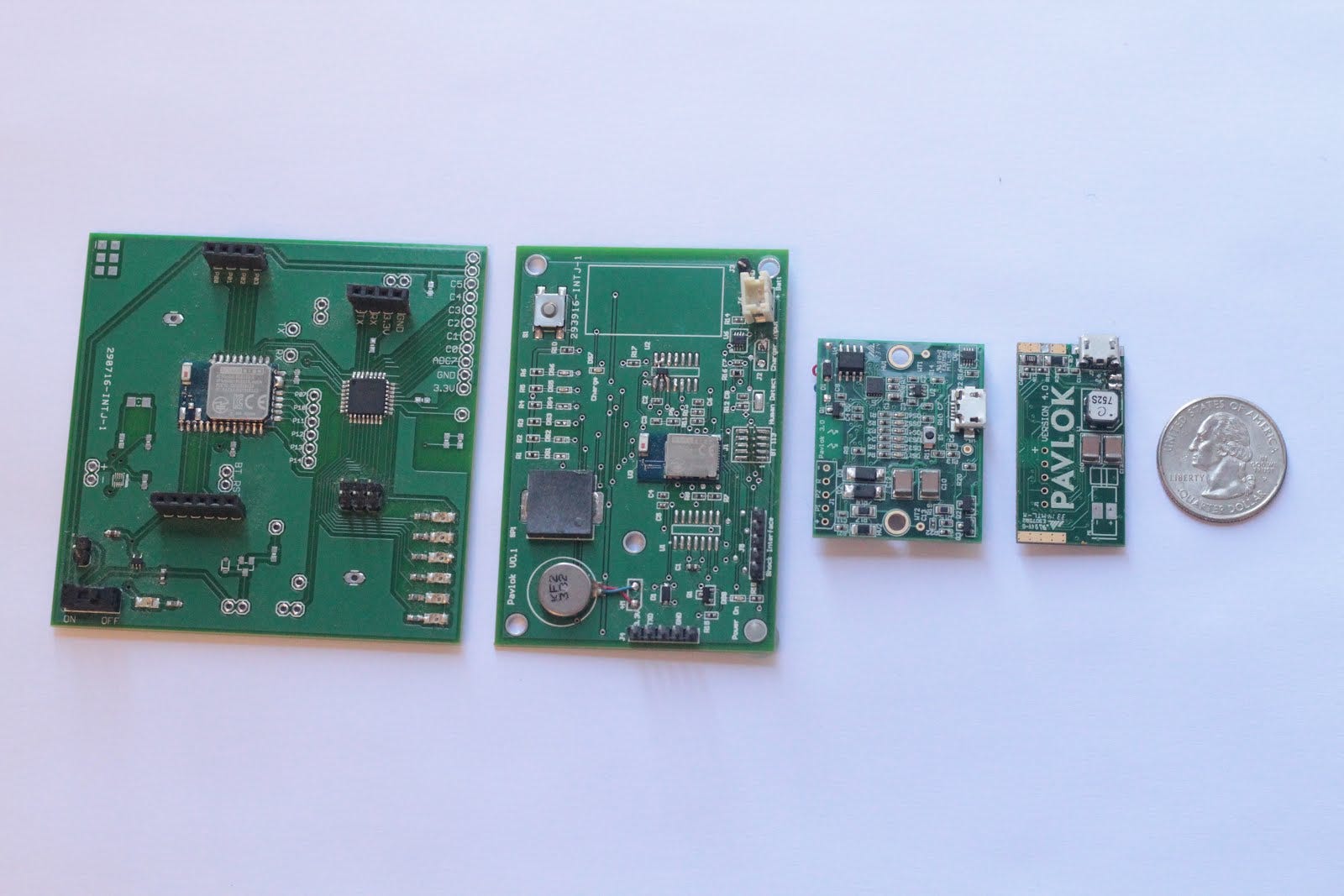
The first 4 iterations of Pavlok boards — -> the far right is the BETA prototype we shipped out.The final production version of Pavlok — shipped to customers.

Bolt was awesome — they even took us to China for a factory tour. Here is a video about our experience:

Debt has been in instrumental part of building our hardware company without raising a Series-A. I want to touch on Ben’s post about the Four Types of Debt — — and add a few others he didn’t mention.

How We Utilized Ben’s Four Types Of Debt

Ben discussed the four types of debt: Presales, Factory Financing, Purchase Order Financing, and Venture Debt. There are also several other forms of debt, which I write about after this section.

Here is how we utilized the four forms of debt that Ben spoke about.

Presales

For our purposes (and you should do this too, according to Ben) we counted both our money raised in crowdfunding ($280k) and post-crowdfunding (but pre-product launch) to be “presales”.

We started our pre-sales phase well before our crowdfunding campaign. In May, 2014 we were running out of cash — — down to two weeks left in the bank. Not knowing what to do, I decided to host an informational webinar about habit formation. About 150 people showed up to this live presentation.

At the end of the presentation, I announced Pavlok and offered pre-orders. We managed to sell $20,000 in presales and prototypes on that webinar, helping us get to the next step (towards our crowdfunding campaign.

In October/November, we launched our IndieGogo campaign.
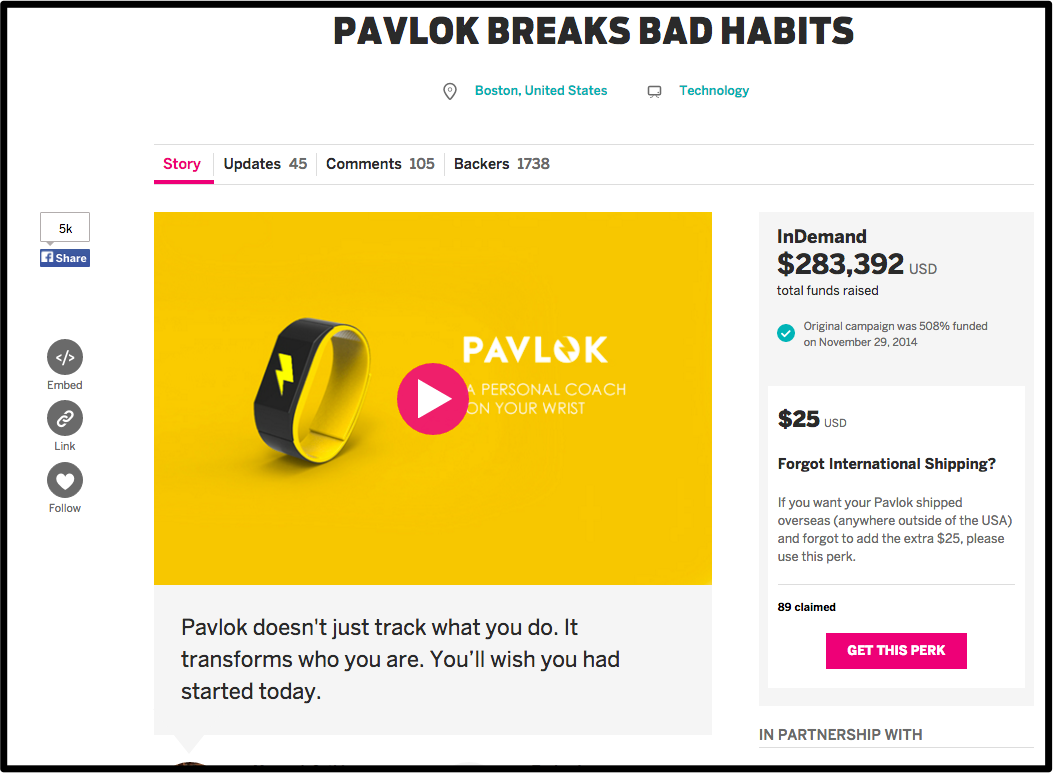
You can see the campaign at https://wp.pavlok.com/igg-1

As Ben mentioned this is not “raised capital”, it is debt because we owed an individual a tangible product in return for the money given to us. Ben summed it up best in his article with this paragraph:

Like other kinds of debt, there are harsh penalties if not repaid on time (delivering late can destroy your reputation). My standard advice to consumer product founders looking to fund their companies with crowdfunding debt: use it only if you’ve completed product development (have an EP) and know your precise BOM, COGS, fixed costs and distribution margin.

It is extremely important to know what your manufacturing costs and delivery costs will be before you begin crowdfunding, or you may find that you raised an insufficient amount to deliver your product to consumers, dooming you to failure. We made the mistake of not calculating in shipping costs (particularly international) when we launched our campaign, and had to quickly backtrack and require our international customers to pay for shipping, or else we would not have been able to deliver their product. As Ben (correctly) stated:

Crowdfunding dollars should be focused on production costs (tooling, inventory, packaging, logistics) rather than development costs (customer development, prototyping, salaries).

One major irony hurt us: because these were pre-sales, they were reflected on our balance sheet as a liability, not as an asset. Thus, when we went to apply for an SBA loan in 2015, it seemed like we had LOST >$250k — — when in fact, it was cash in the bank.

This is a key tip: Pre-selling product can actually hurt your chances of getting a loan.

Factory Financing

Ben is pretty bullish on factory financing, and for good reason. It is essentially a no-cost loan. Obviously you pay for the product eventually, but you get 30, 60, sometimes 90+ days to sell that product before the money for it is due. This helps with sales and manufacturing projections, but also it is just plain useful for liquidity. Here’s Ben’s words on factory financing:

Factory financing is the most powerful form of financing for hardware companies. It usually comes as a line of credit (sometimes known as payment terms) extended by your contract manufacturer (CM). Instead of the CM requiring you to pay for parts and labor upfront, a line of credit allows you to delay that payment by 30 days or more. Unfortunately, CMs rarely extend credit to small startups during their first production run.

Ain’t that the truth. Prototyping companies typically won’t give any terms — — it’s cash up front.

We managed to get one firm to give us a $7,500 credit with net-60 terms. It wasn’t until we had proven much more sales (and had CMs competing for our business) that we managed to negotiate net terms for a greater portion of the product.
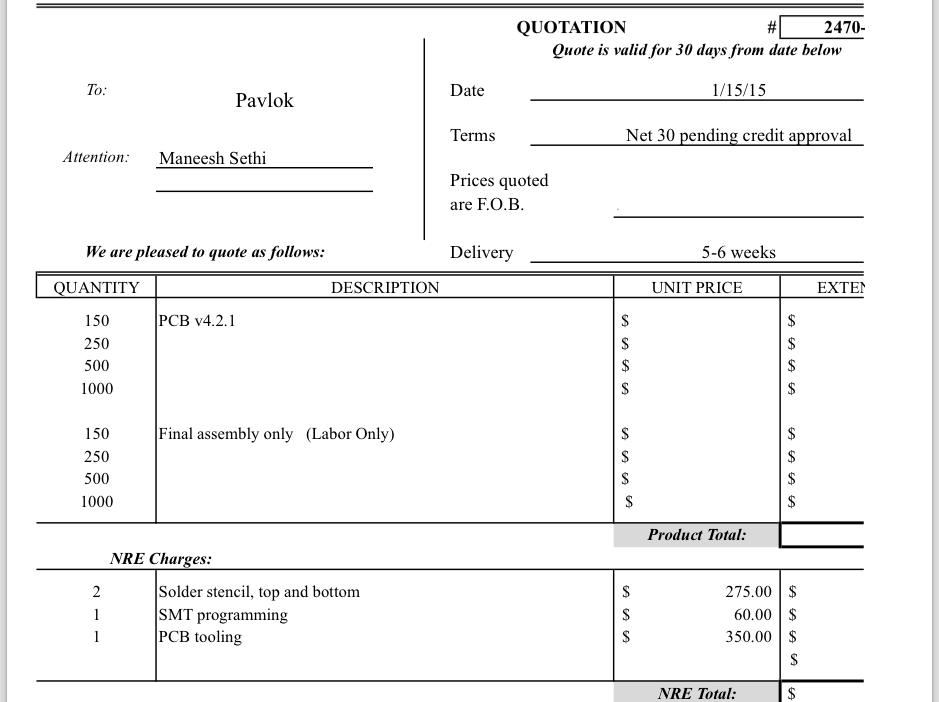
Additionally, we sourced most components ourselves. Pavlok has 80+ components, and many of them won’t allow us terms at all. With our >dozen vendors, some gave us net 30, some net 60 terms.

For our first production run we spent over $30k on tooling alone because we have multiple components, each requiring their own tool. Depending how large your initial production run is, financing production can be a crushing financial burden as well — for our first 18 months, we had to pay up front for all of our manufacturing.

Purchase Order Financing

Purchase order financing is a great way of financing manufacturing, if you’ve already established a sales partnership with a well known retailer. Ben describes one scenario:

If you’re lucky enough to get a significant purchase order from a brand-name retailer (or well-known B2B customer) it’s often possible to convince startup-friendly banks to provide debt financing based on pending sales. There are also financial institutions that specialize in PO financing that can be more lenient than banks. If you’re selling $2M worth of product, the lender may advance your CM $1M to manufacture the product and then collect the payment directly from the retailer. You pay for this with fees based on the amount of time between when the cash must be provided to the supplier and then the customer/retailer pays.

We had the opposite situation — instead of having a big purchase order, we had pre-sales coming through. That is, instead of having upcoming cash, we had already received the cash — — and had already spent it.

Almost every firm we approached turned us down. They said we needed an upcoming purchase order to make it happen.

After a ton of searching, we convinced OnDeck to provide us with $80k in financing (with an option to double it in the future). Inventory/PO financing is VERY expensive. They took a $2,000 initial fee. We had a factoring rate of 1.37 — — which means that we owe back 1.37x the loan, due in 11 months ($109,200). But because we make a profit on each unit, the numbers work out.

Venture Debt

Rather than betting on the potential of the business (like equity investors do) venture debt is mainly betting that your existing investors will keep financing the company. Having access to venture debt often requires investment from brand-name VCs. Often these investors will have to communicate to the venture debt firm that they have significant capital in reserve to fund the company going forward. The amount you can raise will depend on how much venture capital you’ve taken in and you’ll usually issue warrants as downside protection.

We didn’t utilize venture debt because we had very little venture capital to back it up. We tried, but venture debt firms asked us to have a Series-A arriving first. Venture Debt is typically added on as part of a VC round — — it seems unlikely to get it on its own.

Other Types of Debt(ish) Financing

There are a couple types of financing that Ben didn’t mention, that we pursued or utilized.

Bank Line of Credit

If you have a good relationship with your bank, they may extend you a line of credit. Our bank (TDBank) has opportunities for up to $150,000 in credit. A line of credit is a VERY good form of debt — — it has no costs unless you use it, and it’s only charged when you go into the red in your bank account. We were unable to secure a line of credit this year, due to our pre-sales liability situation mentioned in the Pre-sales section above.

SBA Loans

These are loans backed by the Small Business Association. Excellent loans, excellent terms, but we were unable to procure them for the same reasons above. You’ll need your business to have grossed >$50k the previous year in order to apply for a decent SBA loan.

Convertible Debt

Convertible debt is a loan that typically converts into equity at the Series-A. We raised quite a bit of convertible debt — — about $600,000 (uncapped, 10% interest, 20% discount to series A). This was done mostly through angels and friends.

Here is a guide on convertible debt.

Credit Card Debt

Credit card debt can be an effective way to gross cash when you are launching a product. Be VERY wary because obviously credit card debt can rise up and bite you in the ass. But, because we were funding a hardware product we expected to gross a lot of money on, credit cards gave us cash-flow and 30-day no-interest payment terms. I started Bolt with no debt, and probably have about $75k in debt on my cards now.

Our Total Usage of Debt

Here is a summary of our usage of debt (estimates)

  • Presale

1. Crowdfunding: $280k

2. Other pre-sales: $750,000

  • Convertible Debt: $600,000
  • Credit Card Debt: $75,000
  • Purchase Order Financing: $78,000
  • Factory Financing: $7,500 (now, it’s increasing rapidly)

How Our Strategy Worked Out (Or Didn’t) For Us

What went well?

We leaned heavily on presales, and because we had a competitive advantage in our market (our advantage was that we have no competitors) it worked out well for us.

We did not have to take venture capital nor did we have to maintain an astronomical burn rate because our sales we more or less guaranteed, so long as we could reach consumers with our messaging and convey our product and brand values. We might change some of the little steps along the way (promised shipping deadlines, for example), but the strategy was a great one for us. We also didn’t have to take “real debt”, aka a bank loan, until Summer 2015, which is amazing considering we had very little venture capital. Our ability to fuel our growth through presales is one of the things we are most proud of.

What didn’t go well?

Because we weren’t venture backed and we had an unproven product, a lot of people and companies said no to us, for a lot of different reasons. We couldn’t get venture debt because we had no venture capital well to tap into in case we started running low on cash. There were some months where if we didn’t meet pre sales goals for that week or that month, we wouldn’t have been able to pay salaries let alone pay for manufacturing. That was extremely stressful, and raising slightly more venture capital would have eased some of these concerns, allowing us to focus on manufacturing issues instead of sales. This (in part) lead to our delays in shipping, which hurt presales to an extent. We learned that everything is a balance, and all parts of the business affect other parts greatly.

What we would do differently?

If we could do it all over again, we would spend more time considering our manufacturing costs and finding a manufacturer who was willing to give us net-30 or better terms. We could have dramatically reduced our presales period if we did not have to raise the funds for manufacturing through presales — if we could have product on hand to ship when it sold, it would have greatly reduced the stress that we experienced in the presales phase.

Conclusion

Hardware is hard. Everyone (well, anyone who’s done it) knows that. We succeeded because we had a unique product and aggressive sales strategies that allowed us to bring our product to market without taking large amounts of venture capital. Not taking that venture capital did close some doors for us (unable to secure venture debt, we had to struggle to pay for manufacturing costs ultimately leading to a long presales period), but we were able to overcome the challenge of creating the initial manufacturing run without giving away a large stake in the company — something we’re very thankful for now. The market you are attempting to capture will dictate what strategy is best for you. Always remember it is a balancing act: debt = obligation. Don’t take on debt without considering your COGS and overhead costs.

Are you interested in learning more about how to change behavior? Please head over to https://wp.pavlok.com/email and let us know your bad habit. Or, get your own Pavlok on our site or on Amazon.
How We Do User Experience Design (UX/UI) at Pavlok

How We Do User Experience Design (UX/UI) at Pavlok

Hi, this is Norman, Lead User Experience designer at Pavlok! I am going to tell you what a User Experience designer is, how I am applying it at Pavlok, and why I’m so passionate about it.

– Want to know what we are developing and have a voice in what will be built next in the Pavlok app? Go right at the bottom of this article! –

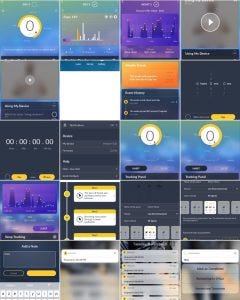
First of all, as a User Experience Designer I consider myself as a User advocate. In simple words, my goal is to create a better Pavlok experience for all of our current and future users. My first action when I arrived was to do a quick audit about what users were experiencing. Here is one that came out rapidly: it was hard to change the Pavlok zap strength in the first version of the app — remember those little circles and dots to turn around? — well, even if that was a fun and interesting concept, it wasn’t really what we call user-friendly. This is why I decided to change it into simple sliders.

You might wonder why I chose to center my work on the Pavlok iOS and Android app, well this is simply because of you, the users. You expressed that even though the Pavlok is working great, it is lacking the visual clues that make the experience of stopping or starting a habit easy. So I decided to answer to that frustration by building an app that would be the screen of your favorite device.

In a broader vision, here is how I work. I articulate my process over 4 main steps: Gathering Inputs, Ideating, Reviewing + User Testing, and Building the App with the software team.

Each of these steps requires a huge amount of feedback from everybody involved with Pavlok: the users (duh!), the Pavlok customer support team, the developers, the business, my friends, my mum… you got it, pretty much everybody! This is one of the many reasons why I am so passionate about my work, because I build for and with many people!

Gathering Inputs

There are many ways to gather information about what I have to create next. The main one though is through user research. To carry it out I send surveys and interview users. But I also rely heavily on our Facebook community — I read all the comments! — and the feedback from the customer support team. At Pavlok, the whole team is very (very!) committed to user happiness, and whenever a user is having a bad experience, getting a bug or needs help to progress on their habit, I make sure the issue is addressed on the design level and that it will make it into the next release of the app.

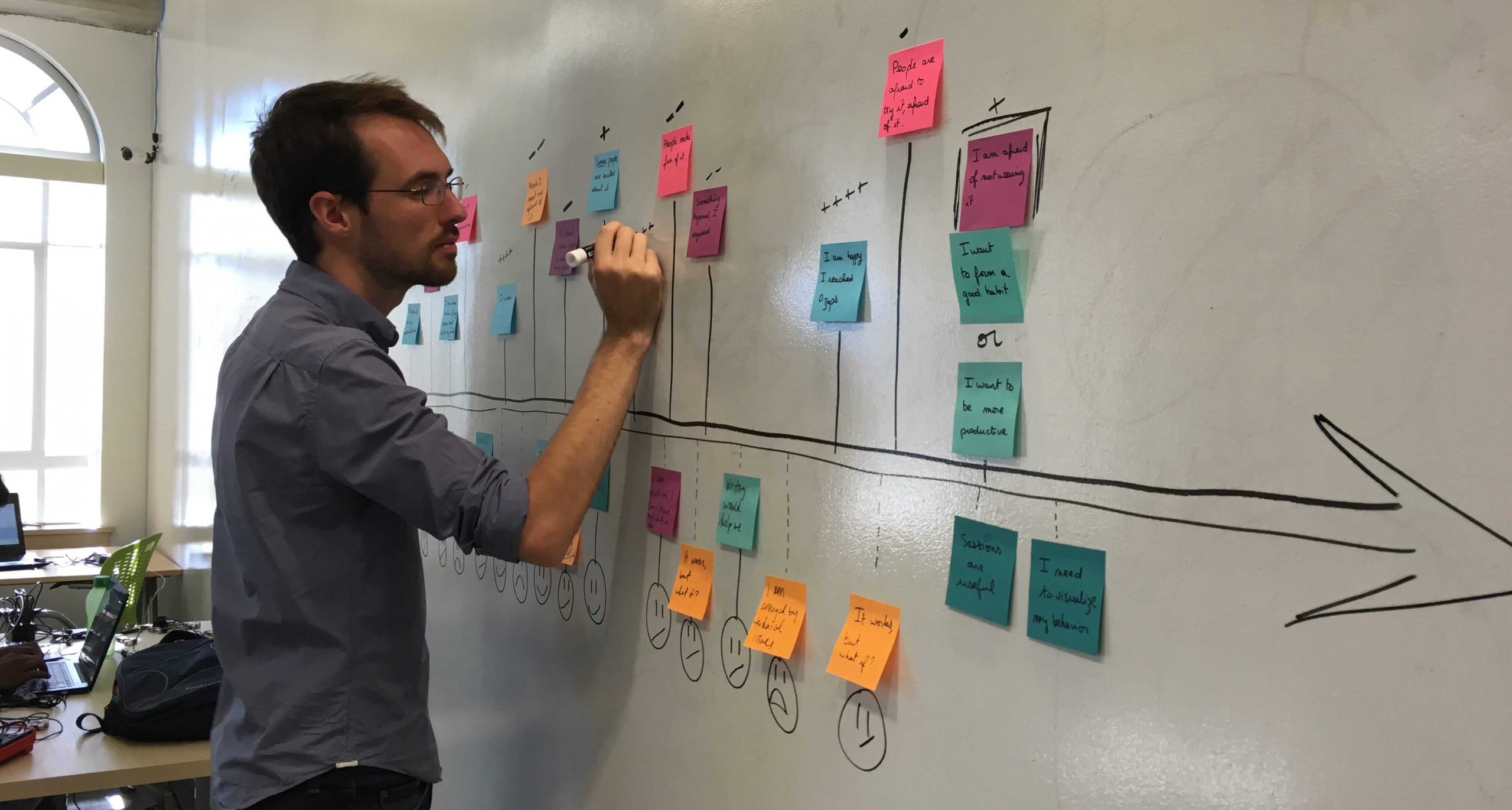
The big part of my work here is to blend all of the information I get into an actionable list of features so we can prioritize what to build next. This usually starts by reading absolutely all the answers and comments in the surveys on an excel spreadsheet, then putting tons of post-it-notes on a wall, a bit of drawing on a whiteboard, and a nice file I can share with the rest of the team.

Here is a “User Journey”, it displays what an average user is experiencing over two weeks using Pavlok and how it affects their emotions. In just a glimpse, you can see that I have some work to do to make sure the entire experience is in a green spot. Good thing that I love my work — yay! –

One of the latest cool examples is that since the October app update, we have a survey that regularly asks our users what habit they are doing. By gathering this info, and for the first time in Pavlok history, I can see what our users are doing, and how it is evolving! I found out that the Pavlok can be used in many more ways than I expected at first and that people can get really creative in what habit they stop or start with the Pavlok. The latest that surprised me? “Stop Eating Meat and Dairy”. That was unexpected and inspiring to see that some people use Pavlok to have a broader impact.

Ideating

Once we figured out what to prioritize and to work on first, the next step is basically to get a little crazy and build many different options. This requires me to find inspiration from what our users like, what apps are doing it well, what our brand is and where we want to take it. Every day, there are awesome new apps that help people changing and tracking their habits, but very few have an actual device. The very interesting step for me is to make sure that we help our users change their habits by having an easier way to use the Pavlok daily. With that in mind, whether it is on paper, on a white board or directly on Sketch (a design software), I create different options of the feature we want to develop.

Reviewing and Testing

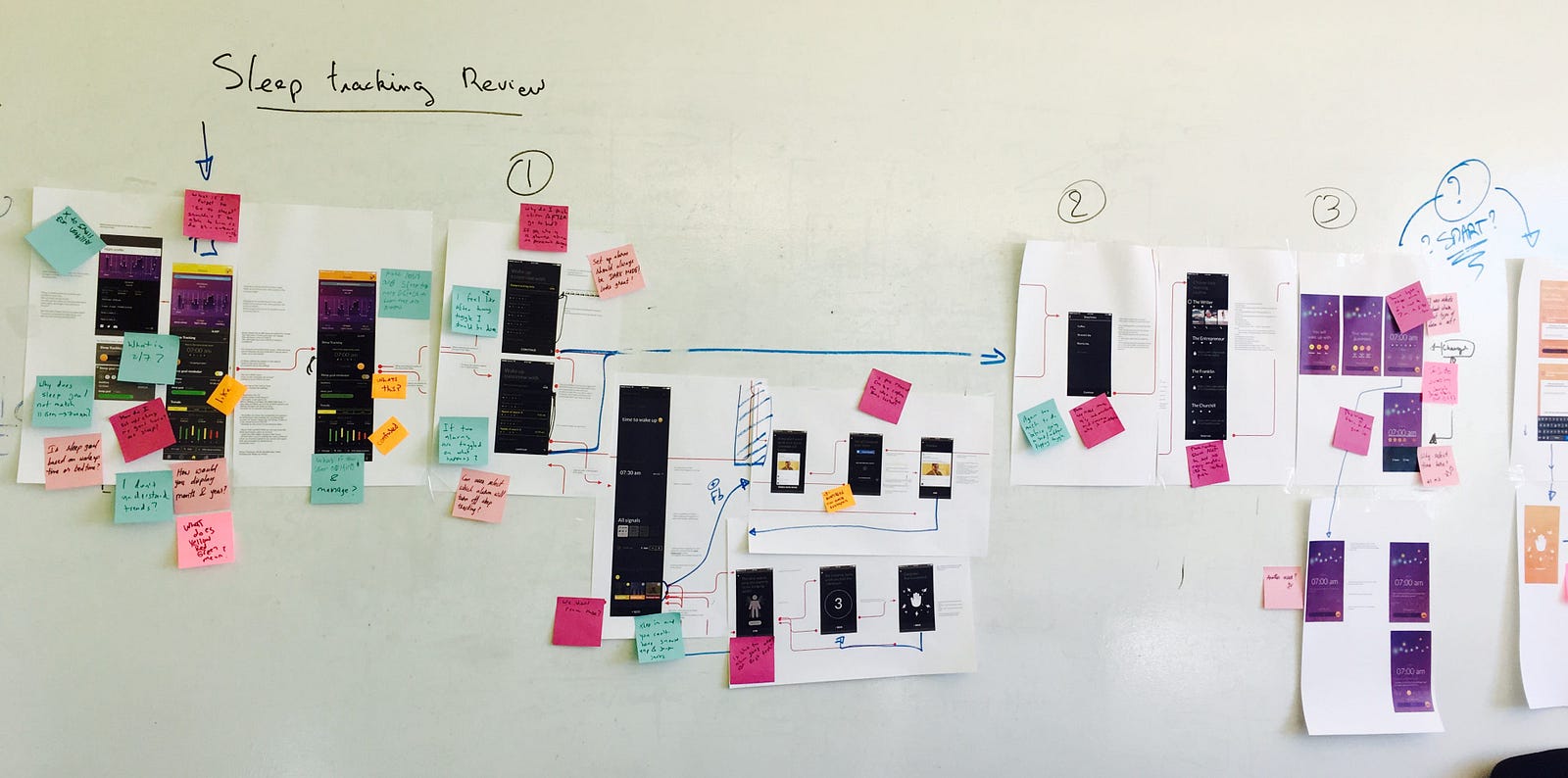
I try to have the Pavlok team review what I am building on a daily basis. But for the big new features such as “Sleep Tracking” I invite the entire team for a full design review session. I print all the screens, put them on the walls and ask the Pavlok team to write comments and questions directly on the designs. It is very helpful to start narrowing down options to make the design easier and clearer for the users.

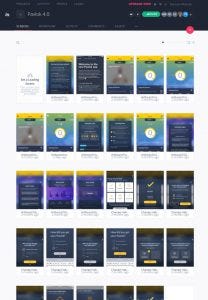
Once we narrowed the design to one solution, I create a clickable prototype on InVision. It enables me to build a fake app that users can interact with almost as if it was a real one.

This is how I can detect that some people cannot complete certain tasks in the new flow, that features can be hard to find or to understand. It is usually the most stressful and exciting moment as it is the first time that people see the new feature and share their honest feelings about it! It is always, always insightful and helps us improve dramatically from a first design to the latest.

“The Importance of User Testing”

For example, users tend to review their habit at night, and they want to have more of a privacy feeling. So we decided to switch the app to a “dark mode”. We call dark mode the style where the text is white over a dark background. It allows users to create a more intimate feeling and it is more comfortable to read at night. My first version of that dark mode was a very dark blue background. And to be honest, it was kind of sad and too serious.

In the December 31st release, you might have seen that we offered a more uplifting version of the dark mode style. Why? This was all due to user testing. Users are attached to the Pavlok brand and the promise to quickly change their habit in an unexpected way. The Pavlok brand is joyful, unexpected and definitely not too serious. While testing the dark blue version people would say: “But I don’t understand why it is so dark, I am changing my habits, it should be uplifting!” And this is how I decided to make the jump to what you have now.

The next cool step in that process will be to allow the users to choose and customize their own theme. I can’t wait to offer that option!

If you agree, don’t hesitate to support it in our new Trello board at the end of this article!

Build with the software team

Once I iterated on the designs and the “user testings” go smoothly, I start to involve the software development team more. Because yeah, somebody eventually has to build it! We are a small team of 5 people working at the interface between the app development for both iOS and Android and the device firmware. This is a lot of work to be carried out as we have to tackle so many aspects at the same time.

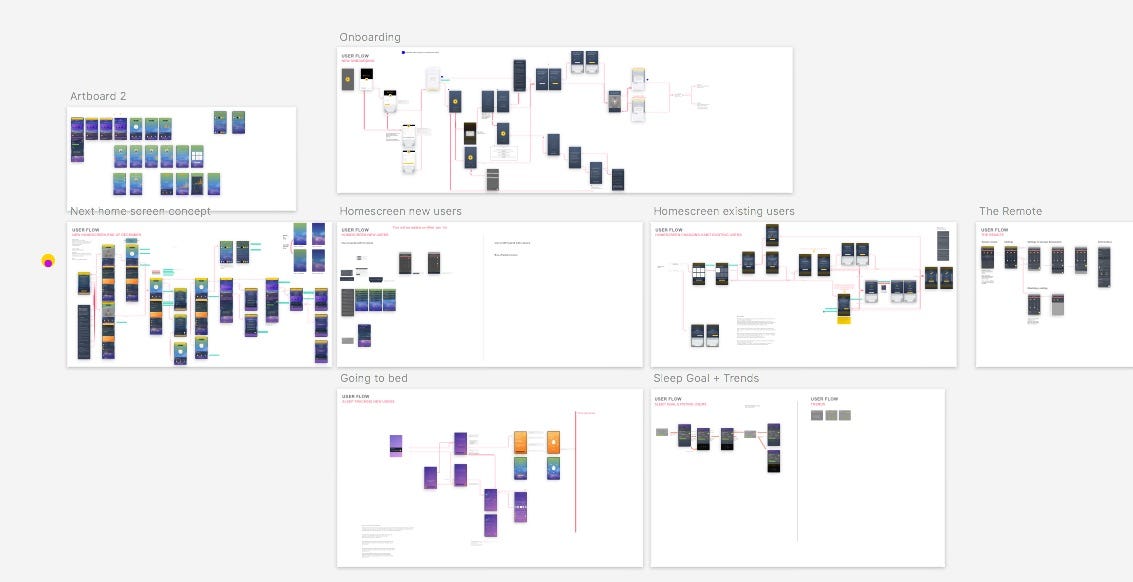
My work ends with the document I share with the software team. It is a flow of all the screens I have made. A nice compilation of a site map and a user flow with the descriptions of the interactions and all the assets they need to code, from fonts, to pictures, to frames for animated icons. Together we break it down to whatever steps are necessary to build the design, all the things that we have to create on our servers and on the app. We work closely together to make sure that we are building something we believe in and that corresponds to our user needs and wants.

The current development team ❤️

Now, it is your turn!

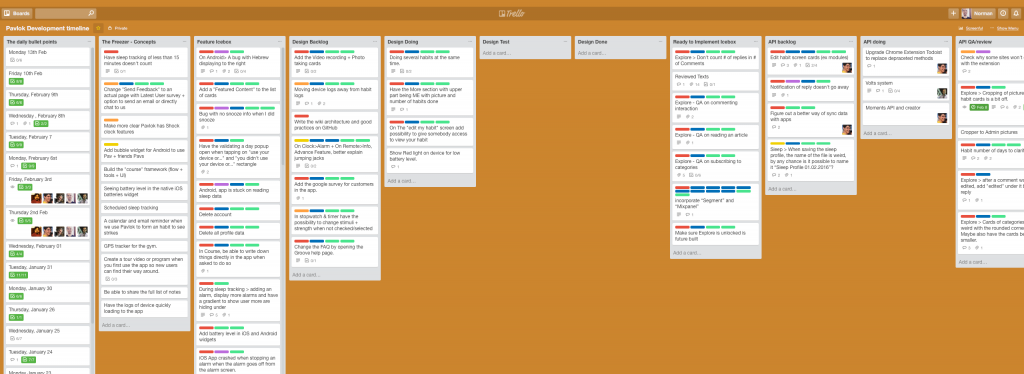
Thanks for reading our UX Pavlok story. You can now decide what feature will be built next! We are launching our open feature developement here. You will see what features are being considered, which ones are planned and the ones we are working on. We are working hard to create the tools and features that make the experience with the Pavlok better.

Go right there to our public Pavlok Feature Development https://trello.com/b/wXOGl4rC

Support the features you want by commenting on them! Tell us what you would like to have to improve your Pavlok experience, I told you, we read all of your comments!

How Dave Rogenmoser Stopped Grinding His Teeth (and Quit Sleeping In)

There are literally one million puns we could use for teeth grinding… But it’s only Monday, and you haven’t had enough coffee.

Here’s what you need to know: Dave was an avid teeth-grinder for years. AND he had trouble waking up on time.

But a lifetime of grinding your teeth with leave you with stubs and tooth pain… Plus an annoyed partner.

Stopping teeth-grinding AND waking up on time? Now THAT is a #motivationmonday story.

His comments on “opening the box was a premium—-almost Apple like experience” made me blush :). The packaging and design is the part of the product that I handled on my own, so I was happy to hear that Dave loved it as much as I do 🙂

What could you use Pavlok to change? What habit would you break?

I want your motivational story to start today – and for you to quit your habits at last!

Dave used a Pavlok to change his habits for good. The Pavlok includes all alarm clock features, plus bad habit features. If you’re only interested in waking up earlier, the Shock Clock is for you. See more about the Pavlok vs Shock Clock Differences here.

——————–

Shock Clock Vs. Pavlok: What are the differences?

[et_pb_section bb_built=”1″ admin_label=”section”][et_pb_row admin_label=”row”][et_pb_column type=”4_4″][et_pb_text admin_label=”Text” background_layout=”light” text_orientation=”left” use_border_color=”off” border_color=”#ffffff” border_style=”solid”]

Short answer:

  • The Shock Clock is an alarm clock that vibrates, beeps, and zaps you awake.
  • The Pavlok includes all of the Shock Clock features, plus a full suite of courses, features, and integrations to help you break bad habits.

Pavlok and Shock Clock both use the same hardware. The Shock Clock can be upgraded to the full Pavlok in the app, after purchase.

[/et_pb_text][/et_pb_column][/et_pb_row][et_pb_row admin_label=”Row”][et_pb_column type=”1_2″][et_pb_text admin_label=”Shock Clock Youtube Embed” background_layout=”light” text_orientation=”left” use_border_color=”off” border_color=”#ffffff” border_style=”solid”]

Watch the Shock Clock Intro

[/et_pb_text][/et_pb_column][et_pb_column type=”1_2″][et_pb_text admin_label=”Pavlok Youtube Embed” background_layout=”light” text_orientation=”left” use_border_color=”off” border_color=”#ffffff” border_style=”solid”]

Watch the Pavlok App Intro

[/et_pb_text][/et_pb_column][/et_pb_row][et_pb_row admin_label=”row”][et_pb_column type=”4_4″][et_pb_pricing_tables admin_label=”Pricing Tables” show_bullet=”on” bullet_color=”#ffcd00″ center_list_items=”off” header_text_color=”#000000″ price_text_color=”#ffcd00″ use_border_color=”off” border_color=”#ffffff” border_style=”solid” custom_button=”off” button_letter_spacing=”0″ button_use_icon=”default” button_icon_placement=”right” button_on_hover=”on” button_letter_spacing_hover=”0″ featured_table_header_background_color=”#ffcd00″ featured_table_bullet_color=”#ffcd00″ remove_featured_drop_shadow=”off”]

[et_pb_pricing_table featured=”off” title=”The Shock Clock” subtitle=”The World’s Best Alarm Clock” button_url=”https://buy.pavlok.com/products/shocking-alarm-clock” button_text=”Order the Shock Clock” header_font_select=”default” header_font=”||||” subheader_font_select=”default” subheader_font=”||||” currency_frequency_font_select=”default” currency_frequency_font=”||||” price_font_select=”default” price_font=”||||” body_font_select=”default” body_font=”||||” custom_button=”off” button_font_select=”default” button_font=”||||” button_use_icon=”default” button_icon_placement=”right” button_on_hover=”on”]

+ Tracks Sleep

+ Set 6 types of Wake Up Alarms

+ Motion detection / Jumping Jacks Snooze Lock

+ Introduction to Habit Change Course

Breaking Bad Habits Courses

– Pavlok Productivity Chrome Extension

Smart Integrations and IFTTT

– Pavlok Unlocked Remote Control Access

[/et_pb_pricing_table][et_pb_pricing_table featured=”on” title=”The Pavlok” subtitle=”Break Bad Habits, Get Productive, and Wake Up On Command” button_url=”https://buy.pavlok.com/products/pavlok-1″ button_text=”Order the Pavlok” header_font_select=”default” header_font=”||||” subheader_font_select=”default” subheader_font=”||||” currency_frequency_font_select=”default” currency_frequency_font=”||||” price_font_select=”default” price_font=”||||” body_font_select=”default” body_font=”||||” custom_button=”off” button_font_select=”default” button_font=”||||” button_use_icon=”default” button_icon_placement=”right” button_on_hover=”on”]

+ Tracks Sleep

+ Set 6 types of Wake Up Alarms

+ Motion detection / Jumping Jacks Snooze Lock

+ Introduction to Habit Change Course

+ Breaking Bad Habits Courses

+ Pavlok Productivity Chrome Extension

+ Smart Integrations and IFTTT

+ Pavlok Unlocked Remote Control Access

[/et_pb_pricing_table]

[/et_pb_pricing_tables][/et_pb_column][/et_pb_row][/et_pb_section]

A Thought Experiment: “What If I Lost Everything…” (How To Use A Gratitude Journal)

Imagine waking up tomorrow and not having any of the comforts that you’ve worked hard for years to obtain or the support systems that you’ve become completely dependent on and accustomed to.

  • You have no money in your bank account.
  • No network of friends or family to help you.
  • No degree to fall back on.
  • No clue what you want out of life.

What would you do? How would you begin to piece your life back together?

Many of us would crumble emotionally. We’d completely shut down.

But once you consider what it would feel like to lose everything, you truly begin to see how many advantages you actually have.

Take a deep breath, and quietly ask yourself right now, “What would I do if I lost everything?”

The concept sounds scary — but believe it or not, you’d only need one tool to piece it all back together.

It all starts with gratitude

If I lost absolutely everything tomorrow, I’d only need one thing to start rebuilding myself.

Gratitude.

At the beginning of the year, we talked about my goals and objectives for 2014. One of them was to begin keeping a gratitude journal filled with everything I’m thankful for on a daily basis.

Here are the two best reasons for keeping a gratitude journal:

First, it’s always energizing to think about the aspects of your life that you love and the reasons you’re happy to be alive. In fact, research has shown that simply adopting a positive mindset can actually increase your real-life happiness, productivity and overall health.

Gratitude and happiness act as feedback system. The more grateful you are for your life (even the little things), the happier you become. The happier you are, the healthier and more productive you get — and that brings more gratitude. The cycle starts anew.

Keeping a gratitude journal is a great way to start that feedback loop.

The next reason for keeping a gratitude journal is even more powerful than just the cultivation of a positive mental outlook.

Simply put, forcing yourself to name people and things you’re grateful for actually challenges your brain to think about what life would be like without these things — and then come up with creative solutions.

Oftentimes, we let our “idea muscles” grow weak. We don’t practice coming up with creative solutions. We stop thinking of innovative ways to solve problems. But coming up with solutions to our problems is a skill, just like any other. We must practice using this part of our brain.

A James Altucher talks about the link between gratitude, creativity and happiness in his “Daily Practice.”

I use my gratitude journal as a catalyst to spark my “idea muscles.” Once before I wake up, and once again before I go to sleep, I pull out my journal and write down at least 10 things I’m grateful for.

I try to think of 10 different things in the morning and 10 new ones in the evening. Even “little wins” like, “I got to wear my favorite shirt today” count. Always acknowledge the little things.

Then I use that positive energy to come up with solutions for the problems I’m dealing with.

Start your gratitude journal, right here on Hack The System

Let’s start our gratitude journals, right here. Together.

Here’s what I want you to do.

  1. Ask yourself, “What would I do if I lost everything?”
  2. After considering what it would be like to lose everything, write 10 things that you’re very grateful for in the comments. Bonus points if they were things that you hadn’t taken the time to appreciate until today.

What is the Pavlok Unlocked Web App?

Unlock the power of your Pavlok across the web!

Don’t like zapping yourself? Do you need that extra support from your family to do your dirty work? Or maybe you just want to zap your best friend, so he/she quits that bad habit? You can!

Introducing Pavlok Unlocked

The Pavlok Unlocked provides an easy way for you to let someone assist you in breaking your bad habits. It is the best way to send or get zaps, beeps, and vibrations from anywhere or anyone with an internet connection.

Say your significant other is trying to stop nail biting. You see he/she chewing mindlessly away over on the couch. You can simply take out your phone and zap, vibrate, or beep them with a push of a button.

Think of Pavlok Unlocked as your partner in crime. It will help others make you more aware of your habits so that you can be successful!

How To Set Up Your Pavlok Unlocked

Get help from someone by granting access to your device. It’s straightforward and easy.

  1. In the app, go to the “More” section,
  2. Under “Device” go to “Pavlok Unlocked”,
  3. Follow the instructions to configure your Pavlok with the Pavlok Unlocked web app securely,
  4. Add Friends by simply adding their email address, they will receive an invitation to set up an account as well.

Access To Your Friends Pavlok Unlocked Remote

Your friend or significant other gave you access to her/his Pavlok.

  1. Open your favorite web browser on any device,
  2. Go to https://pavlok-unlocked.herokuapp.com,
  3. Log in to your account,
  4. Open Manage friends,
  5. Open your friend’s web remote and activate the stimuli you want (don’t forget to save your friends remote for later ????).

Keep In Mind

The Pavlok Unlocked Web App is securely connected to the Pavlok device through the Pavlok app.

For the remote to work the Pavlok users has to be connected to the internet, and to be paired with the app.