Blog

What’s New In The Latest Firmware Update


Hey Shockers!

As you know we recently released our latest firmware update with a ton of bug fixes and new features released. The Pavlok team continues to work hard to make the Pavlok hardware and software combination the absolute best way to improve your habits for good.

Here’s what’s new with the latest update.

Don’t have a Pavlok? Order now. Or download the app on IOS and Android (no hardware required.)

Pavlok Firmware Update

  • Vibe strength now works down to 10%
  • Low-battery indicator added: at 7% or lower a periodic (every 30s) red LED flash occur. This is a unique pattern of three sets of two very short flashes. Connecting to the charger will clear this.
  • Clock-not-set warning flash added: when the battery discharges fully, the real-time clock (RTC) chip will not be set after power is restored, until the device is paired with the app. When this condition exists, the red LED will flash periodically in a warning pattern: two sets of two short flashes followed by a one-second long pulse. The warning flash should stop within a few seconds of connecting to the phone.

        Jumping jack option added for alarms

  • More flexible stimulus (vibe/beep/zap) and LED combinations.
  • Alarm stimuli are now sequential, so instead of vibe+beep+zap occurring together, an alarm will now do vibe, pause, beep, pause, zap, pause, and repeat (or an appropriate subset, depending on the selected stimuli).
  • Stimulus pattern durations (on and off times) are now controllable from 10ms up to 10s.
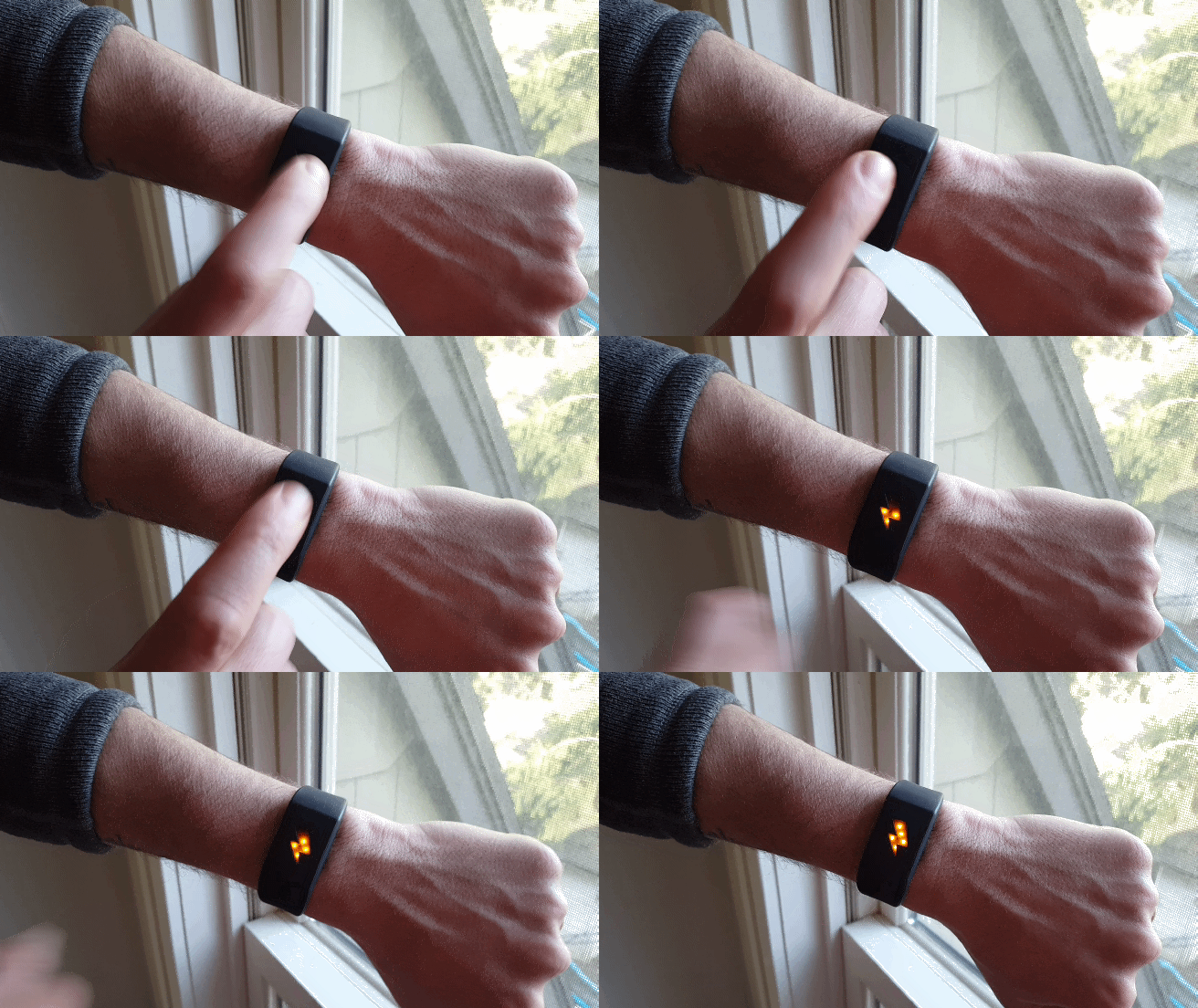
  • Snooze indicator with triple yellow LED flashes every 10s as long as alarm is snoozed.
  • Fixed alarm dialog is shown properly if phone is paired after alarm has already triggered.
  • Implemented haptic feedback for initial button press: a quick vibe that simulates the “click” of a regular button. Also added additional vibes for “long” and “very long” presses, to signal when you’ve held the button long enough.
  • Alarms are now cancelled when the button is held down long enough (2.5s) even while it’s still being held down.
  • Pressing the button will cancel any active stimulus (including multi-zap!) and no additional stimulus will be started as long as the button is held down (except the haptic feedback, and the double-vibe when an alarm is stopped).

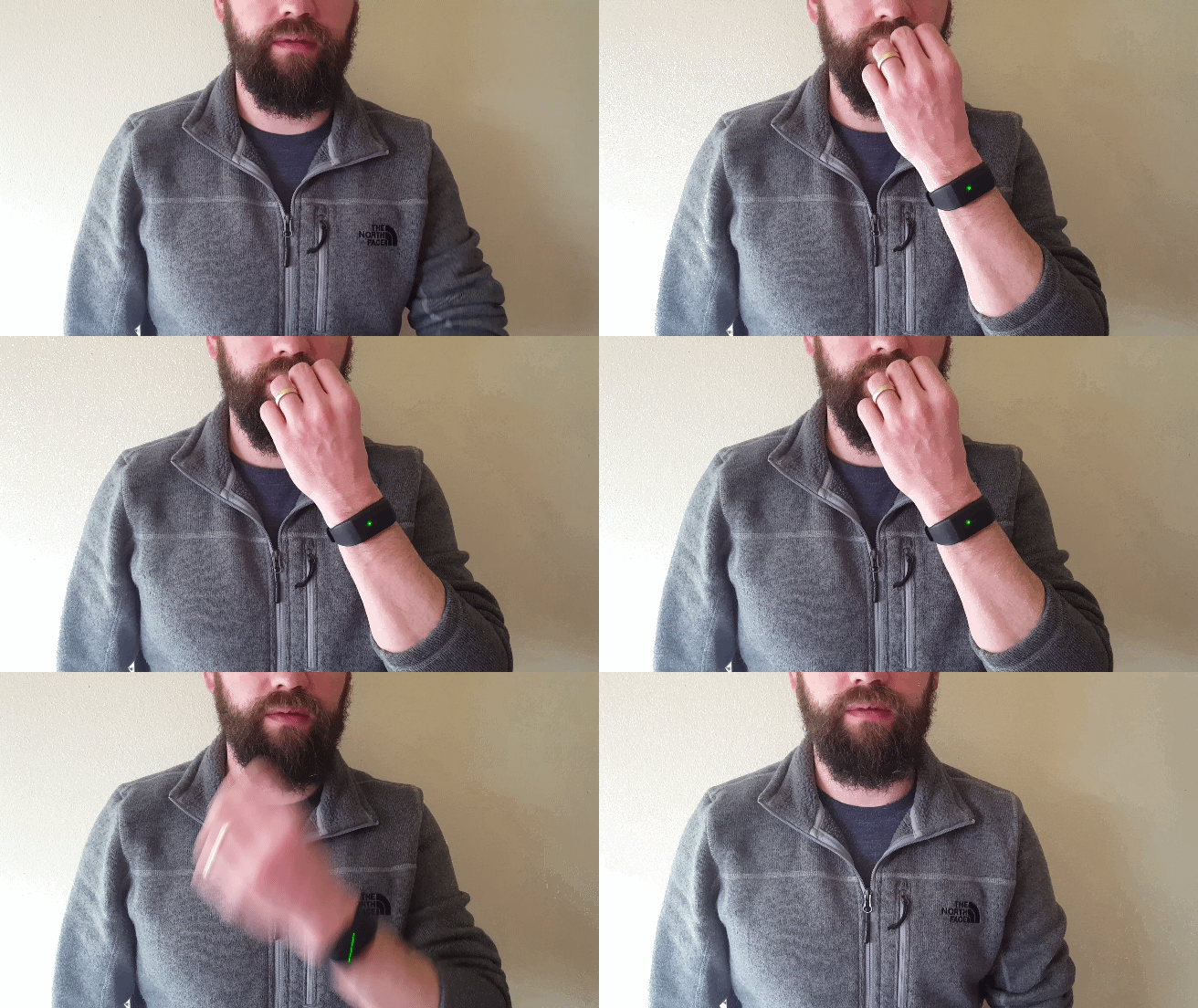
    Hand detect now allows selection of several stimulus patterns: vibe, beep, zap, or “countdown” which cycles through vibe (3 short ones), beep (3 short ones), then a sequence of 3 zaps, before starting over. The zap level is configurable as well.

  • Vibe and beep stimulus patterns now include a green LED indicator whenever the motor or buzzer is active, for additional user feedback.

We’re very excited to continue adding improvements to firmware to help you reach your goals.

As always, if you have any questions, feedback, or need help transforming your habits, please reach out to support@wp.pavlok.com

The Secret Technique To Stop Unhealthy Eating

Man with junk food


If you snack or eat fast food more often than you would like, you’re not alone – 1 in 4 Americans will visit a fast food restaurant today. Nutritionists advise limiting fast food meals to once per month, but how many people follow this advice? University of Alberta researchers recently found that a drink and a snack from a vending machine would provide 15 teaspoons of sugar and 433 calories—roughly the caloric equivalent of a McDonald’s Quarter Pounder.

60% of Americans are overweight or obese, and the Surgeon General has stated that “fast food is a major contributor to the obesity epidemic.” This isn’t surprising, considering a single meal at a fast food establishment can fulfill your total calorie intake for the day. It’s also not hard to see how uncontrolled snacking can contribute as well.

And whether or not weight is a concern for you, processed foods are not a healthy part of any diet. Yet potatoes are the most consumed vegetable in America – in the form of French fries, and how far down the list do you think potato chips fall?

No one walks into a fast food chain like Wendy’s or Burger King expecting a nutritional and healthy meal. We know the risks, we’ve been shown the statistics, but we still spend billions of dollars on fast food every year. Or how about the quick stroll down to the office snack machine?

Why do we maintain this destructive relationship with unhealthy food?

The most commonly known answer is in the label itself: fast food. As the national average work week increases, you’re left with less and less time to plan and prepare meals. As a result, many Americans are more concerned with convenience than health when hunger strikes. We’ve also been conditioned to use food as a response to outside circumstances. Did you have a bad meeting and need to respond? Difficult conversation with a friend or loved one? We habitually turn to food.

The argument of the availability of unhealthy food isn’t new. But new studies are suggesting an additional factor that makes it so hard to beat an unhalthy food habit.

Have you ever considered the added sugar in processed foods?


Sugar can be More Addictive than Cocaine


Cocaine


On average, Americans consume between a quarter and half a pound of sugar. Every day. That’s 800+ calories with no nutritional value. You don’t just love the taste of a Frosty, you’re addicted to it.

Studies have been conducted on rats regularly receiving cocaine through an IV. When they have the option of switching to sugar, almost all of them switched, and those who switched ending up binging on sugar more than cocaine. If a rat is given total 24/7 access to all of the cocaine it could want, it will eventually stop eating and stop sleeping. It will use more and more cocaine until it dies.

Guess what happened when rats were given that kind of access to sugar? (Hint: they didn’t join Weight Watchers).

Added sugars (present in about 75% of packaged food in America) activate the same pathways as other addictive substances, and have parallel effects. Drugs like cocaine, heroin, and nicotine all change the way your brain processes dopamine. Over time, this leads your brain into an increasingly violent cycle between withdrawal and reward.

So when you want to avoid snacking or the drive-thru, it’s not as simple as packing a lunch in advance. Your brain has been programmed over time to function on snacks and fast food to satisfy its addiction to sugar, and it will produce intense cravings when you try to stop!

This can be good and bad news. The good news: if you’ve tried and failed to avoid snacks and fast food in the past, you can’t put yourself entirely at fault. There are more factors going on than the strength of your willpower alone. The bad news: while you can absolve yourself from total responsibility, this also means it’s a lot harder to stop than you thought.


Luckily, there’s good news

There’s one, little known secret method, that can break negative habits in their tracks

That secret…

Aversion Therapy Works Against Addiction


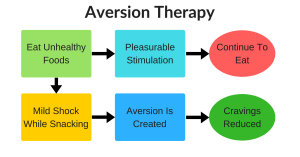
Aversion Therapy Infographic


Luckily, there’s more good news. Every time you sip your shake, the sugar activates the reward pathway in your brain, and this pathway works in reverse!

This is the basis of aversion therapy. Just as you can get your brain to make positive associations, you can teach it negative associations that work in your favor. Today, with America’s growing dependence on sugar, there are a lot of self-proclaimed ‘professionals’ out there trying to monetize the epidemic with expensive programs to help you quit.

Examples include a collection of slideshows pairing pictures of junk food with morbid and disgusting images, hypnotists who will come to your home (and charge by the minute), and detailed guides containing cleanses and recipes that will dictate what you’re allowed to eat for the rest of your life (plus shipping and handling).

The way to start curing sugar addiction is to treat it for what it is: an addiction. Snacking and fast food has rewired your brain, so attention must be paid at the neurological level.

Consider drugs like nicotine and alcohol. They function in several different ways, but both of them, like sugar, raise the concentration of dopamine in the brain — making you feel rewarded, and ultimately causing addiction.

Electrical aversion therapy, which pairs a mild electric shock with the drug, helped the majority of those addicted to nicotine and alcohol quit in five (or fewer) days.

Sugar has various effects on the body, but recent research has shown it shares its main effect on the brain with these drugs. So if electrical aversion therapy can cure the majority of smokers and alcoholics, wouldn’t you rather give that a try before you start cold-calling hypnotists?

We know convenience is important to you. Pavlok is a wristband with a simple one-button system to deliver a safe shock, and you can adjust the intensity to a level that’s comfortable for you. Electrical aversion therapy has always been effective, and now, it’s more convenient than ever.


How to Use Pavlok to Stop Eating Fast Food

Pavlok for Aversion

The actual addictive qualities of the sugar in your snacks and fast food were only revealed recently, and researchers are still working to understand the full extent of its ability to change how your brain works. Meanwhile, Americans across the country are continuously starting and ending magic fixes and extreme diets. And they all support the idea that if you fail, you are the one to blame.

But we now know that your snacking and fast food habit is more than that. Your brain has been altered to want sugar, and will give you cravings if you try to resist!

That’s why Tasha had been trying for years to stop eating sugar, but was never able to make a permanent change in her diet. But she started using Pavlok the same day it arrived in the mail, and has not had refined sugar since!

You’re not expected to be able to ignore your brain’s needs on your own, and Pavlok can help reverse this reward circuit in five days or less.


Order Your Pavlok And Quit Unhealthy Eating In As Little As Five Days!


Sign up below to get your free copy of “Five Fast Ways To Cure Food Cravings“. This e-book has helped thousands of people quit food cravings and can be the first step to making the best you the REAL YOU! 


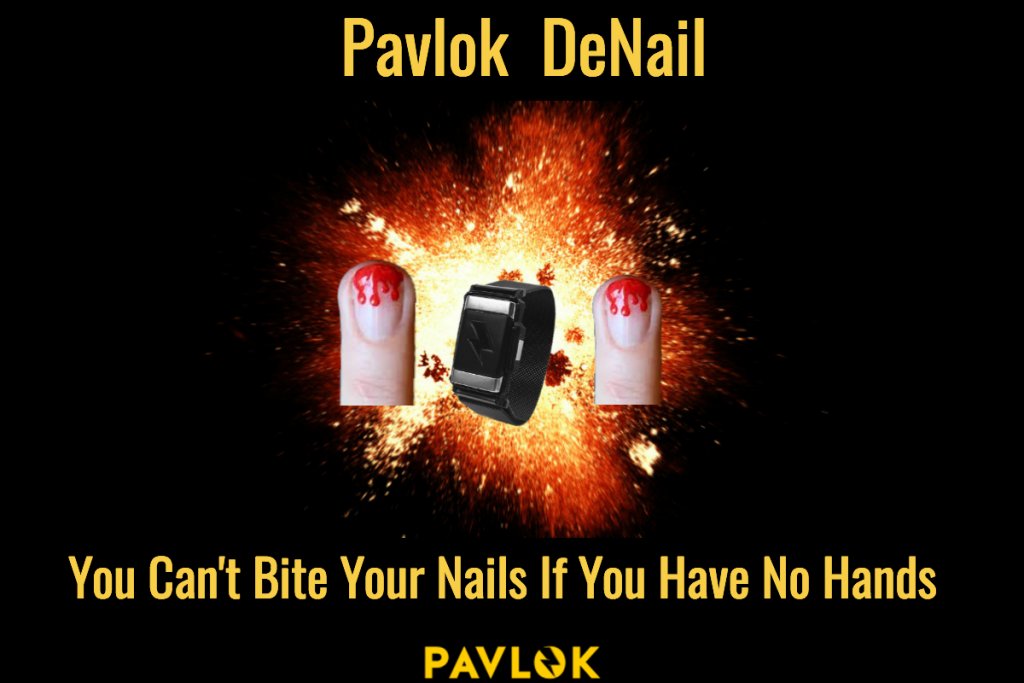
Introducing Pavlok DeNail

Happy Easter fellow shockers,

Today we couldn’t be more excited to announce the latest addition to the Pavlok family – Pavlok DeNail.

We have been secretly at work on this for the last several months and truly believe it is the most important moment of the company since Pavlok was originally founded.

Having helped thousands of people all around the world break bad habits, we’re always looking for ways to make habit change even easier!

And while Pavlok already has an incredibly high success rate in helping Pavlok users quit smoking, quit biting their nails, cutting back on sweets and more…

We know we can do even better. Which is why we built Pavlok DeNail.

Pavlok DeNail was specifically designed to ensure 100% that you can quit your bad habits for good, specifically biting your nails.

We mean it. 100% success rate guaranteed. No that’s not a typo.

It’s the very first wearable of its kind, and it’s going to revolutionize how we view habits. Pavlok DeNail takes habit change to the extreme.

So how does Pavlok DeNail work?

Like the regular Pavlok, you wear you wear the Pavlok DeNail throughout the day.

With its state of the art hand detection and integrations with dozens of apps, Pavlok DeNail will ensure you will stop biting your nails and quickly.

You’ve already used Pavlok, and it has helped significantly, but you want to go that extra mile.

With Pavlok DeNail we have introduced the three strikes, and they are gone feature.

Bite your nails once? Strike one.

Bite your nails twice? Strike two.

Bite your nails three times?

Pavlok DeNail will activate, and your device will immediately explode, leaving you with serious (and potentially life-threatening) injuries.

You can’t bite your nails if you’re missing your hand.

This goes for smoking as well. You’ll sure think twice about lighting up a cigarette after a 10k hospital bill.

Best yet, the Pavlok DeNail is fully customizable, so you can tweak it to fit your exact needs.

Want five warnings before your device goes nuclear? Easily change your settings in the intuitive and easy to use app.

Want your device to play the Jaws movie soundtrack before it explodes? The choice is yours.

We’ve been fortunate to have a few users test the Pavlok DeNail beta and here is what they had to say…

“Before Pavlok DeNail I couldn’t stop biting my nails. Nothing worked. After I lost my first finger, I haven’t had the urge to bite my nails even once. Despite the hundreds of questions I get about my missing finger, I couldn’t be happier! Thanks, Pavlok!”

“Knowing my Pavlok DeNail explode the after I miss gym three times in a row… is so motivating!!!”

We expect our first batch of Pavlok DeNail’s to sell out very quickly.

If you’re tired of your bad habits holding you back, it’s time you give Pavlok DeNail a try.

Order Pavlok Pavlok DeNail now.

Disclaimer: Pavlok is not responsible for any lost limbs or medical bills that will likely occur during the use of Pavlok DeNail . Please consult with a nutritionist, life coach, and physician before starting any exercise program and take out a life insurance policy before purchasing your Pavlok Code Red.

P.S. APRIL FOOLS!

6 Proven Ways To Reduce Procrastination

As much as we try to deny it, the truth is, we all struggle with procrastination from time to time, and for many of us, procrastination is a serious issue that affects our relationships, career, habits, and life.

While there’s no way to cut out procrastination entirely, there are a few tips and strategies to help you gain more control of your time and energy throughout the day.

Here are five tips you can try:

Make It Difficult To Procrastinate

It’s no secret that from the moment we wake up to the moment we go to bed, we are bombarded with distractions.  Ads, commercials, social media, texts, popups, family responsibilities, all pounce for our attention throughout the day.

You can have every intention to have a productive day but have a single tweet distract you for hours.

While the likes of social media and modern communication certainly have their place, one of the easiest ways to reduce your procrastination is to make it difficult to procrastinate.

For example, our founder Maneesh recently removed his Facebook app from his phone and has found it to improve his peace of mind and productivity substantially.

Maybe you love spending hours upon hours on Reddit or can play CandyCrush until your battery dies.

Maybe you like playing a few rounds of Call of Duty or like to stock up on cleaning supplies instead of getting things done.

Make it as difficult as possible for you to partake in the habits that affect you most.

Remove Twitter from your phone. Disconnect from the internet when writing. Commit to cleaning the home only on Sunday’s and not any other day of the week.

Of course, there will always be things to tempt you throughout the day no matter what measures you put in place, but making it difficult for you to fall into your bad habits can make all the difference in the world.

Commit To Just Five Minutes

Many times, the reason we procrastinate is that we are overwhelmed with all the things we have to do.

Writing a 20-page paper for work is enough to scare anyone who is sane. Trying a new complex workout with exercises you can’t even pronounce is a sure way to ensure you won’t follow through.

An easy trick to get yourself to stop procrastinating is to commit to doing a task for five minutes. After five minutes feel free to browse Reddit or watch Netflix for as long as your heart desires.

Many times, however, once you’ve overcome the initial resistance of starting, it’s not that bad. You’ll often notice those five minutes quickly turn into an hour of highly productive work. Sometimes, five minutes is all you can do — and that’s perfectly okay.

The goal is to get moving and see where your action taking gets you. While simple on the surface, the five-minute trick is a powerful way to get more things done and have plenty of time to enjoy the rest of your day in peace.

Use Pavlok

Sometimes all you need is a push in the right direction, which is why thousands of people around the world have used the Pavlok wearable to help them fight procrastination and improve their productivity. With dozens of customizable ways to help keep you on track, Pavlok can help even if you’re a self-defined “lifelong procrastinator.”

You can use services such as the Pavlok Chrome extension, IFTTT,  Alexa, and more to ensure you are giving yourself the best chance to succeed.

Have your Pavlok buzz, beep, or zap you when you open too many tabs.

Have your Pavlok zap you if you aren’t at the gym by 6 PM.

Using the Pavlok to bring awareness to your distracting habits and behaviors will give you the tools and data needed to change your environment and routine.

If you need an extra boost to help you quit procrastinating, Pavlok can help.

Procrastinate With Purpose

While procrastination does tend to get a bad rap, and for a good reason, it’s not always the end of the world to spend an hour or two doing nothing “productive.”

The best way to fight procrastination is by procrastinating with purpose. It’s perfectly okay to spend an hour or two watching Netflix.

You don’t always have to be go-go-go productive for every second that you’re awake.

The secret to procrastinating with purpose is to hit your defined goals for the day and then allow yourself to do what you please; this typically can be done by establishing your three “MIT’s” for the day.

In the morning define your three most important tasks for the day, the ones that you would feel great about accomplishing and once those are done and checked off your list, feel free to continue you working or curl up on the couch and watch your favorite sitcom. The choice is yours.

Punish Yourself

Okay. That might sound extreme, but for many, having a specific and slightly painful ‘consequence’ for procrastinating is just enough motivation to get things done.

Maybe you’ve been putting off cleaning your garage for a year. Bet your friend $100 bucks it will be done by the weekend.

Maybe you’ve put off updating your resume despite the urgent need. Have your friend send it out incomplete to your three favorite companies if you don’t get it finished.

You get the idea. While the self-punish method to avoid procrastination doesn’t work for everyone if you continue to struggle with procrastination no matter what you try, give this a go, we promise the results will surprise you.

Stop Overthinking

Another reason we tend to procrastinate is that we fall into the trap of overthinking. What if I do a bad job on the presentation? What no one reads the blog post I’m about to write?

What will my friends and family say about me trying to the write a book?

If you find yourself procrastinating, especially on tasks you typically enjoy, perhaps you’re letting outside influence hold you back from getting to work.

The first step to overcome overthinking is to become aware that it happens. Are you too concerned with what others will think? Are you worried you might come up short?

Don’t let the fear of mistakes and not being perfect prevent you from getting started in the first place.

No matter what project, habit, or task you’re trying to tackle, have a basic plan and do your best to execute it. You can’t improve or grow by living on the sidelines.

Don’t let the sneaky overthinking trap keep you stuck in the same procrastination loop.

Putting It All Together

While procrastination will never go away, you can always learn how to manage it more efficiently; if you’re tired of procrastinating on a regular basis and ready to change your approach, give one of our six suggested strategies a try.

Don’t let procrastination prevent you from being your best self.

-Team Pavlok

 

13 Must Read Books To Improve Your Habits and Life

Happy Friday Shockers! We hope you had a great week!  Team Pavlok has an exciting weekend ahead with our founder and CEO Maneesh giving a TEDx talk on the greatest story ever told.  You can hear his outline of the speech here.

While we typically reserve Friday’s for sharing interesting stories around the web, a fellow Shocker recently asked what some of the best books on habits were, so our team put together some of our favorites.

As you know, habit change and personal growth are a never-ending journey – there’s always more we can learn!

While not all these books are specifically related to habits, we’re confident you’ll find a gem or two to help you take your habits and life to the next level!

The Power of Habit – Easily one of the most popular habit books in the last ten years, The Power of Habit by Charles Duhigg shares the latest scientific discoveries on how to change your habits and behavior. If you haven’t given this a read yet, cancel your weekend plans.

Mindset:The New Psychology of Success – Written by Stanford University psychologist Carol S. Dweck, Ph.D., this incredibly successful book put the concept “growth mindset” on the personal development map. Dweck shares some of the best insights and strategies to live an exceptional life.

The One Thing – With so many apps, hacks, and strategies pulling us in thousands of directions, it’s no wonder it’s so hard to make lasting change. The One Thing challenges us to hone our focus and make daily strides in the areas of our lives that matter. If you’ve struggled to stay focused on your big picture goals this book is for you.

Drive – Understanding motivation and how it affects your day to life is essential in building a life in which you’re growing and improving every day. In this excellent book, Daniel Pink shares the latest research on motivation and why it’s so misunderstood. You’ll walk away with a new understanding of the world after you finish this one.

Allen Carr’s Easy Way To Quit Smoking – One of the most popular books on how to quit smoking every written, Allen Carr takes a unique approach to how to quit smoking for good. If you’ve struggled to quit smoking no matter what you’ve tried, this book will give you the mindset needed to become a non-smoker once and for all.

Make It Stick – Learning how to learn is one of the most beneficial investments you can ever make. Unfortunately, we rarely take the time to examine how we’ve been taught to learn and whether or not what we have been taught is effective.  Drawing on the latest psychology and cognitive science, you’ll learn how to be more productive in your personal and professional life.

The Miracle Morning – One of the best selling books in recent memory, and for good reason, Hal Elrod shares his incredible transformation from having a morning routine. Even if you’ve never considered yourself a ‘morning person’ this book is packed with actionable insight on how to get the most out of your day.

The Motivation Myth – “Motivation” is perhaps one of the most misunderstood concepts in science and personal development today. What’s the real ‘secret’ to motivation? Are people born with the ‘motivation’ gene? One of INC.com’s most popular columnists shares a deep dive of the latest research on motivation, and his findings will surprise you.

The Now Habit – Procrastination is a habit. The Now Habit shares actionable steps and strategies to help you stop delaying and get to work. With dozens of inspiring stories from ‘lifelong procrastinators,’ there’s plenty to take away and apply in your life. While we all procrastinate from time to time, this book will show you how to be more productive and get more done than you ever thought possible.

Nudge – With the average person making hundreds of choices each day, everything we do from what we wear to our bedtime routine can change the quality of our life. Nudge shares the latest research on how to make high-quality decisions that will create positive ripples throughout every area of your life.

Predictably Irrational – One of the most popular books among the Pavlok team, Dan Ariely shows how irrational humans are. Why do we spend hundreds of dollars on a night out, but cut out coupons for the grocery? Why do we have such counterproductive habits when it comes to romantic relationships? This book is a true masterclass in human behavior.

Jonathan Livingston Seagull – This short story about a seagull committed to living his best life is sure to move you to think about how you can take your life to the next level. It didn’t sell millions of copies around the world on accident. If you’ve ever struggled to fit in especially when it comes to your personal development journey pick up a copy today.

The Compound Effect – Small actions add up over time. Instead of swinging for the fences with your habits, finances, and fitness, invest in the long term and take small actions each day. If you’ve struggled to lose weight, quit smoking, or move up in your career, this book is a must-read.

That’s it for our special edition of #LinkFriday.

Have a great weekend, and we’ll see you next week!

-Team Pavlok

Three New Features And How To Update Your Pavlok Firmware to 5.3.0

Hey there Shockers!

We’re VERY excited to announce that we have just launched firmware update 5.3.0. The Pavlok team has been hard at work behind the scenes continuing to improve Pavlok and make habit change easier than ever.

Here are a few key updates pushed live with the new update.

-Hand Detection
-Light Stage Sleep Alarms
-Double Tap

How To Update Your Firmware to 5.3.0

Hand Detection

Light Sleep Alarms

Double Tap

As always, please let us know if you run into any issues or have any questions.

Yours in habit change,

-The Pavlok Team