Optimize Your Daily Routine with 7 Habit Hacks

On the weekend I was hanging out with Pavlok’s Head Habit Hacker — Justus.

First stop was a pub where they had one of those basketball arcade games.

Why did we spend Saturday night feeding $1 bills into Hoop Fever?

It’s a way to make exercise fun (shooting balls, aiming for high scores), and that helps build the habit.

FYI, I’m terrible at sports — but that doesn’t matter — 326 missed shots is still a good arm workout.

And that is just one way our Head Habit Hacker optimizes his off hours.

For today’s post, I asked Justus to share 7 more habit hacks you can build into your daily routine.

Here’s his list…


1: Tea and Burpees

One of our teammates taught me this. When you put on a pot of tea, do some pushups, or better: some burpees. This hack includes two of our favorite principles of habit-change: triggers and routines.

When Pavlov rang the bell, his dogs salivated. When you put on a pot of tea, do some calisthenics. The dog got fed, you get ripped.

When x happens, do y behavior, reap z reward.

2: One-Foot Tooth-Brushing

Improve your balance by standing on one foot while you brush your teeth. I’m at the point where I can brush my teeth and floss without leaving my non-dominant foot. I honestly want to bolster my hygiene routine just to take this habit to the next level.

This is a good example of using a challenge to make the habit more fun.

FYI: I’m actually writing this in tree pose at my standing desk (a cooler on a desk).

3: A Journal Silhouette

One of our highest-performing customers has started a consistent writing habit using Pavlok. She has been notoriously creative with her habit-modification tactics.

Not so long ago, she found herself misplacing her journal. The solution to this was to outline the journal’s usual resting place with painter’s tape. Now, whenever the journal’s silhouette is empty, she instinctively seeks the journal to return it.

4: Commit to a Cause

One of the most popular — and most effective — tools for habit change is placing a bet. Our customers often bet medium dollar amounts ($200-2000) on their behavior.

If the client is successful, they spend the money on an awesome trip or other reward.

If the client fails, the money can be forwarded to a charity they wouldn’t normally support (since we can’t legally burn currency on camera).

This bet mechanism is generally quite effective. I have not had many clients begrudgingly hand over their cash. Our CEO, Maneesh, is well-known for making ridiculous fitness bets with his friends as well as at least one $10,000 longevity bet with a Pavlok employee.

5: Morning Pages

Big ups to my coach for introducing me to Julia Cameron’s The Artist’s Way, which introduced me to morning pages.

This habit is very simple:

  1. Wake up
  2. Free write 3 pages
  3. That’s it.

This is one of the best early-morning habits for turbo-charging creativity on a daily basis. If you’re not familiar with free-writing, it’s simply writing whatever comes to mind with no concern for content or substance.

6: Cleanup Time

I learned this one from a master of organizational psychology, a kindergarten teacher.

To encourage collective cleanliness:

  1. Acquire the attention of a group by clearing your throat.
  2. Announce cleanup time.
  3. Play a block-rocking-beat.
  4. Start cleaning and don’t quit ’til the music stops.

This is the best way I’ve found of getting engineers to clean their workspace.

7: Celebrate Every Win

Take a moment and pat yourself for reading through this entire post. Most things don’t get finished. The fact that you made it this far is a small win and you should celebrate it.

Now use that win as momentum. Get off the computer and make something. Be something!

Have a favorite habit hack? Share it in the comments below.

This post was written by Justus Eapen, Head Habit Hacker at Pavlok. For more of his writing, you can follow Justus on Twitter.

Boost Your Productivity

Consider the time it takes you to complete an assignment for school or work.

Now, think of the time it takes to convince yourself to start the task, and how often you might take breaks during the project by opening a new tab or grabbing a snack. The pen-to-paper contact time can pale in comparison to how much time you spend delaying the work.

A study conducted by the American Psychological Association found that 20% of the U.S. population suffers from “chronic procrastination”. And while this group is often written off as lazy or careless, a researcher from the study says that “it is not a time management issue — it is a maladaptive lifestyle.”

Procrastination doesn’t really provide anything helpful. In the moment, it can feel like you’re doing yourself a favor by putting off a responsibility. But by periodically choosing to avoid an assignment, you’re inflating your perception of the effort it will require. By the time you actually finish, it can feel like you were working all day just by delaying, confirming your idea of how difficult the task was.

In hindsight, you might be able to tell yourself, “That wasn’t so bad! I could have saved a lot of stress if I had just started sooner!”. But when the next project comes around, you find yourself staring at the deadline-bulldozer as it approaches from the horizon. And you stare, and stare, and stare … until the threat of a failing grade or job termination forces you to begin.

What do We Gain by Procrastinating?

Your brain is, by biological design, a great learner — it is very efficient at associating different behaviors with punishment or reward. And as the delay between the behavior and reward grows, it becomes harder for your brain to affirm that connection.

Imagine two dogs learning “sit”. One dog receives a treat immediately after sitting upon command. The other dog gets his treat an hour later.

Procrastination is instant gratification. When you ask yourself, “Should I start that project, or should I watch TV for a while?”, you are are choosing the immediate treat by indulging in television. On the other hand, by beginning the project, you’re investing in a treat later on.

But your brain is all about strong connections, so it builds the false sense that you are gaining something each time you decide to procrastinate.

All Treats are Not Created Equal

Compare the actual reward you get from mindlessly browsing the internet for hours to the reward of accomplishing a task. There are countless fun websites out there that can serve as a pleasant distraction indefinitely — but you can’t fully enjoy that distraction with the deadline looming over your head.

Whereas if you could focus on completing your work without dawdling, you get a tangible reward of value, and you have legitimate free-time afterward to do whatever you want!

Technological developments can put a speedbump in this process. Being expected to work on a computer with internet access is like trying to stay on a long and monotonous highway with exits available every ten feet, each one promising you instant gratification.

Computers are meant to help us save time with word processors and innumerable amounts of information at our fingertips, but this limitless access can also help you shoot yourself in the foot.

Use Technology for What It was Meant to Do

We could all abandon our electronic devices and isolate ourselves in random forests to maximize productivity, but that would be denying an enormous resource. The key is getting your brain to understand when browsing the internet is an interesting and engaging activity, rather than a route to distraction.

RescueTime is software that helps you manage your time across devices — it tracks how long you spend working and compares it to time spent on other websites, and uses that info to give you feedback on how to improve your productivity. It gives you the option of blocking websites of distraction for certain intervals of time to keep you on track.

And now, you can integrate RescueTime’s features with Pavlok’s shock device, a one button wristband that delivers a short and safe shock at an intensity level of your choice. So, if your productivity starts going down, Pavlok will let you know — first by beeping, then with vibrating, and then a shock. The goal is to get back to the task as soon as you notice yourself getting distracted.

You can also use Pavlok’s browser app to temporarily block certain websites and limit the number of tabs you can have open to maximize your efficiency as long as you have work left to do.

You already know that procrastination isn’t worth it, and that facing your work in advance will save you time (and worrying) in the long run. Technology should be used as a tool, not a distraction, and Pavlok can help you stay on track.

And if you’re still stuck in the instant gratification loop, just let us know! We can provide personal feedback to help you get over your bad habit.

Everyone is a procrastinator, but not everyone procrastinates. Pavlok can save you time by getting you out of the routine once and for all.

Drink In Moderation

This article isn’t about quitting alcohol forever, it’s about a science-backed method for drinking in moderation.

According to the Substance Abuse and Mental Health Services Administration (SAMHSA), one in four U.S. adults binge drinks regularly. ‘Binge drinking’ is defined as having four or more drinks on one occasion. When looking at the U.S. college student population, this number goes up to over 40%. And a study conducted at Columbia University shows that an estimated 1 in 5 college students suffers from an alcohol use disorder.

If you have an interest in cutting down, what’s the next step?

You’ve probably heard of Alcoholics Anonymous (AA). Right off the bat, there are more than a few parts of the program that discourage newcomers. AA uses a one-size-fits-all approach to alcoholism; it prescribes lifelong abstinence to anyone attending meetings. Twelve Steps and Twelve Traditions, the book that accompanies the program, reads “unless each AA follows the suggested steps to recovery, he signs his own death warrant.”

But this neglects research on the Alcohol Deprivation Effect (ADE). While abstinence may seem like the best way to be in full control of an alcohol addiction, the cravings for alcohol actually increase over time. And in a study on ADE, subjects who tried alcohol after weeks of abstinence drank in higher quantities than ever before.

It’s Not 1935 Anymore – We Know How Addiction Works

Alcoholics Anonymous has no medical evaluation for newcomers, so everyone at every meeting is treated as a lifelong alcoholic and is expected to seek total sobriety. With the proven increased risk of binging on alcohol, it’s not surprising that AA has a success rate between 5 and 10 percent.

AA was founded in the 1930s before we had any concept of the way addiction works in the brain. As a community, it provides an open forum for members to share feelings about their drinking problem.

This type of talk therapy can help a lot of people, but it assumes you’re willing to spill your guts to a room full of strangers, and it doesn’t address the real underlying mechanism of addiction in the brain.

As the neuroscience field developed, we made strides in understanding how addiction works.

Disulfiram (better known as Antabuse) causes nausea, headache, and other unpleasant symptoms when combined with a drink. An opioid antagonist, commonly known as Naltrexone, prevents the mood-altering effects of alcohol.

But if you’d like to be able to drink in moderation, there’s no motivation to keep taking Antabuse, as it will make you sick after any amount of alcohol. And while Naltrexone’s effects are painless, its used by medical professionals to promote abstinence from alcohol, not improved control alone.

And as described by The Atlantic in an article published this month, fewer than 1% of problem-drinkers in the U.S. will receive prescriptions for Antabuse or Naltrexone, as Alcoholics Anonymous is still considered the best route.

Is the Only Option to be Sober Forever?

In previous studies, Naltrexone has been shown to be most effective at reducing drinking when combined with alcohol, as it takes away the rewarding effect of drinking. Your brain has learned to expect a reward from drinking through classical conditioning, and Naltrexone helps you forget this association.

Antabuse helps a significant number of alcoholics quit entirely by adding terrible physical consequences to drinking. This is a form of aversion therapy, where an unpleasant association is added to a routine to further break the habit.

But what if you want to be somewhere in the middle? You’d like to have a drink or two while enjoying the effects that Naltrexone blocks, without the sickening effects that Antabuse adds.

Pavlok can meet you halfway.

Adding a short and safe electric shock to your drinking habit can mimic the efficacy of these drugs. You’ll still feel the alcohol, and you won’t make yourself sick, but the shock will work to break the association your brain has between alcohol and reward.

Relearning How to Drink in Moderation

Shock aversion therapy has been shown to help 60% of alcoholics quit drinking. The study, conducted by the London Institute of Psychiatry, described aversion as the ‘starting point’ of getting over the habit.

And this study didn’t even combine electric shock with the actual act of drinking; the subjects were presented with alcohol-related pictures, and were shocked when they fantasized about drinking alcohol.

Classical conditioning combined with drinking is successful in 80% of alcoholics.

So if your drinking habit has gotten out of hand, and you’re interested in getting some control back, Pavlok might be able to help you out. It’s a one-button wristband that lets you safely self-administer shocks at an intensity level of your choosing.

It’s helped people get rid of habits like smoking and eating junk food through shock aversion therapy, which has been proven to help beat alcoholism, too.

Getting Back to Normal With Pavlok

Pavlok lets you replicate these studies on your own. If you feel the urge to drink, it’s OK — just make sure your wristband is on. Pick a level of shock that works for you, and shock yourself each time you take a sip.

And so on. The shock aversion studies only took a few days to break the association between drinking and reward that kept alcoholics in the routine, so keep track of your cravings and number of drinks.

If you notice your drinking has been reduced (as seen in the studies), you can try having a drink with friends without shocking yourself. If you’re able to enjoy drinking sans-shock in moderation, great! But if you see yourself slipping into old habits, go back to conducting regular aversion sessions as needed.

Of course, if your habit is truly out of control, you might want to speak with a doctor before trying to address the problem on your own.

But if you were able to enjoy drinking in moderation in the past, and you’re finding it hard to cut back on your own, shock aversion therapy can give you some perspective.

Stop Facebook Stalking Your Ex

When I was 18 I broke up with this angry Italian girl.

Within 2 months her MSN Space was full of “kill Michael” drawings.

e.g., stabbing me to death with a toaster

Within 16 months I saw her in an ad for some porn site.

Now she has a website about cats.

Why did this happen?

Because in 2003 there was no Facebook stalking — we had to find our own outlets.

Today’s post covers:

  • why your ex’s boring life is the key to your happiness
  • how to use Pavlok to stop obsessing over the past
  • and the burning question: is Facebook stalking more fun than sex?

Here’s the article:


According to a 2012 study at the University of Western Ontario, almost 90% of people admit to periodically Facebook stalking their exes, regardless of how the relationship ended. 100% of them described Facebook as being the most distressing factor in their attempt to get over the relationship.

The study says that ‘Facebook surveillance’ limits your own self-growth. By continuing to check up on your ex, you simultaneously consider that they’re checking up on you, too — this makes you self-conscious about how they would perceive you.

So, after scrolling through the latest status updates, you might put extra effort into your own appearance to make yourself feel better … but you do that by wearing the sweater they always liked. This reinforces your pattern of thinking in the frame of the old relationship, and by staying in this cycle, you’re preventing yourself from moving on.

facebook stalking

Those who kept tabs on an ex were more likely to want to return to the relationship, and had higher ratings of ‘heartache’ post-break up.

It only makes moving on harder, but we keep doing it. How can we resist?

Some people respond to break-ups by immediately unfriending their ex. While you can’t stalk them anymore (or at least, not as thoroughly), the study found that this can prolong the heartache. Unfortunately, by entirely separating yourself from the profile, you raise the level of ‘mystery’ concerning your ex’s current life, which can make them seem more attractive.

Your Ex’s Boring Life = Key To Moving On

Basically, if you have all-access to your ex’s day-to-day life, you’re not letting yourself get on with your own life. And by totally cutting yourself off, you’ll spend so much time wondering about your ex’s life that you won’t be able to focus on anything else anyway.

So, the best solution is to maintain the Facebook friendship. While you might be tempted to hit the ‘unfriend’ button in an effort to quickly forget the relationship ever happened, you’re only delaying your own recovery, and you might end up regretting the ‘unfriend’ when you’re no longer in heartache mode.

In fact, there’s nothing wrong with reading a status update from your ex if it comes up on your newsfeed — the study says routine exposure to mundane posts like, ‘going bowling!’ or ‘just ate a burrito!’ can help you lose interest in your ex even faster.

The issue is while that small-exposure works in theory, it’s hard to do. Something as simple as a status update can launch you into a stalking binge.

What if you could make it easier? Imagine being in total control, and being able to move on with your life faster!

You Can Make the Pain Work in Your Favor!

Clicking through your ex’s pictures with their new honey really hurts. Even after you finish the album (… for the third time), the pain doesn’t end when you close your laptop — you can go about your day, but you can’t get the images out of your head.

What if you could replace that emotional trauma with less than a second of pain, a safe and simple pinch, guaranteed to help you stop the stalking once and for all? Your way to getting over your ex can be found with classical conditioning.

If you’ve heard of Pavlov’s dogs, you already have a sense of how it works. Man takes out food, dog likes food — dog comes running. Man rings bell, dog doesn’t know what that means. But if man rings the bell, and then takes out the food, the dog knows that a bell ringing means food. So man rings bell — dog comes running.

This is classical conditioning. You can associate two factors (in this case, bell and food) to change behavior. Unfortunately, it works even if the factors are bad for you, like the association between nicotine and smoking in cigarette addiction.

But there’s good news: classical conditioning works in reverse! It’s called aversion therapy, and using a stimulus like mild electric shock helps the majority of smokers quit.

Is Facebook Stalking More Fun Than Sex?

Every time you type your ex’s name into the Facebook search bar, you’re satisfying your curiosity craving. Even if you feel worse afterward, the impulsive part of you is rewarded, and your brain increases its association between Facebook stalking and reward.

Electric shock can break this connection, and it does — for most smokers, gamblers, overeaters, and more. No matter how much you doubt your ability to stop, you can’t beat the way your brain is designed to function.

If you’re entertaining the idea of using electric shock, you’re probably wondering how you’d go about it. That’s where Pavlok comes in to help you out.

Pavlok brings the efficacy of aversion therapy into your home, and everywhere else you go — it’s a light wristband with a button to give yourself a quick and safe shock. You can control the intensity with an app on your phone. And it can help you break your bad habit in days, no unfriending required.

Using Pavlok to Stop the ‘Facebook Surveillance’

You can conduct an aversion session once a day for 4 days — it only takes a few minutes.

Just put on your Pavlok and sit down at your computer. Open up Facebook, and as soon as you start typing your ex’s name in, shock yourself. Go to their page, find an interesting clump of posts, and creep to your heart’s content. But while you’re free to indulge, shock yourself around once every 15 seconds (4 times a minute) for as long as you continue.

When your curiosity has been extinguished, the session’s over, and you’ve started to step out of the cycle!

You can satisfy your desires to stalk in these four aversion sessions, but resist any temptations to check on their profile otherwise. Before you give in to any of the cravings, try shocking yourself!

After the sessions are over, use Pavlok to maintain your progress. If Facebook shoves your ex’s ‘spring break in aruba!!’ photo album in your newsfeed, and you really want to click, it’s completely natural.

But you can give yourself a shock, and remind yourself that following that link will not help you move on with your life. Don’t let your ex live rent-free in your head!

Aversion sessions help most people with their bad habits, no matter how ingrained they might be. One day, you’ll be able to look back on your relationship with more perspective — you’ll have full access to your ex’s profile without feeling the need to keep up with every single update.

Personal growth will get you that perspective, and Pavlok can give you the control and the room you need to grow!

Quit biting your nails

About a quarter of college students and 15% of adults bite their nails. While you might make light of the habit, it has serious implications. You’re routinely exposing yourself to germs, you can end up with embarrassing and unsightly fingernails, and you risk permanently damaging your nail beds.

And if you’re a current nail-biter, you might be interested in stopping, but part of what makes this habit hard to beat is its availability – your nails are always within reach!

It’s not like smoking where you need to go to a store and buy a pack of cigarettes, or drinking where you need a glass, instead it’s available all the time — literally at arm’s length. The possibility of a relapse is constantly at your fingertips, and you might not even realize you are biting until you’ve reduced your nail bed to a cuticle stub. So even if you have willpower of steel, it’s hard to stay strong if you don’t even know when you need to be.

Why You Bite Your Nails

betty-the-biter

Nail biting often comes from stress, anxiety or even boredom. And as you start biting your nails more often, your brain learns to react with it in more situations — this is why you can find yourself biting your nails across all situations, from waiting for a job interview to watching television.

Even the experts don’t have an exact reason for why people make and keep this habit. Across individuals’ reasons for biting their nails, there’s a common theme: it gives you something to do. It can be a manifestation of stress, an exertion of nervous energy, or just a way to occupy yourself. Think of how your hands shake when you’re anxious or the way you tap your foot when you’re restless — biting your nails can be seen as an alternate way of expressing this energy.

So while it might seem easy enough to stop, you’ve basically trained your brain to believe that this is a good way to get rid of excess energy. And, as mentioned before, its availability means your brain has all-access to its habit without your conscious consent.

And this is where the benefits of aversion sessions come in. Aversion sessions involve adding a negative association to a routine your brain finds rewarding, essentially reversing the habit its made.

You might have heard of (or even tried) painting your nails with a product designed to make your nails taste bad to discourage you from biting.

It works in a similar way, but the smelly polish needs to be re-applied several times a day, and is recommended to be used over a period of months.

Mild Pavlovian Stimulus Helped 65% of Nail-biters Quit in 4 Days

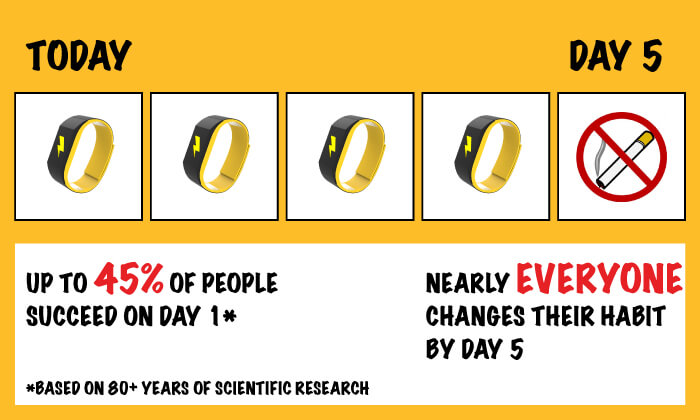
In a clinical study conducted by UCLA, self-administered, mild Pavlovian stimulus helped the majority of participants stop biting their nails — 45% percent on the first day alone. By day 4, 65% quit. The subjects were given a personal Pavlovian device and were responsible for zapping themselves.

We’ve known the efficiency of aversive conditioning for decades, and yet it couldn’t be taken advantage of. The device used was limited to medical professionals, and was never available to the average consumer.

But Pavlok changes that! Pavlok is a simple wristband with an embedded “one-button” zap system. An app on your phone acts like its remote control — you can adjust the intensity to a level you’re comfortable with.

How to Quit Biting Your Nails in 5 Days with Pavlok

  1. Try it on and try it out. Don’t worry about starting the aversion therapy as soon as you get the wristband. Spend the first day getting acquainted with the device so you’re comfortable using it. Track when and where you bite your nails for the rest of the day — this will help you start being more mindful about your habit and to incorporate Pavlok into the routine later.
  2. Conduct an aversion session. When you first notice yourself biting your nails, give yourself zaps every few seconds for as long as you keep going (which may not be long!). Afterward, continue observing your nail biting habits without zapping, but keep recording when and where it happens. Try to resist these urges as they come.
  3. Start using Pavlok every time you bite your nails. By this point, you’ll probably find that the time you spend biting your nails has been reduced drastically, or that you’re able to resist the temptation altogether.
  4. Track your progress and adjust as needed. If you’ve stopped biting completely, you can choose to zap yourself when you notice an urge. If you slip up, don’t worry — just keep logging your progress to improve mindfulness and remind yourself how far you’ve come!

It can be hard to stop a habit like nail-biting because of how easy it is to do at any moment. And it’s an unconscious habit for most people, which is a reflection of how good your brain is at learning and associating behaviors — use this system to your advantage!

That’s what Nagina did. She had been biting her nails for her entire life, and noticed an immediate improvement after using Pavlok for 2 days.

Pavlovian stimulus aversion sessions help almost everyone quit. It works because it tackles your habit from the inside out, and Pavlok gives you this effective technology in a simple and safe wristband.

Quit Smoking

quit-smoking-5-days

It’s easy to make the resolution, “I’m going to quit smoking.”

And it’s easier to break that resolution.

Sure, you can convince yourself that this is the last time you’ll ever smoke a cigarette, and you might really believe it, too – but when you’re faced with something as simple as finishing a meal or having a drink, you can feel a sudden need to smoke. And you’re just as good at talking yourself into having one as you were at never having one again.

It only takes 3 days for your body to completely eliminate all of the nicotine in your system, and this is why quitting ‘cold turkey’ is often recommended. But you can still experience cravings like this for weeks, months, and even years after your last cigarette.

This is because your brain, even at the biological level, is constantly learning through associations. Whether you’ve smoked five cigarettes or five thousand cigarettes, each one has served as a lesson. Nicotine has taught your brain to associate smoking with a form of psychological relief, based on the way it activates your reward pathway.

So when you’re finishing your lunch, your brain lights up with neuronal firing, leading to you thinking ‘I should have a cigarette now.’ And your brain is very efficient at creating and maintaining these associations, which is what’s responsible for the high relapse rates among those attempting to quit.

While products like nicotine patches and gum can help you through the withdrawal period, you’re left to rely on your willpower alone when it comes to facing the way your brain has learned to need cigarettes. Nicotine substitution methods like the patch have a success rate of only 9% — over 90% of users go back to cigarettes within 6 months.

Aversion sessions interrupt this reinforcement loop by adding an unpleasant factor to these associations. A negative consequence to smoking a cigarette changes the way your brain works –- instead of fighting your cravings as they come, you can rewrite the code itself at the neuronal level.

In a scientific study, following five days of pairing shocks with cigarette smoking, 60.6% of subjects successfully quit — maintaining total abstinence from cigarettes over a year after the sessions. Beforehand, these subjects smoked an average of over 32 cigarettes per day, and 80% had tried to quit in the past.

After 5 days of pairing electric shock with smoking, 60.6% of smokers quit entirely.

Scientists have been using electric shock in labs for over 50 years in experiments to end bad habits. This technology has always been limited to research studies.

Now, Pavlok puts it in your hands, literally — by building a wristband with simple “one-button activation”. You can safely self-administer electric shocks, and you can control the level of intensity for each shock using an app on your phone. Pavlok’s device means you can take advantage of the scientific research for your own benefit!

How to Use Pavlok to Quit Cigarettes in 5 Days

  1. Try out the device. Shocking yourself can be a little daunting at first, but you can adjust the intensity on your phone to calibrate and find a level of shock that works for you.
  2. Shock for your first cigarette of the day. After getting familiar with the wristband, start administering a shock for each inhale of your first cigarette of the day. Your desire for this primary cigarette is often the most habitual, and breaking this initial craving will have a huge impact on your ability to kick the habit altogether.
  3. Shock for additional cigarettes. You guessed it — after getting accustomed to shocking yourself for each puff of your first cigarette on day one, you can start applying shocks in the same pattern every time you light up.
  4. Keep shocking and keep track of your progress. Continue administering shocks for every inhalation of every cigarette. Many Pavlok users report a rapid drop in daily tobacco use very soon after starting aversion sessions; if you experience this, you can advance to shocking yourself based on cravings alone.

A great example of Pavlok’s success in quitting cigarettes is Marty, who was a pack-a-day smoker for over seven years. He used Pavlok to quit smoking by following the method above, including continuing to shock himself until his cravings subsided.

No matter how long you’ve been a smoker, it’s never too late to quit. Even if you’ve been smoking cigarettes for years, or have tried and failed to quit in the past, Pavlok can help you break your habit in five days!

We know that once you try Pavlok, you’ll love it, and you can join the incredible group of smokers who were able to quit using electric shock aversion sessions.